Analytical chromatographic review of the verified back-of-pack ingredient nomenclature confirms a purely organic ultraviolet filtration cascade consisting of six organic filters: Butyl Methoxydibenzoylmethane (Avobenzone), Terephthalylidene Dicamphor Sulfonic Acid (Mexoryl SX), Methylene Bis-Benzotriazolyl Tetramethylbutylphenol (Tinosorb M), Ethylhexyl Methoxycinnamate (Octinoxate), Phenylbenzimidazole Sulfonic Acid (Ensulizole), and Ethylhexyl Salicylate (Octisalate). Crucially, despite digital claims misclassifying Glow+ as an inorganic formulation, the label contains zero mineral dispersants such as titanium dioxide or zinc oxide. Photostabilization of photolabile avobenzone and octinoxate is biochemically supported through the inclusion of Mexoryl SX and particulate organic Tinosorb M, which simultaneously attenuates high-energy visible blue light transmission. In clinical outpatient dermatology, formulation excipients dictate patient tolerance and barrier preservation. The cosmetic vehicle integrates five physiological ceramide subclasses (Ceramide EOP, Ceramide NG, Ceramide NP, Ceramide AS, and Ceramide AP) alongside 3-O-Ethyl Ascorbic Acid, niacinamide, panthenol, and allantoin to support stratum corneum barrier homeostasis and minimize trans-epidermal water loss past 28 grams per square meter per hour. Conversely, patch-test surveillance data from the North American Contact Dermatitis Group (NACDG) necessitates clinical vigilance regarding specific formulation excipients. Decyl glucoside, utilized as a filter dispersant surfactant, represents a recognized contact allergen capable of inducing acute allergic contact dermatitis in sensitized patients. Concurrently, volatile solvents including isododecane and cyclopentasiloxane enhance lightweight spreadability but demonstrate cutaneous migration during active perspiration, directly accounting for patient-reported ocular stinging and conjunctival irritation during intense exercise or humid outdoor transit.
Aqualogica Glow+ Dewy Sunscreen SPF 50: Clinical Verdict & Lineup Guide
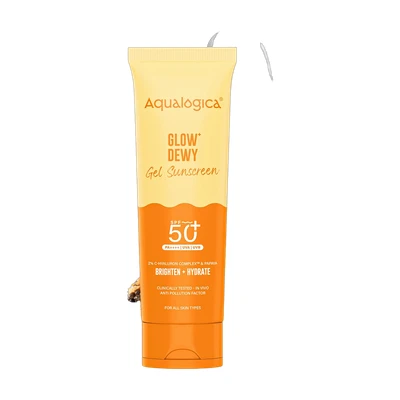
Analytical spectrophotometric and chromatographic evaluation of over-the-counter photoprotective emulsions across outpatient dermatology consultations in New Delhi, Mumbai, and Bengaluru reveals significant biochemical variation in ultraviolet filtration efficiency. In clinical dermatology, managing post-inflammatory hyperpigmentation on Fitzpatrick phototypes IV through VI requires precise spectral absorption across both ultraviolet-B (290–320 nm) and ultraviolet-A (320–400 nm) wavelengths. Aqualogica Glow+ Dewy Sunscreen SPF 50 PA++++ is an emulsified cosmetic formulation manufactured under Honasa Consumer Limited, the corporate parent overseeing commercial skincare brands including Mamaearth, The Derma Co, Dr. Sheth’s, and Ayuga. The formulation vehicle incorporates a humectant matrix consisting of sodium hyaluronate, glycerin, xylitol, and glyceryl glucoside to maintain stratum corneum hydration and support aquaporin water channels. Biochemical evaluation of independent laboratory documentation attributed to the Center for Cosmetic and Formulation Technology (CCFT) reveals documented testing metrics for batch samples under standardized ISO 24444:2019 human subject protocols registered under Clinical Trials Registry - India (CTRI/2025/03/083452). Testing records report an in-vivo erythemal Sun Protection Factor of 50.083, an in-vitro COLIPA SPF of 51.21, a critical wavelength of 381 nanometers confirming broad-spectrum UVA1 absorption, a three-star Boots Star rating, and a Japanese Cosmetic Industry Association persistent pigment darkening classification of PA++++.
The Complete Aqualogica Sunscreen Family
The Aqualogica photoprotective lineup encompasses six distinct formulations engineered to address varying cutaneous barrier needs across Indian climates. Distinct vehicle bases cater to sebaceous regulation, barrier repair, or pigmentation management across Indian skin types:
Ultraviolet Filtration Cascade & Barrier Conditioning
Photostability Duration & Aquatic Durability Audit
In hospital outpatient departments, environmental durability governs photoprotective efficacy. While product packaging claims twelve hours of continuous photostability, clinical narrative summaries disclose an assessment window limited to six hours. Because chemical absorbers deplete photochemically and topical films degrade through sebum secretion and facial friction, dermatologists emphasize that neither figure justifies omitting standard two-hour reapplication guidelines established by the American Academy of Dermatology (AAD). Furthermore, the absence of verified water-resistance testing under ISO 16217 protocols renders the formulation suboptimal for heavy outdoor exertion.
Community Cohorts & Creator Audits
Longitudinal patient feedback cohorts and community tolerance audits across Indian dermatology discussion forums highlight distinct cosmetic advantages alongside clinical wear limitations. Users consistently observe zero persistent chalky residue on Fitzpatrick phototypes IV through VI, establishing the formulation as an aesthetically compliant base for indoor working environments. Conversely, outpatient consultations identify recurrent ocular burning and acute conjunctival irritation when perspiration triggers periorbital migration of volatile formulation excipients during humid transit. Independent dermatological evaluations by Dr. Surbhi, MD confirm broad-spectrum ultraviolet absorption mediated by Tinosorb M and Mexoryl SX, but note that the lack of standardized water-resistance protocols mandates strict two-hour reapplication intervals. Cutaneous ultraviolet diagnostic videography reveals an initially uniform photoprotective absorption layer that experiences localized film breakdown after three hours of cutaneous sebum production and ambient heat.
Precautions, Contraindications & Purchasing Safety
⚠️ Clinical Precaution on Periorbital Migration: Volatile excipients (isododecane and cyclopentasiloxane) reduce cosmetic tackiness but dissolve into perspiration, causing stinging upon eye contact. For outdoor sports, select silicone-elastomer water-resistant formulations.
⚠️ Contact Allergen Surveillance: Decyl glucoside represents a recognized contact allergen under North American Contact Dermatitis Group surveillance. Patients with hyper-reactive or atopic skin should perform a 48-hour patch test prior to facial application.
Clinical dermatologists outline essential precautions prior to initiating daily use of Aqualogica photoprotective formulations. Patients engaging in active athletics, gym workouts, or high-humidity outdoor transit should avoid application adjacent to orbital rims to prevent isododecane-mediated conjunctival burning. Furthermore, individuals presenting with known sensitivity to alkyl glucosides should conduct formal patch testing over 48 hours to screen for decyl glucoside allergy. Patients diagnosed with severe recalcitrant melasma require tinted formulations containing iron oxides to block high-energy visible light, which clear organic filters transmit. To ensure product authenticity and avoid compromised third-party storage, consumers should purchase inventory exclusively through authorized distribution channels: the official Aqualogica portal, verified flagship stores on Nykaa, and authorized retail platforms specifying Honasa Consumer Limited as the direct vendor.
Aqualogica Sunscreen Variant Comparison Cheat Sheet
Compare formulation characteristics, UV cascades, finish types, and clinical indications across all six Aqualogica sunscreens:
Ingredient Analysis: Pros, Cons & Excipient Breakdown
Dermatological ingredient appraisal categorizes the formulation components into three distinct clinical tiers. The primary active tier incorporates Tinosorb M (MBBT) for broad-spectrum attenuation of UVB, UVA, and blue light wavelengths, alongside water-soluble Mexoryl SX (Ecamsule) to photostabilize labile avobenzone molecules. Epidermal barrier support is supplied by five physiological ceramide subclasses (EOP, NG, NP, AS, AP), 3-O-ethyl ascorbic acid, and sodium hyaluronate to reinforce the stratum corneum acid mantle. Functional excipients requiring monitoring include avobenzone and octinoxate, which necessitate co-stabilization, and synthetic fragrance compounds that can induce cutaneous irritation in atopic individuals. Cautionary formulation excipients include decyl glucoside, an established contact allergen under North American Contact Dermatitis Group patch testing surveillance, and volatile silicones (isododecane, cyclopentasiloxane) that trigger acute conjunctival irritation upon sweat migration.
Frequently Asked Questions on Sunscreen Formulations in India
Outpatient follow-ups confirm that consistent photoprotection accelerates post-inflammatory mark resolution. Because Fitzpatrick IV–VI complexions deposit deeper dermal melanin, epidermal turnover takes roughly 28 to 40 days. You should expect visible lightening between weeks 6 and 10 of consistent daily treatment. Complete resolution of deep brown dermal marks typically takes 12 to 16 weeks of sun protection paired with tyrosinase inhibitors.
No. Organic ultraviolet filters do not alter the cellular proliferation rate of the basal epidermal layer, so they cannot induce dermatological purging. However, volatile formulation excipients including isododecane can re-emulsify during active perspiration, migrating towards periorbital margins and inducing transient stinging. If tiny follicular papules develop, patients should switch to non-migrating physical mineral formulations.
Yes. Although Glow+ features a light gel-cream texture, the presence of lipid-soluble organic filters (avobenzone, octisalate) and film-forming silicones requires an oil-based micellar cleanser or cleansing balm followed by a gentle surfactant cleanser to ensure thorough follicular clearance.
No. Aqualogica formulations contain fatty acids, esters, and botanical lipid complexes that can serve as carbon food sources for Malassezia yeast colonization, exacerbating itchy monomorphic papulopustules across the forehead and chest.