
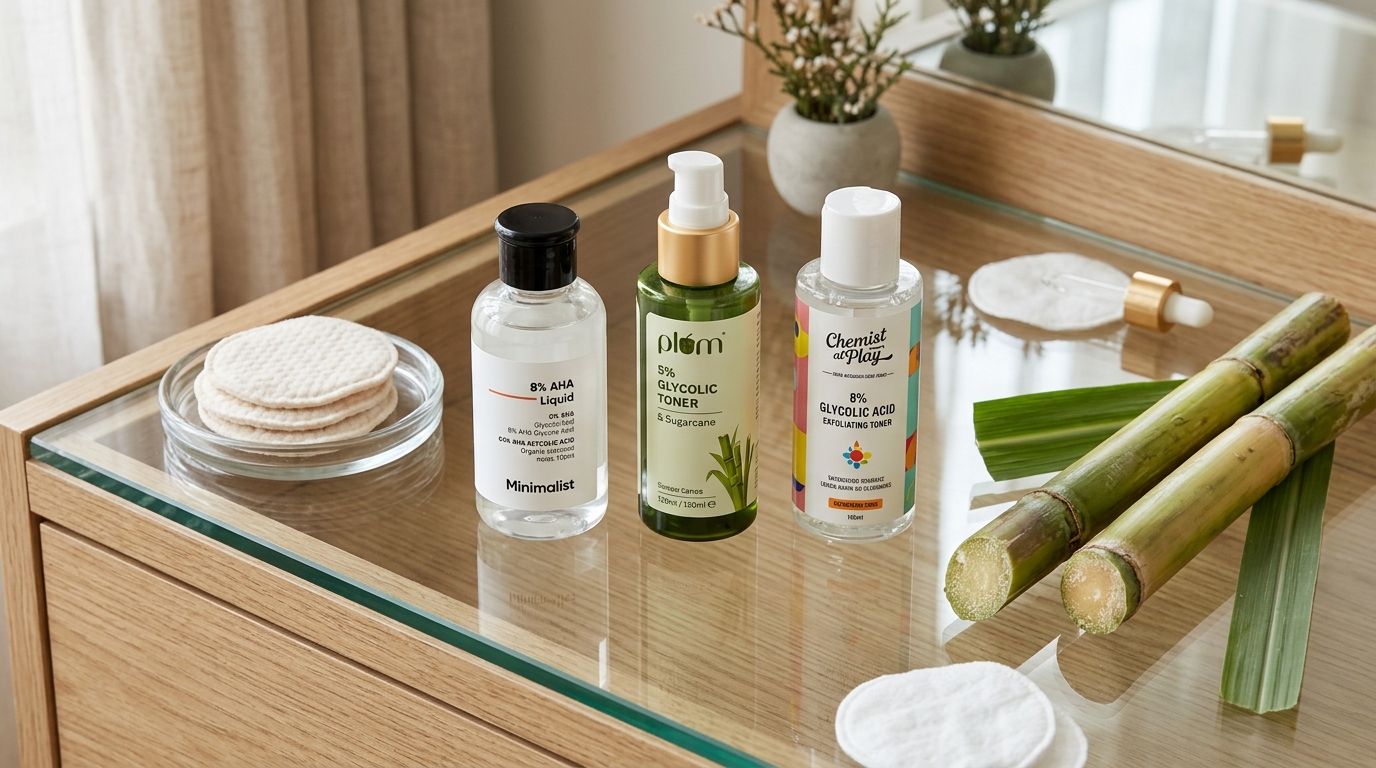
When dealing with acne scars—whether they manifest as textural irregularities (atrophic scars) or persistent dark spots (Post-Inflammatory Hyperpigmentation - PIH)—glycolic acid is often hailed as a gold-standard active. However, for Indian skin (Fitzpatrick Types IV and V), the molecular mechanics of glycolic acid require careful clinical navigation to avoid paradoxical darkening and inflammation.
1. The Molecular Science of Glycolic Acid: Penetration Dynamics
Glycolic acid, an alpha-hydroxy acid (AHA) derived from sugarcane, possesses the lowest molecular weight among its AHA counterparts (76.05 g/mol). This diminutive molecular size allows for rapid, uncontrolled trans-epidermal penetration. While this ensures high efficacy in dissolving the desmosomal bonds holding dead corneocytes together, it also spikes the risk of acute irritation. In melanin-rich Indian skin, this irritation cascade can rapidly stimulate melanocytes, leading to PIH.
Molecular weight penetration science & pH-dependent efficacy
Due to its low molecular weight, glycolic acid penetrates rapidly. This rapid penetration ensures immediate keratolytic action, smoothing textured scars over time. At higher concentrations, glycolic acid reaches the dermis, stimulating fibroblasts for collagen production.
2. Glycolic Acid Formulations: Toners vs. Pharmacy Creams vs. Peels
In the Indian pharmaceutical landscape, Glyco 6 (6% w/w Glycolic Acid) and Glyco 12 (12% w/w Glycolic Acid) are staple prescriptions. Formulated in a cream base, the lipid content slows down the acid's penetration, making it safer for Indian skin compared to aqueous toners of similar strengths. Glyco 6 is the ideal entry point for treating mild textural scars and hyperpigmentation.
Cosmetic toners like the Ordinary Glycolic Acid 7% Toning Solution are highly popular but often misused. Applied daily, the watery vehicle allows deep penetration that can compromise the skin barrier in humid Indian climates.
The Minimalist AHA 25% + PHA 5% + BHA 2% Peeling Solution represents the high-end of at-home exfoliation. The extremely low pH and high free-acid value mean it delivers clinic-like resurfacing. However, it must be used strictly as a wash-off treatment (max 10 minutes) to mitigate severe chemical burns and subsequent PIH on darker skin tones.
Never Use High-Strength Peels on Active Inflamed Acne
Applying high-percentage peels (like 25% AHA) on active breakouts or compromised skin barriers will induce severe chemical burns and long-lasting post-inflammatory hyperpigmentation (PIH). Always wait until active acne has subsided before targeting scars.
3. Comparison Table: Glycolic Formulations for Indian Skin
| Product / Type | Strength | Delivery Vehicle | Best For | PIH Risk Level |
|---|---|---|---|---|
| Glyco 6 Cream | 6% | Cream (Emulsion) | Beginners, mild PIH, subtle texture | Low (due to cream base) |
| Glyco 12 Cream | 12% | Cream (Emulsion) | Stubborn hyperpigmentation (body/face) | Medium |
| The Ordinary Toner | 7% | Aqueous Solution | Maintenance, body pigmentation | Medium to High (if overused) |
| Minimalist 25% Peel | 25% AHA Blend | Viscous Liquid | Severe texture, deep exfoliation | High (requires strict protocol) |
4. Clinical Protocols for Atrophic Scars vs. Hyperpigmentation
Addressing acne scars requires understanding the distinction between textural atrophic scars (ice pick, boxcar, rolling) and macular discoloration (PIE and PIH). Glycolic acid works differently on both.
For Textural (Atrophic) Scars
Glycolic acid cannot entirely reverse deep atrophic scars; however, prolonged use of collagen-stimulating formulations like Glyco 12 can soften their edges. For significant textural improvement, in-clinic high-percentage peels (30-70%) administered by a dermatologist are required to induce controlled wounding and dermal remodeling.
For Macular Discoloration (PIH)
This is where glycolic acid excels. By accelerating cell turnover, it sheds melanin-laden superficial cells. A structured routine integrating tyrosinase inhibitors (like Kojic Acid or Alpha Arbutin) alongside Glyco 6 ensures that while the AHA exfoliates existing pigment, the inhibitors prevent new melanin synthesis.
5. The Risk of PIH in Darker Skin (Fitzpatrick IV-V)
The paradox of glycolic acid is that the very tool used to treat hyperpigmentation can cause it. When the acid penetrates too quickly, it induces erythema (redness). In Indian skin, this inflammatory response sends distress signals to melanocytes, which pump out melanin to protect the skin, resulting in a dark patch—this is post-inflammatory hyperpigmentation. To mitigate this:
- Barrier Prioritization: Always use a ceramide-rich moisturizer.
- Sandwich Method: Apply moisturizer, then Glyco 6, then moisturizer again to buffer penetration.
- Strict Sun Protection: AHAs cause photosensitivity. Broad-spectrum SPF 50 is non-negotiable.
Sun sensitivity after AHA — mandatory SPF 50
Active exfoliants and retinoids increase skin sensitivity to ultraviolet radiation (UVB and UVA rays). Exposure to sun rays without adequate broad-spectrum protection degrades collagen, impairs skin repair, and triggers melanin overproduction. Daily broad-spectrum SPF 50 sunscreen application is mandatory for anyone using active acne formulations.
6. Dermatological Clinical Analysis & Patient Application Guidelines
Achieving long-term clearing of active acne lesions while preserving stratum corneum integrity requires strict adherence to evidence-based active dosing protocols. Dermatologists emphasize that over-application of topical keratolytics or antibacterial agents leads to acute trans-epidermal water loss (TEWL), triggering reactive sebum hyper-secretion and exacerbating microcomedone formation.
Mechanism of Action & Follicular Dynamics
Topical active ingredients target acne through distinct biological pathways. Keratolytic agents like Salicylic Acid (BHA) and Glycolic Acid (AHA) cleave ionic desmosomal bonds holding dead corneocytes together, shedding follicular plugs. Antimicrobial compounds like Benzoyl Peroxide (BPO) release free radical oxygen species that sterilize anaerobic Cutibacterium acnes bacteria without inducing bacterial resistance. Dicarboxylic acids like Azelaic Acid selectively inhibit tyrosinase enzymes to prevent post-inflammatory hyperpigmentation (PIH).
Barrier Preservation & Retinoid Layering Protocol
To avoid chemical irritation and severe flaking, always follow the Sandwich Protocol when layering retinoids or high-strength acids: apply a light hydrating layer of non-comedogenic ceramide lotion, allow 10 minutes for absorption, apply your active treatment, and seal with a barrier moisturizer.
- Morning Routine (AM): Cleanse with a mild hydrating wash, apply active spot treatment or serum, follow with barrier moisturizer, and complete with broad-spectrum SPF 50+ sunscreen.
- Evening Routine (PM): Double-cleanse to remove UV filters and urban particulate matter, apply targeted treatment on 100% dry skin, and lock in hydration with ceramide-rich creams.
Preventing Post-Inflammatory Hyperpigmentation (PIH) on Dark Skin Tones
Melanin-rich skin (Fitzpatrick IV–VI) responds to skin barrier trauma by accelerating melanin synthesis. Never pick, pop, or scratch active inflammatory papules. Use hydrocolloid patches on whiteheads to absorb exudate, and introduce brightening actives like 4% Niacinamide, 2% Alpha Arbutin, or 15% Azelaic Acid once inflammation subsides.
7. Clinical Summary: Glycolic Acid vs Other Chemical Peels
Compared to Salicylic Acid (BHA) which is oil-soluble and targets sebum inside pores, Glycolic Acid (AHA) is water-soluble and excels at epidermal texture renewal. For patients dealing with both active acne and shallow boxcar or rolling scars, alternating between BHA and AHA exfoliants on separate nights provides complete pore clearing and surface scar smoothing.
Always maintain realistic expectations: surface AHAs like Glyco 6% and Glyco 12% smooth micro-texture and fade epidermal post-acne dark marks (PIH), but deep ice-pick or tethered fibrotic scars require in-clinic dermatological procedures such as microneedling, subcision, or TCA cross.
Internal Resources and Further Reading
- Salicylic Acid vs Glycolic Acid
- Hormonal Acne Treatments
- Azelaic Acid for Inflammation
- Navigating the Tretinoin Purge
- Dietary Triggers for Cystic Acne
- Niacinamide and Barrier Health
- Treating Post-Inflammatory Erythema (PIE)
- Best Sunscreens for Acne-Prone Skin
- Benzoyl Peroxide Contact Therapy
- Retinol for Beginners