How Kojic Acid Fades Post-Acne Marks
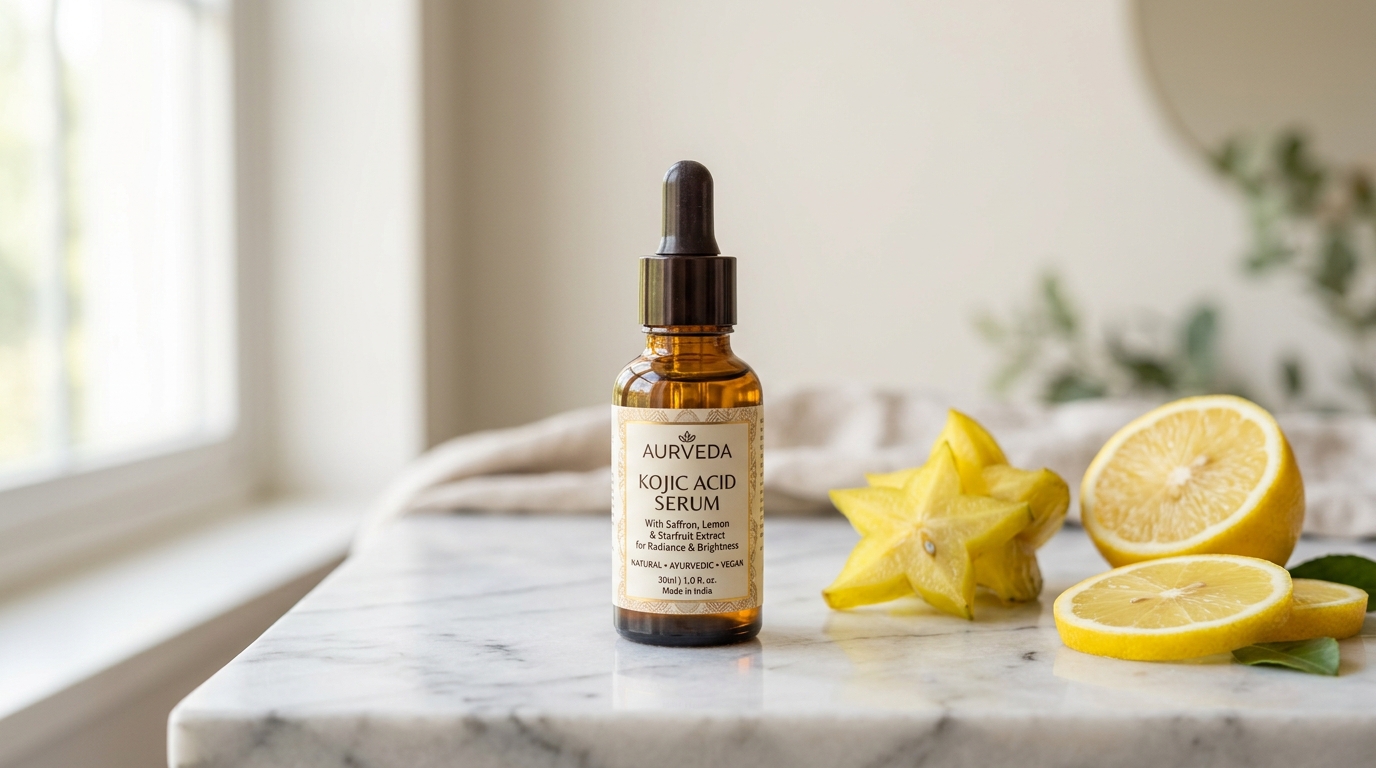
Kojic acid is a fungal-derived metabolite — naturally produced by Aspergillus oryzae during the fermentation of sake and soy sauce. In dermatology, its significance lies in a precise biochemical mechanism that makes it uniquely suited to Indian skin.
The Tyrosinase Inhibition Pathway
Melanin — the pigment responsible for those flat, brown marks left after acne heals — is synthesised via an enzyme called tyrosinase. Tyrosinase requires two copper ions (Cu²⁺) at its active catalytic site to oxidise L-tyrosine into DOPA, then DOPA into melanin.
Why It's Safer Than Hydroquinone for Indian Skin
Critically, kojic acid is non-cytotoxic: it inhibits the enzyme but does not destroy the melanocyte cells that produce it. This is the fundamental safety advantage over hydroquinone, which kills melanocytes and carries a risk of irreversible ochronosis (blue-black skin discoloration) on darker Fitzpatrick IV–VI skin types common across India.
Because melanocytes remain intact, the inhibition is reversible and safe for long-term use — a key consideration for managing the chronic hyperpigmentation patterns typical of Indian post-acne skin.
Kojic Acid vs Hydroquinone: Full Comparison Matrix
Both are tyrosinase-pathway inhibitors, but with critically different safety profiles for darker Indian skin tones.
| Feature | Kojic Acid (1–2%) | Hydroquinone (2–4%) |
|---|---|---|
| Mechanism | Cu²⁺ chelation → tyrosinase inhibition | Substrate competition + melanocyte cytotoxicity |
| Ochronosis Risk | ✅ Zero risk | 🔴 High risk on Fitzpatrick IV–VI after 3–4 months |
| Long-term Safety | ✅ Safe for prolonged use; non-cytotoxic | ⚠️ Limit cycles to 3 months; cytotoxic to melanocytes |
| PIH Efficacy | ✅ Effective — reduces melanin in brown flat marks | ✅ Effective — faster initial response |
| PIE Efficacy | ❌ Ineffective — does not target blood vessels | ❌ Ineffective — does not target blood vessels |
| OTC / Rx Status | OTC (up to 2% in India) | Rx required above 2% in India |
| Cost in India | ₹200 – ₹750 (wide range available) | ₹150 – ₹500 (Rx products, pharmacies) |
PIH vs PIE: Why This Distinction Matters
This is the single most important thing to understand before starting any depigmentation treatment. Kojic acid works on one type of acne mark — and not the other.
Post-Inflammatory Hyperpigmentation
Flat, brown or tan marks caused by excess melanin deposition following the inflammation of an acne lesion.
- Melanin-based discoloration
- Responds to tyrosinase inhibitors
- Fades in 8–12 weeks with kojic acid + SPF
- More common in Fitzpatrick IV–VI skin
Post-Inflammatory Erythema
Flat, pink or red marks caused by dilated or damaged superficial blood vessels after acne inflammation resolves.
- Vascular damage — not melanin
- Kojic acid has zero effect
- Needs: Niacinamide, Centella, or PDL
- More visible in Fitzpatrick I–III skin
Top Indian Kojic Acid Products (2026 Picks)
All four options are formulated within the safe 1–2% concentration range and widely available in India. Ranked by formulation complexity.
Safety Protocol for Indian Skin
Follow these non-negotiable rules to get results without triggering paradoxical PIH or irritation on darker Fitzpatrick IV–VI skin.
-
Stay at max 2% topical concentration. OTC products in India are limited to 2%. Higher concentrations increase irritation risk disproportionately on sensitive Indian skin without meaningfully better outcomes.
-
Daily SPF 50 PA++++ is mandatory — non-negotiable. Kojic acid inhibits melanin production, which means your skin's natural UV protection is temporarily reduced. Without sunscreen, UV triggers a surge in melanin causing paradoxical PIH worse than what you started with.
-
Do not combine with strong AHAs or retinoids in the same application. Glycolic acid at high concentrations and retinoids both disrupt the skin barrier. When combined with kojic acid in the same PM step, irritation and reactive PIH risk spikes. Use on alternating nights if both are in your routine.
-
Set realistic timelines. On Indian Fitzpatrick IV–VI skin, visible improvement in PIH marks typically requires 8–12 weeks of consistent use. Do not increase frequency or concentration out of impatience — this causes irritation and rebound PIH.
-
Stop and consult a dermatologist if you notice: contact dermatitis, spreading redness, or any paradoxical darkening. These are rare but require a clinician to rule out allergic reaction or incorrect PIH/PIE diagnosis.