Discovering a bump on your lip can be frustrating and alarming. Because our lips are a highly visible and sensitive part of the face, identifying the exact nature of a lip bump is the first crucial step toward safe treatment. In India, the humid weather, frequent threading or waxing of the upper lip, and the popularity of heavy lip oils and glosses can often lead to confusing lip eruptions.
To identify your lip bump, you must look at its specific anatomy, where it is located, and how it behaves. Below, we break down the three most common lip bumps:
1. Lip Pimple (Lip Line Acne)
A lip pimple forms when a hair follicle or sebaceous gland near the outer border of the lip becomes blocked with sebum, dead skin cells, and acne-causing bacteria (Cutibacterium acnes). It behaves exactly like acne elsewhere on your face: it starts as a hard, tender, red bump and eventually develops a small, white or yellow head of pus.
Key feature: It always forms on the outer lip line (known as the vermilion border) or the surrounding skin, where hair follicles and sebaceous glands exist. It never forms on the pink, moist, mucosal part of the lip itself, which lacks hair follicles.
2. Cold Sore (Herpes Labialis / Fever Blisters)
A cold sore is caused by a highly contagious viral infection, specifically the Herpes Simplex Virus Type 1 (HSV-1). After initial exposure, the virus lies dormant in the nerve cells of the face until it is reactivated by triggers like sun exposure, stress, fever, or a weakened immune system.
Key feature: Unlike a pimple, a cold sore begins with a distinct tingling, itching, or burning sensation before any visible bump appears. It then erupts into a tight cluster of tiny, fluid-filled blisters directly on the pink/red lip tissue. These blisters eventually break open, ooze a clear fluid, and form a dry, yellowish scab before healing.
3. Fordyce Spots
Fordyce spots are small, painless, white, cream-colored, or yellowish bumps that appear along the lip line or inside the mouth. They are completely harmless and are not a disease. They are simply ectopic sebaceous (oil) glands—meaning they are oil glands present in a location where there are no hair follicles.
Key feature: They are completely painless, do not itch, burn, or ooze, and do not change in size. They are present in a large percentage of the adult population and are entirely cosmetic.
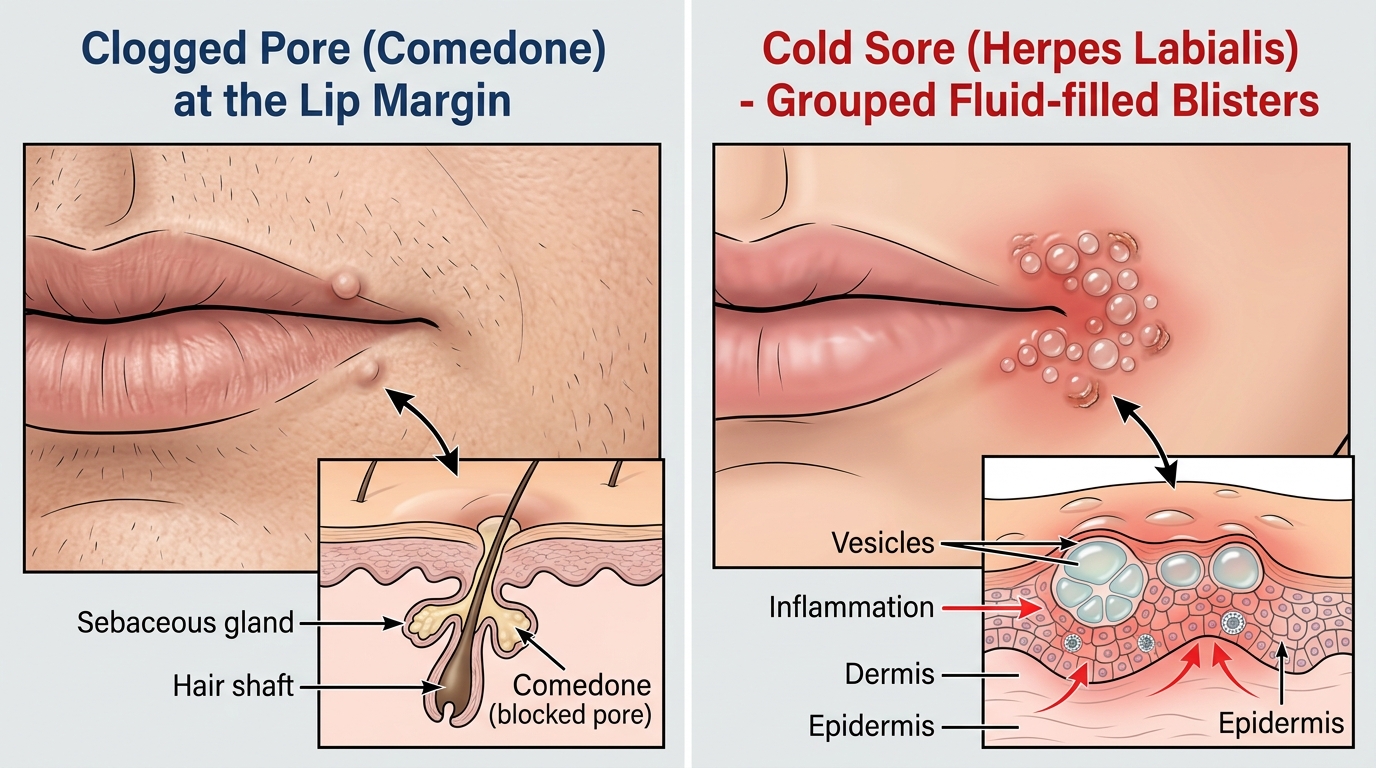
If you need to make a quick decision about your lip bump, use this clinical comparison matrix. This matrix outlines the symptoms, contagiousness, triggers, and standard treatments in India.
| Feature | Lip Pimple | Cold Sore (Herpes Labialis) | Fordyce Spots |
|---|---|---|---|
| Primary Cause | Clogged pore (sebum + dead skin + bacteria). | Herpes Simplex Virus Type 1 (HSV-1). | Normal, prominent sebaceous (oil) glands. |
| Starting Sensation | Mild tenderness, localized swelling. | Tingling, burning, or itching 24-48 hours before erupting. | Completely painless and asymptomatic. |
| Visual Appearance | A single red bump with a central white/yellow pus head. | A cluster of tiny, clear, fluid-filled blisters that rupture and scab over. | Tiny (1-3 mm), flat or slightly raised white/yellow spots. |
| Exact Location | Outer lip line (vermilion border) or surrounding skin. Never on pink lip tissue. | Pink/red part of the lip, corners of the mouth, or under the nose. | Along the vermilion border or inside buccal mucosa. |
| Contagiousness | No (completely non-contagious). | Yes (highly contagious via kissing, sharing cups/lip balm). | No (completely non-contagious). |
| Typical Duration | 3 to 7 days (heals without scarring if not popped). | 10 to 14 days (progresses through blister, weep, and scab stages). | Permanent/Persistent (harmless cosmetic feature). |
| Common Triggers | Comedogenic lip oils, wax/threading irritation, poor face hygiene, stress. | Sun exposure, fever/cold, physical lip trauma, stress, low immunity. | Natural development (becomes prominent during puberty). |
| Standard Care | Salicylic Acid/Benzoyl Peroxide spot gel, non-comedogenic lip care. | Acyclovir antiviral creams or oral tablets, cold compress. | No treatment required. Purely cosmetic. |
Because the skin bordering the lips contains a high density of active sebaceous glands, it is highly prone to clogging. Squeezing or popping a pimple on the lip line is extremely dangerous due to the "danger triangle" of the face (the area from the corners of the mouth to the bridge of the nose). Infections in this area can easily spread to the deep facial tissue. Here is how to heal a lip pimple safely:
1. Root Causes: What Clogs the Lip Line?
- Comedogenic Lip Care: Many commercial lip balms, lip glosses, and lipsticks contain heavy, occlusive ingredients like petroleum jelly (petrolatum), mineral oils, paraffin, beeswax, and coconut oil. While great for dry lips, these ingredients easily seep onto the surrounding skin, blocking the tiny hair follicles and causing comedones.
- Upper Lip Hair Removal: Threading, waxing, or shaving the upper lip area causes micro-trauma to the hair follicles. If you apply heavy creams or oils immediately afterward to soothe the skin, you trap bacteria inside, leading to a breakout of red pustules (folliculitis).
- Dietary Residue: Greasy food oils, spicy masalas, and dairy residues left around the mouth after eating can feed acne-causing bacteria if not washed off promptly.
2. Dermatologist-Approved Lip Pimple Care
To clear a lip pimple without leaving dark marks (post-inflammatory hyperpigmentation or PIH) or risking infection, follow these steps:
The Safe Routine:
- Cleanse the Lip Line: Wash your face twice daily with a gentle BHA cleanser containing 1% to 2% Salicylic Acid (e.g., Saslic DS, Minimalist Salicylic Acid Cleanser, or Cipla Saslic). BHA is oil-soluble and will penetrate the clogged follicle to dissolve the sebum plug.
- Apply a Targeted Spot Treatment: Apply a tiny dot of 2.5% Benzoyl Peroxide gel (e.g., Persol 2.5% or Brevoxyl) or a 2% Salicylic Acid serum directly onto the pimple. Important: Keep the product strictly on the outer skin; do not let it get onto the dry, pink mucosal part of the lip as it will cause severe dryness, peeling, and irritation.
- Use Hydrocolloid Pimple Patches: Apply a small, round pimple patch over the bump. These patches absorb the pus, protect the open sore from external bacteria, and prevent you from picking or touching the area.
- Soothe After Hair Removal: After threading or waxing, avoid heavy cold creams. Instead, apply a lightweight gel like pure aloe vera or a soothing centella-based lotion.
3. Make the Switch: Non-Comedogenic Lip Care
If you are prone to pimples around your lips, audit your lip care products. Swap heavy, petrolatum-based balms for formulations containing non-comedogenic emollients. Look for ingredients like squalane, hyaluronic acid, shea butter, and ceramides which hydrate without clogging the pores along your vermilion border.
Because cold sores are viral (HSV-1), they do not respond to typical acne treatments like Salicylic Acid or Benzoyl Peroxide. In fact, applying harsh acne acids to an active cold sore will worsen the irritation and delay healing. In India, clinical treatment focuses on suppressing the virus to shorten the outbreak and relieve pain.
1. Topical Antiviral Creams (Available in India)
Topical antiviral creams are highly effective if applied during the prodromal stage—the very first sign of tingling, itching, or burning before the blister physically appears.
- Acyclovir Cream (5% w/w): This is the most common topical treatment. Popular Indian brands include Acivir Cream (Cipla), Lovir Cream, and Zovirax Cream.
- How to Use: Apply a small amount of the cream to the affected area using a cotton swab. Apply it 5 times a day (approximately every 4 hours) for 4 to 5 days.
- Important Tip: Never apply the cream with bare fingers, as the active virus can easily spread to other parts of your hand, face, or even your eyes. Wash your hands thoroughly immediately after application.
2. Systemic Oral Antiviral Tablets
If you experience severe, large, or frequent cold sore outbreaks, a dermatologist or general physician in India will prescribe oral antiviral pills. These are prescription-only drugs and must be taken under medical guidance:
- Acyclovir Tablets (e.g., Acivir 400mg / 800mg): Standard dosing is usually one 400mg tablet taken 3 to 5 times a day for 5 to 7 days, depending on the severity of the outbreak.
- Valacyclovir Tablets (e.g., Valcivir 500mg / 1000mg): Valacyclovir has superior bioavailability compared to Acyclovir. It is typically dosed at 2 grams twice a day for a single day to halt the infection rapidly.
- Famciclovir Tablets (e.g., Famtox): Another effective oral option, usually taken 3 times daily.
3. Outbreak Management and Safety Guidelines
Managing an active cold sore requires strict hygiene to prevent spreading the virus to others or to other areas of your own body:
- Hands-Off Policy: Do not pick, scratch, or peel the cold sore scab. Picking the scab will delay healing, cause secondary bacterial infections (which may require topical antibiotic creams like Mupirocin or Fusidic Acid), and increase the risk of scarring.
- Zero Contagion Contact: Strictly avoid kissing, sharing food, water bottles, cups, spoons, towels, or lip cosmetics from the first sign of tingling until the cold sore is completely healed and the scab has fallen off.
- Sun Protection (Primary Trigger): India's intense UV radiation is a major trigger for HSV-1 reactivation. Protect your lips by wearing a daily lip balm with SPF 30 or higher (e.g., Sebamed Lip Defense SPF 30 or Lano10 SPF lip balm) when going outdoors.
- Soothing Cold Compress: Apply a clean, cold, damp cloth to the lips for 5 to 10 minutes at a time to reduce swelling, redness, and throbbing pain.
Have more questions about lip bumps? Read our clinical FAQ to clear up your doubts.
No. A lip pimple is completely non-contagious. It is caused by a blocked pore due to excess sebum, dead skin cells, and local bacteria (Cutibacterium acnes). It cannot be passed to another person. In contrast, a cold sore is caused by the Herpes Simplex Virus Type 1 (HSV-1) and is highly contagious through direct skin-to-skin contact, kissing, or sharing lip balms, cups, and towels.
A cold sore typically takes 10 to 14 days to heal completely on its own. The healing process progresses through five main stages: tingling/burning (days 1-2), blistering (days 2-3), weeping/ulcerating (days 4-5), crusting/scabbing (days 5-8), and final healing (days 9-14). Applying antiviral creams like Acyclovir (Acivir) within the first 24-48 hours can reduce the duration by several days.
No, you should avoid using standard hydrocolloid pimple patches (meant for acne) on an active, weeping cold sore. Regular pimple patches are not designed to contain viral discharge, and pulling them off can prematurely tear away the delicate cold sore scab, delaying healing and increasing the risk of scarring. Only use patches specifically designed for cold sores (like Compeed Cold Sore Patches), which provide antiviral isolation and moist healing.
Threading, waxing, or shaving the upper lip causes physical micro-trauma to the hair follicles, leaving them open and vulnerable to bacteria. If you apply heavy, occlusive creams (like cold creams or petroleum-based lotions) immediately after hair removal, you trap sebum and bacteria inside the raw follicles. This results in localized folliculitis (pimple-like bumps). To prevent this, soothe the area with a lightweight, oil-free gel like pure aloe vera or a mild salicylic acid toner instead of heavy moisturizers.
You should consult a dermatologist if:
• The lip bump does not heal or improve within 2 weeks.
• You experience frequent outbreaks of cold sores (more than 5-6 times a year), which may require suppressive oral antiviral therapy.
• The cold sore blister spreads near your eyes, which is a medical emergency (ocular herpes).
• The bump bleeds easily, is extremely painful, or appears as a deep, non-healing ulcer.
• You have a compromised immune system (e.g., due to diabetes, chemotherapy, or autoimmune conditions) and notice any lip sore.