
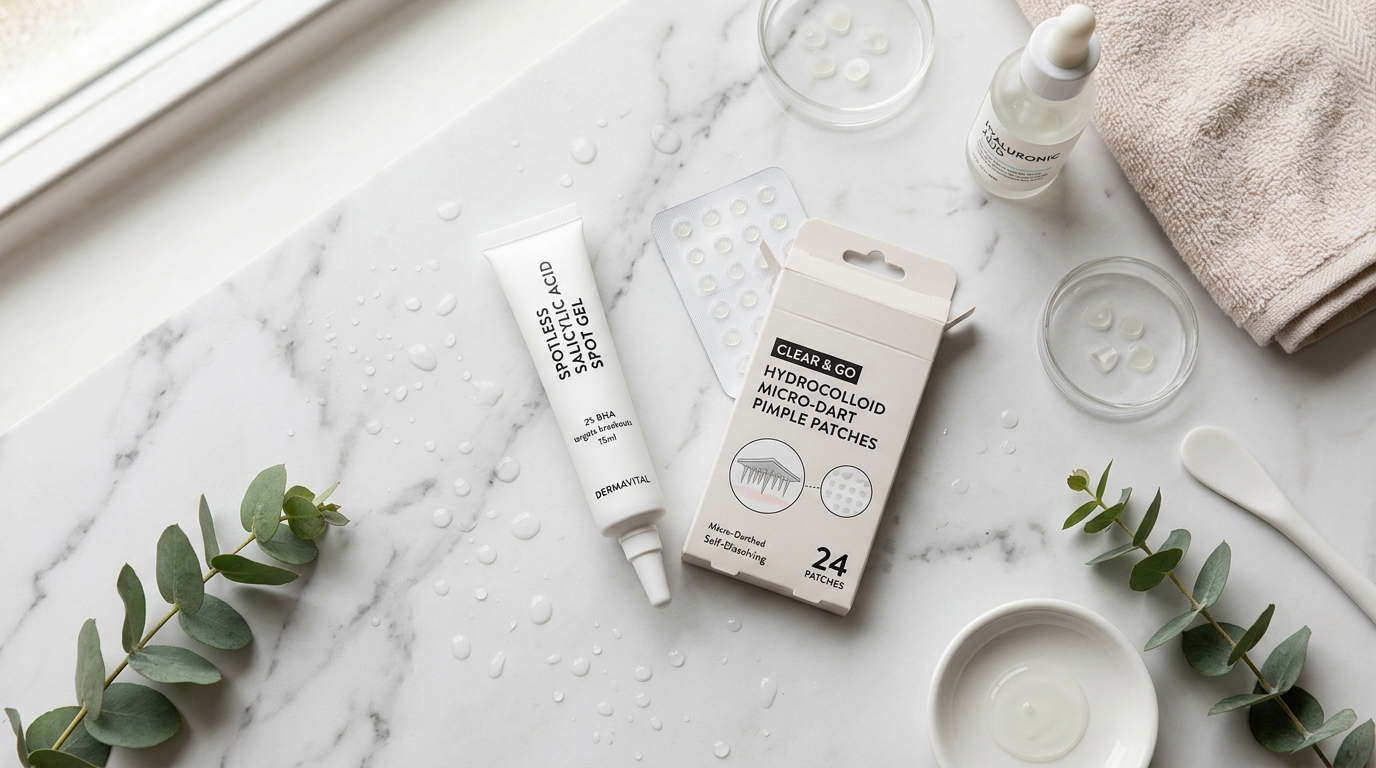
1. Emergency Pimple Science: Spot Treatment vs Full-Face Active Layering
Waking up to an inflamed, throbbing facial pimple triggers an immediate impulse to coat the entire face in high-potency exfoliants. However, clinical dermatology makes a sharp distinction between targeted spot treatment and full-face active layering—a distinction that is particularly vital for South Asian and Indian skin types (Fitzpatrick III-V).
Salicylic Acid is a Beta-Hydroxy Acid (BHA). Unlike water-soluble Alpha-Hydroxy Acids (AHAs like glycolic or lactic acid), BHA is lipophilic (fat-soluble). This chemical structure allows it to bypass surface moisture, penetrate deep inside sebaceous follicle ducts, and dissolve oxidized sebum plugs, cellular kerato-debris, and Cutibacterium acnes colonies.
Targeted Spot Dabbing
Delivers a high local concentration (typically 2% BHA) directly onto the papule or pustule wall. Focuses cellular keratolysis on inflamed tissue without altering surrounding healthy epidermal lipids.
Full-Face Layering Risk
Applying 2% BHA across dry or combination Indian skin can strip intercellular ceramides, cause trans-epidermal water loss (TEWL), and trigger rebound hyper-seborrhea (surging oil production).
Indian skin tones contain higher melanocyte density and melanosome transfer rates in the stratum basale. When full-face acid layering disrupts the skin barrier, inflammatory cytokines (IL-1α and TNF-α) trigger hyper-pigmentary cascades. Spot treating isolates the active acid strictly to the lesion site, preserving skin barrier integrity.
2. BHA Spot Gels vs Micro-Dart Hydrocolloid Patches Comparison Matrix
Choosing between a topical 2% Salicylic Acid spot gel and a hydrocolloid patch depends entirely on the histological stage of your breakout. Hydrocolloid patches act as physical moisture-absorbing seals, whereas micro-dart patches deliver active actives deep into non-surfaced bumps.
| Feature / Parameter | 2% Salicylic Acid Spot Gel | Standard Hydrocolloid Patch | Micro-Dart Dissolving Patch |
|---|---|---|---|
| Primary Target | Early papules & inflamed oil pores | Surface whiteheads with open exudate | Deep, painful under-the-skin blind cysts |
| Mechanism of Action | Dissolves sebum & kills C. acnes | Absorbs pus via hydrophilic polymer | Self-dissolving micro-needles deliver BHA/Cica |
| Penetration Depth | Follicular duct level | Surface (stratum corneum) | Epidermal-dermal junction (0.25mm) |
| Risk of PIH (Dark Marks) | Moderate if over-applied | Very Low (Protects from picking) | Low (Controlled micro-dosing) |
| Ideal Wear Time | Overnight or daytime under SPF | 6 to 8 hours continuously | 6 to 10 hours overnight |
| Water / Makeup Compatibility | Can pill under heavy silicone makeup | Seamless matte thin edge coverage | Best worn while sleeping |
3. The Overnight Emergency Pimple Protocol (Step-by-Step Dabbing)
Follow this clinical 5-step overnight dabbing routine to shrink emergency pimples without irritating healthy surrounding tissue or causing chemical burns.
Gentle pH 5.5 Cleansing
Wash your face with a non-stripping, sulfate-free syndet cleanser. Pat the area 100% dry with a clean microfiber towel. Applying BHA to damp skin increases penetration velocity, causing burning.
Isolate Healthy Skin Barrier
Apply your regular oil-free moisturizer across your face, but leave a 0.5 cm ring around the active pimple completely bare. This prevents diluting the spot gel.
Precision Micro-Dabbing
Squeeze a pinhead amount of 2% Salicylic Acid spot gel onto a clean cotton swab or clean fingertip. Dab strictly onto the apex of the pimple. Do not rub or spread across healthy skin.
The Occlusion Decision (Wait 15 Minutes)
If using a hydrocolloid patch over spot gel, you MUST wait 15-20 minutes until the gel dries down into a completely matte film. Trapping wet liquid acid under a patch will cause an acid burn.
Morning Neutralization & Barrier Repair
In the morning, peel off the patch or gently wash off dried gel with lukewarm water. Immediately apply a Centella Asiatica / Niacinamide serum followed by broad-spectrum SPF 50.
4. Interactive Spot Treatment Finder
Not all pimples require the same treatment. Select your current breakout presentation below to get an instant, dermatologist-approved action plan tailored for Indian skin.
5. Preventing Dark Spot Marks (PIH) After a Pimple Dries
For individuals with Fitzpatrick III-V skin tones, the primary concern isn't just flattening the pimple—it's preventing the dark brown mark (Post-Inflammatory Hyperpigmentation or PIH) that lingers for months after the pimple vanishes.
When skin experiences mechanical trauma (squeezing) or chemical irritation (over-dabbing high % acids), basal layer melanocytes release an surge of melanin to safeguard the tissue. This protective mechanism leaves behind a stubborn epidermal hyper-pigmented macule.
3 Golden Rules for Zero Dark Marks:
- Never Pop or Squeeze: Puncturing a pustule tears the follicular wall, forcing bacteria and inflammatory debris deeper into the dermis, escalating melanocyte activation.
- Pair BHA with Anti-Inflammatory Soothers: Choose spot treatments formulated with Niacinamide (4-5%), Allantoin, Licorice Root, or Centella Asiatica to down-regulate melanogenesis while BHA works.
- Shield Healing Tissue from UV-A Rays: Direct sunlight oxidizes melanin precursors in fresh post-acne skin. Always apply broad-spectrum SPF 50 PA++++ over healing spots.
6. Comparative Pharmacological Review of Indian Spot Formulations
Topical spot preparations differ significantly in vehicle delivery, lipophilic penetration, and epidermal barrier preservation. Below is our clinical assessment of standard pharmacy and retail formulations available across India.
1. Ethicare Sebogel (Salicylic Acid 2% + Nicotinamide 6%)
Pharmaceutical hydrogel vehicle combining free salicylic acid with concentrated nicotinamide. The lipophilic BHA hydrolyzes follicular desmosomes while nicotinamide stabilizes barrier ceramides and inhibits melanosome transfer, minimizing post-acne macules on Fitzpatrick IV-VI skin.
2. The Derma Co 2% Salicylic Acid Gel
Formulated with 2% BHA, Melaleuca alternifolia distillate, and zinc PCA. Zinc pyrrolidone carboxylate reduces local sebum production while terpinen-4-ol suppresses follicular Cutibacterium acnes colonization without disrupting stratum corneum hydration.
3. Medical-Grade Hydrocolloid Dressings
Carboxymethylcellulose polymer matrices designed for exudative pustules. Creates a moist semi-occlusive wound-healing environment that absorbs cellular debris, prevents manual excoriation, and protects resolving lesions from ambient bacterial contamination.
4. Micro-Dart Transdermal Patches
Self-dissolving hyaluronic acid micro-structures delivering salicylic acid and centella asiatica extracts into early follicular microcomedones before significant dermal neutrophil migration occurs.
7. Clinical Precautions and Application Safety
Improper localized active application frequently precipitates severe irritant contact dermatitis, epidermal erosion, and pronounced secondary hypermelanosis across melanin-dense complexions.
Applying dentifrice pastes, citrus juices, or sodium bicarbonate causes severe alkaline or acidic stratum corneum disruption, leading to chemical ulceration and profound dermal hyperpigmentation.
Topical 2% beta-hydroxy acid spot gels should be applied at most once or twice daily. Excessive reapplication induces focal stratum corneum detachment and persistent inflammatory erythema.
Placing an occlusive hydrocolloid dressing over undried liquid acid dramatically accelerates trans-epidermal flux, causing localized chemical burns and refractory post-inflammatory pigmentation.
8. Fitzpatrick III-V Sun Safety for Drying Spots
Salicylic Acid increases epidermal cell turnover, exposing fresh, vulnerable skin cells at the spot treatment site. For South Asian skin (Fitzpatrick III-V), UV-A rays and High Energy Visible (HEV) blue light penetrate into the upper dermis, stimulating melanocytes and darkening healing spots.
Sun Protection Rules During Spot Treatment:
- Use Broad-Spectrum SPF 50 PA++++: Ensure your sunscreen offers high protection against UV-A rays (responsible for pigmentation) as well as UV-B rays.
- Consider Tinted Iron Oxide Sunscreen: Iron oxides present in tinted sunscreens block HEV blue light emitted by sunlight and digital screens, protecting against persistent hyperpigmentation.
- Reapply Sunscreen Every 2-3 Hours: If you are outdoors or sitting near windows, reapply a light gel sunscreen over your dried spot treatment area.
9. Frequently Asked Questions (FAQ)
A concentrated 2% BHA spot gel starts dissolving follicular sebum and reducing inflammatory cytokines within 4 to 6 hours. While it flattens redness overnight (8-12 hours), deep papules typically require 24 to 48 hours of targeted micro-dabbing.
Only if the BHA spot gel has dried down 100% completely (wait 15-20 minutes). Trapping wet liquid acid beneath an occlusive hydrocolloid seal causes transepidermal chemical burns and severe post-inflammatory hyperpigmentation (PIH) on Indian skin (Fitzpatrick III-V).
Fitzpatrick III-V skin possesses hyper-reactive melanocytes. Over-applying acid, picking pimples, or skipping sunscreen triggers excess melanin production during cellular recovery. Prevent PIH by micro-dabbing non-stripping BHA formulations, pairing with Centella/Niacinamide, and applying broad-spectrum SPF 50 daily.
Yes, hydrocolloid micro-dart patches are specifically engineered for 6 to 10 hours of wear. The self-dissolving micro-darts melt within 2 hours, releasing active ingredients, while the hydrocolloid matrix absorbs pus and protects against external bacterial contamination while you sleep.
Apply spot gel directly to clean, dry skin BEFORE moisturizer and sunscreen so the lipid-soluble BHA can penetrate the pore unimpeded. Allow the spot gel 2-3 minutes to absorb, then apply lightweight oil-free moisturizer around the spot, finishing with broad-spectrum SPF 50.
Regular hydrocolloid patches are smooth, moisture-absorbing bandages designed for surface whiteheads that have already erupted. Micro-dart patches feature self-dissolving microscopic needles that deliver active ingredients (BHA, Cica, Hyaluronic Acid) deep into early-stage, under-the-skin blind pimples before a head forms.