Acne vulgaris develops when hair follicles become clogged with dead skin cells and sebum. Depending on whether the pore is open or closed, and whether bacteria trigger an immune response, the acne manifests in six distinct forms — each requiring a different treatment approach.
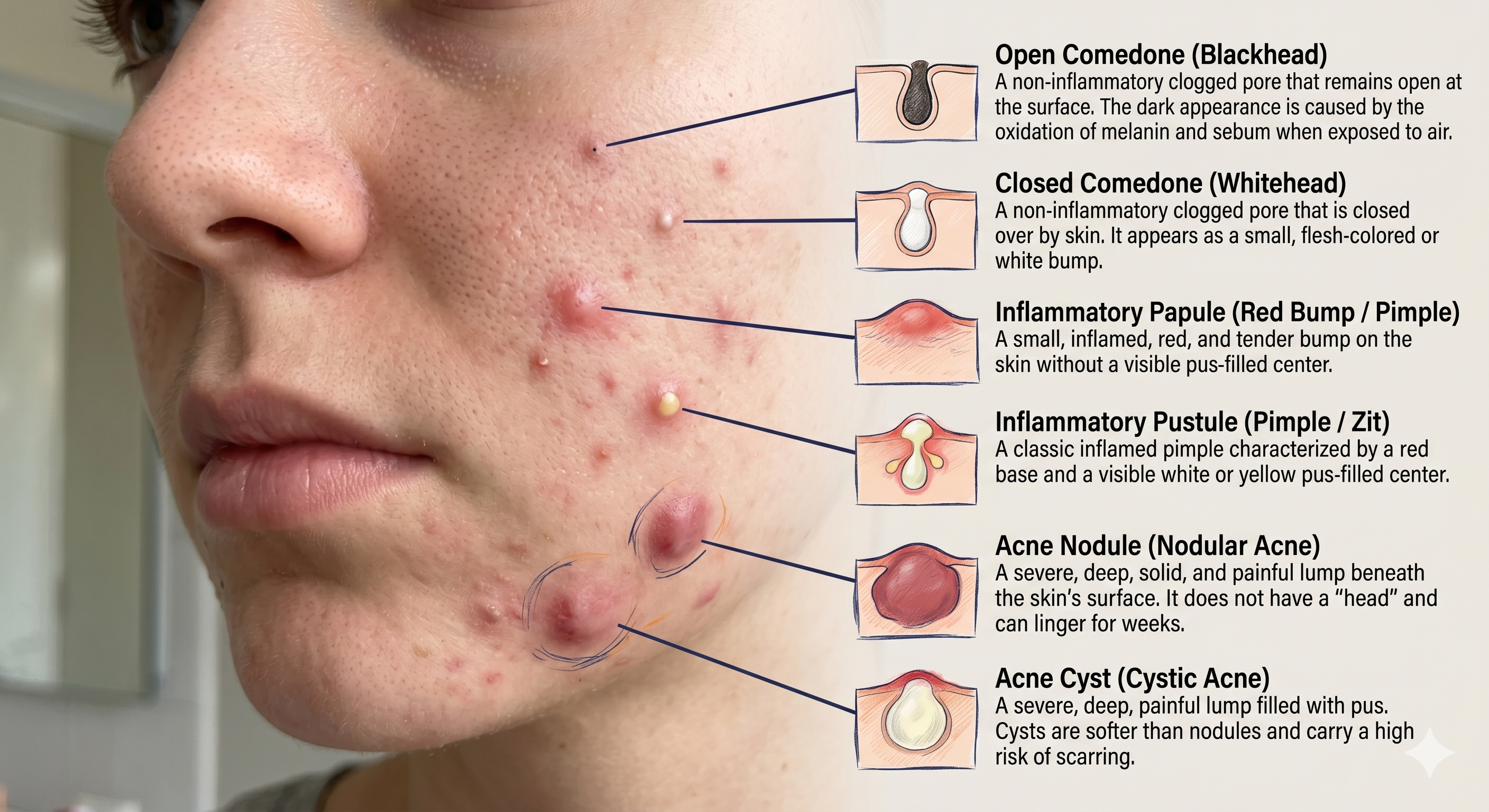
| Acne Type | Common Name | Inflammatory? | Scarring Risk | First-Line Treatment |
|---|---|---|---|---|
| Open Comedone | Blackhead | No | Very Low | Salicylic Acid 2%, Retinoid |
| Closed Comedone | Whitehead | No | Very Low | Adapalene 0.1%, AHA Exfoliant |
| Inflammatory Papule | Red Bump / Pimple | Yes | Low–Moderate | Benzoyl Peroxide 2.5%, Niacinamide |
| Inflammatory Pustule | Pimple / Zit | Yes | Moderate | BPO 2.5–5%, Clindamycin Gel |
| Acne Nodule | Nodular Acne | Yes — Deep | High | See Dermatologist — Oral Antibiotics / Retinoids |
| Acne Cyst | Cystic Acne | Severe | Very High | Dermatologist — Isotretinoin, Cortisone Injection |
Non-inflammatory acne consists of clogged pores that have not become infected with Cutibacterium acnes bacteria. They are painless, have no redness, and do not feel tender to the touch. They are extremely common on the nose, chin, and forehead in India — especially due to high humidity and sebum production.
Blackheads (Open Comedones)
The pore is stretched open at the surface. The mixture of trapped sebum and melanin (skin pigment) oxidises dark when exposed to air — not dirt. Common myth: squeezing them helps. Reality: it widens the pore and increases risk of scarring.
Where they appear: Nose, chin, forehead, chest.
Treatment: Salicylic acid (BHA) penetrates the oil-filled pore and dissolves the plug.
Whiteheads (Closed Comedones)
The exact same mixture of oil and dead skin cells — but sealed under a thin layer of skin, preventing oxidation. They appear as small flesh-coloured or white bumps, often in clusters on the forehead and chin.
Where they appear: Forehead, around nose, chin.
Treatment: Adapalene 0.1% gel accelerates cell turnover to prevent the follicle wall from thickening and sealing the pore.
When a clogged pore wall ruptures beneath the skin, or Cutibacterium acnes bacteria multiply rapidly inside the follicle, your immune system mounts a response. This creates redness, swelling, heat, and pain — the hallmarks of inflammatory acne.
Papules
Hard, red, tender bumps without a visible pus centre. The follicle wall has broken but white blood cells haven't accumulated yet. Picking a papule forces the infection deeper and dramatically increases PIH risk on Indian skin.
Feel: Firm, tender, slightly raised.
Treatment: Benzoyl peroxide 2.5% + niacinamide serum to calm redness and kill bacteria.
Pustules
The white/yellow visible centre is pus — an accumulation of white blood cells, dead skin cells, and bacteria your body sent to fight the infection. This is the classic "pimple" most people recognise.
Feel: Raised, red base, soft white/yellow top.
Treatment: BPO 2.5–5% + clindamycin gel (prescription). Pimple patches (hydrocolloid) draw out pus overnight without scarring.
Nodular and cystic acne represent the most severe grades of acne vulgaris. These lesions originate deep within the dermis — far below the reach of any OTC product. They are highly prone to permanent pitted and ice-pick scarring.
Nodules
Hard, solid, painful lumps that sit deep below the skin surface with no visible head. They develop when a ruptured follicle triggers a deep immune reaction. They can linger for weeks or months and leave box-car or rolling scars.
Feel: Rock-hard, very tender, no whitehead.
Treatment: Oral antibiotics (doxycycline), tretinoin — dermatologist required. Cortisone injections for immediate deflation.
Cysts
Similar to nodules but filled with pus, making them feel softer. They're often incredibly painful and inflamed. Cysts rupture internally, seeding infection into surrounding tissue — creating new cysts and almost guaranteeing deep ice-pick scarring.
Feel: Large, soft-ish, throbbing pain.
Treatment: Isotretinoin (Accutane/Sotret) — the only proven cure. Anti-androgens (spironolactone) for hormonal cystic acne. Cortisone injections for emergency relief.
The single most common skincare mistake is using the wrong active ingredient for the wrong type of acne. Use this matrix to match your breakout to the right treatment:
| Acne Type | OTC Active (India) | Prescription Option | What to Avoid | Indian Brand Examples |
|---|---|---|---|---|
| Blackheads | Salicylic Acid 2% (BHA) | Adapalene 0.1% gel | Physical scrubs (spread plugs) | Minimalist 2% SA, Neutrogena SA, Adaferin Gel |
| Whiteheads | Adapalene 0.1% (OTC) | Tretinoin 0.025% | Heavy oils, comedogenic moisturisers | Adaferin Gel 0.1%, Retino-A 0.025% |
| Papules | Benzoyl Peroxide 2.5% | Clindamycin + BPO gel | Picking (forces deeper) | Benzac AC 2.5%, Acne Star Gel |
| Pustules | BPO 2.5–5% + Hydrocolloid patch | Clindamycin 1% gel (Clindac A) | Popping (spreads bacteria) | Cosrx Pimple Patches, Clindac A, Persol AC |
| Nodules | None effective (topicals don't reach) | Doxycycline 100mg + Tretinoin | Squeezing (guaranteed scar) | Doxycap 100 (Rx), Retino-A 0.05% (Rx) |
| Cysts | None — OTC is ineffective | Isotretinoin (Sotret/Accutin) | Any picking, DIY extractions | Sotret 20mg, Accutin 10mg (dermatologist Rx only) |
When to See a Dermatologist — 4 Red Flags
Nodules or Cysts
Even 2–3 nodular or cystic lesions warrant an urgent appointment. Every week without treatment increases permanent scarring risk.
OTC Not Working After 8 Weeks
If consistent use of salicylic acid or BPO shows no improvement after 2 months, your acne type may need prescription-grade actives.
Leaving Dark Marks (PIH)
Post-inflammatory hyperpigmentation is extremely common on Indian skin. A derm can co-prescribe azelaic acid or niacinamide to prevent it alongside acne treatment.
Mental Health Impact
If breakouts are causing anxiety, social withdrawal, or affecting your quality of life — this is a medical emergency equally important to treat.
Cyclical / Hormonal Pattern
Acne that flares predictably before your period or around ovulation — especially on jaw and chin — often requires hormonal evaluation (PCOS panel) and anti-androgen treatment.
Pitted or Ice-Pick Scars Forming
Once collagen in the dermis is destroyed, topicals alone cannot rebuild it. Early clinical intervention (TCA CROSS, RF microneedling) dramatically improves outcomes. Scar type guide →