
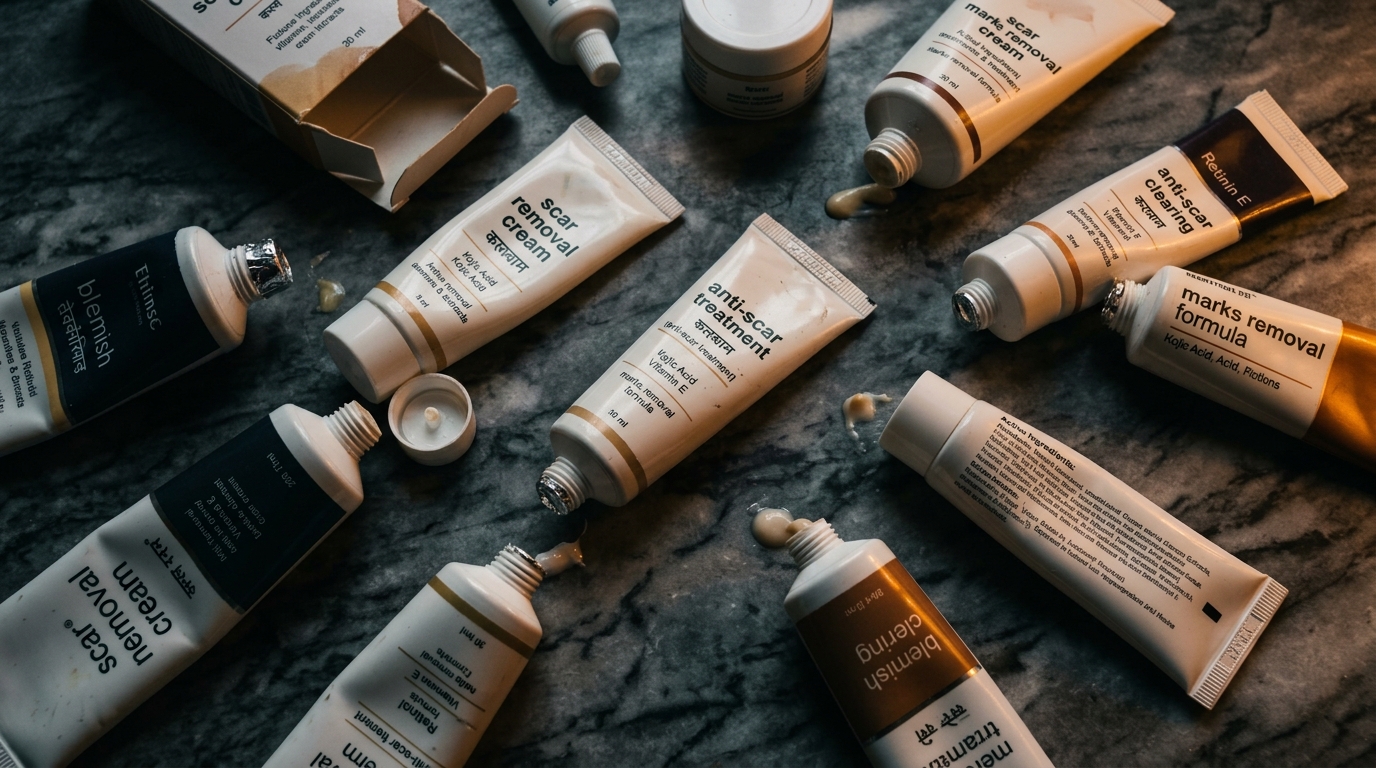
The "Scar Removal Cream" Myth — Why It Persists in India
🎯 The Definitive Answer
No topical cream can remove a structural (pitted, depressed, or raised) acne scar. A structural scar involves physical loss or excess of collagen in the dermis — a layer that no cream can penetrate deeply enough to structurally rebuild. What many creams do well is treat PIH (flat dark marks after a pimple heals) — which is not a scar, despite looking like one. This conflation is how the "scar removal cream" myth survives.
The myth survives in India for three reasons:
- Most people with "acne scars" actually have PIH, not structural scars. PIH genuinely does fade with topicals — so creams "appear to work" for what people call their "scars."
- Marketing language is unregulated for cosmetics in India. A cream can legally call itself a "scar reducer" even if it only fades discolouration — because the CDSCO (cosmetic regulator) does not require clinical proof of scar remodelling for cosmetic products.1
- Confirmation bias and time: PIH fades naturally over 6–24 months even without treatment. Any cream used during that period will appear to have "worked."
The Critical Distinction: Structural Scar vs PIH Mark
Before evaluating any product, you need to determine what you actually have:
| Characteristic | Structural Scar | PIH Mark |
|---|---|---|
| Texture | Depressed (pitted), or raised — skin surface changes | Flat — no textural change |
| Colour | May or may not be discoloured | Brown, red, or purplish dark mark |
| Test: Stretch skin sideways | Depression/elevation remains | Mark colour fades when stretched |
| Root cause | Collagen damage in dermis | Excess melanin in epidermis/upper dermis |
| Topical creams effective? | No — structural damage | Yes — targets melanin |
| Timeline to fade (no treatment) | Permanent without procedure | 6–24 months naturally |
💡 Self-Test: Do You Have a Scar or PIH?
Place two fingers on either side of the mark and gently stretch the skin laterally. If the dark colour significantly lightens or disappears when stretched — it's PIH (topicals and SPF will work). If the depression or elevation is still visible when stretched — it's a structural scar (you need a clinical procedure for meaningful improvement).
The Topical Ingredient Evidence Audit — Indian Skin Specific
This is the most complete evidence-based breakdown of topical ingredients marketed for acne scars in India, rated specifically for their utility on Fitzpatrick IV/V Indian skin.
| Ingredient | Works on PIH? | Works on Structural Scars? | Evidence Level | Indian Skin Notes | Timeframe |
|---|---|---|---|---|---|
| SPF 50 PA++++ | Yes — prevents darkening | No | High | Non-negotiable foundation step. Without SPF, no topical works well on Indian skin PIH. | Immediate (prevention) |
| Niacinamide 5–10% | Yes — inhibits melanin transfer | No | High | Well-tolerated on sensitive Indian skin. Also anti-inflammatory, helps active acne. Available: Minimalist, The Ordinary. | 4–12 weeks to see PIH reduction |
| Azelaic acid 10–20% | Yes — tyrosinase inhibitor + anti-inflammatory | No | High | Dual action: fades PIH and reduces active acne. Prescription-grade (15–20%) more effective. Well-suited for Indian skin. | 4–8 weeks |
| Kojic acid 1–2% | Yes — tyrosinase inhibitor | No | Moderate | Effective PIH treatment, but some users develop contact dermatitis. Patch test required. Available OTC in India. | 6–12 weeks |
| Vitamin C (L-Ascorbic Acid 10–20%) | Yes — antioxidant, inhibits tyrosinase | No | Moderate | Unstable in heat/humidity — refrigerate. Suitable Indian products: Minimalist 10% C E Ferulic, The Derma Co. 10% C serum. | 4–12 weeks |
| Tretinoin 0.025–0.05% (Prescription) | Yes — accelerates cell turnover, clears PIH | Partial — improves shallow texture over 12+ months | Very High | Schedule H drug in India — prescription required. Most evidence-backed single topical for PIH + shallow atrophic texture. See tretinoin guide. | 8–16 weeks for PIH; 12+ months for texture |
| Hydroquinone 2–4% (Dermatologist prescription) | Yes — very effective for deep PIH | No | High | Schedule H above 2% in India. Gold standard for persistent PIH but must not be used continuously >3–6 months (risk of ochronosis). | 4–8 weeks |
| Vitamin E oil / coconut oil | No meaningful evidence | No | Low / Myth | Vitamin E is comedogenic for many. Coconut oil is highly comedogenic — worsens acne on Indian oily skin. Cultural myth; not evidence-backed for scars or PIH. | Not applicable |
| Aloe vera gel | Mild soothing only | No | Weak | Safe, well-tolerated, mild anti-inflammatory. Cannot fade PIH effectively alone. Good as a lightweight moisturiser base. | Not a PIH treatment |
The Biggest Acne Scar Cream Myths in India — Debunked
🔍 Common Myths vs Clinical Reality
SUPERIORITY ASSETWhat Actually Works for PIH on Indian Skin: The Evidence-Backed Protocol
If your concern is PIH (flat dark marks — the most common post-acne concern for Indian users), this is the most effective evidence-backed protocol:
Step 1: Stop the cause — SPF 50 PA++++ daily (non-negotiable)
Without daily SPF, UV re-activates melanocytes at the PIH site constantly. Any brightening serum you use in the evening will be partially undone by morning sun exposure. SPF is the most impactful single step for PIH management on Indian skin.11
Step 2: Choose your primary PIH-fighting active (pick one to start)
- Niacinamide 10%: Best for sensitive or reactive skin — gentle, well-tolerated, also helps active acne
- Azelaic acid 10–15%: Best if you still have mild active acne alongside PIH — dual action
- Tretinoin 0.025% (prescription): Best for comprehensive improvement — PIH + early shallow texture + long-term collagen support
Step 3: Support the barrier (ceramide moisturiser)
A compromised skin barrier slows PIH healing and makes actives less effective. A ceramide-rich moisturiser (CeraVe, Cetaphil available in India) used twice daily maintains barrier function and allows actives to work effectively.
Step 4: Add a secondary brightener at 8–12 weeks if needed
If PIH is still visible after 8–12 weeks of Step 2, add kojic acid 1–2%, Vitamin C 10%, or (under dermatologist supervision) hydroquinone 2–4%.
Ingredients to Avoid in Indian "Scar Removal" Products
🚫 Red Flags — Avoid These
- Mercury-containing "skin lightening" creams: Banned in India but still found in import market and some local brands. Mercury is a nephrotoxin — causes kidney damage with prolonged use. If a lightening cream has no ingredient list or the list is vague, do not use it.
- High-concentration steroids (>1% betamethasone) in OTC creams: Some Indian pharmacy brands combine steroids + hydroquinone + antifungal — "triple cream." These cause skin atrophy, acneiform eruptions, and permanent skin changes with long-term unsupervised use.
- Lemon juice (undiluted) applied directly: Citric acid at uncontrolled concentration (lemon pH ~2.0) can cause chemical burns and dramatically worsens PIH on Fitzpatrick IV/V skin — especially without SPF afterwards.
- Products promising "scar removal in 7 days" or "guaranteed results": No topical can structurally remodel a scar in 7 days. This is false advertising. Report such products to the CDSCO (cdsco.gov.in).
Realistic PIH Fading Timeline for Indian Skin
| Regimen | PIH Fading Timeline (Indian Skin) | Structural Scar Improvement |
|---|---|---|
| SPF only (no actives) | 12–24 months (natural fading + UV prevention) | None |
| SPF + Niacinamide 10% | 4–8 months for mild–moderate PIH | None |
| SPF + Niacinamide + Azelaic Acid | 3–6 months for mild–moderate PIH | None |
| SPF + Tretinoin 0.025% (prescription) | 2–4 months for mild PIH | Mild improvement in shallow texture after 12+ months |
| SPF + Hydroquinone 4% (dermatologist-supervised) | 1.5–3 months for moderate–severe PIH | None |
| No SPF + any actives | 24+ months or no fading | None |
Frequently Asked Questions
No topical cream can remove a structural (pitted/depressed/raised) acne scar. What many creams do effectively is treat PIH (flat dark marks) — which is not a structural scar, despite looking like one. This conflation is how the "scar removal cream" myth survives in India's skincare market.
Kojic acid 1–2% is generally safe for Indian skin and is one of the most studied depigmenting agents. However, some users develop contact dermatitis — patch test before full-face use. At concentrations above 2%, irritation risk increases. Avoid products combining kojic acid with mercury (still found in some India market imports).
With consistent SPF 50 PA++++ + niacinamide 10% + azelaic acid, mild–moderate PIH on Indian skin typically fades in 3–6 months. Without SPF, the timeline extends to 12–24 months. With tretinoin added (prescription), mild PIH can clear in 2–3 months.11
Hydroquinone 2–4% is one of the most effective PIH treatments. Over-the-counter sale is restricted in India above 2% — it is Schedule H. It must not be used continuously for more than 3–6 months without a break due to risk of ochronosis (paradoxical darkening). Always use under dermatologist guidance.
Vitamin E oil has weak evidence for scar improvement and can be comedogenic (pore-clogging) — worsening acne on Indian skin. Coconut oil is highly comedogenic and should not be applied to acne-prone Indian faces. Neither can rebuild the collagen structure of a depressed scar. These are persistent cultural myths not supported by clinical evidence.10
References & Sources
- Central Drugs Standard Control Organisation (CDSCO). Cosmetics regulation overview. cdsco.gov.in
- Saano Clinics India. Acne scar vs PIH distinction. sanoclinics.in
- Grimes PE. Management of hyperpigmentation in darker skin. Semin Cutan Med Surg. 2009;28(2):77-85.
- Levin J, Momin SB. Niacinamide and skin hyperpigmentation. J Clin Aesthet Dermatol. 2010;3(2):22-41.
- Sori T, Manconi M. Azelaic acid: a review. Skin Pharmacol Physiol. 2008;21(5):247-253.
- Morand JJ, et al. Kojic acid for hyperpigmentation. Ann Dermatol Venereol. 2012;139(12):819-826.
- Schweiger E. Vitamin C for PIH. schweigerderm.com 2022.
- Reszko AE, et al. Hydroquinone for melasma and PIH. J Drugs Dermatol. 2009;8(3):221-223.
- Olsen EA. Tretinoin for atrophic scars. J Am Acad Dermatol. 1994;30(4):S34-40.
- Baumann L, Spencer J. The effects of topical Vitamin E on scar appearance. Dermatol Surg. 1999;25(4):311-315.
- Touloei K, et al. SPF compliance and PIH outcomes in darker skin. J Clin Aesthet Dermatol. 2014;7(3):13-7.
- Olivia Clinic. Scar removal cream truth. oliviaclinic.com
- The Derma Co. India. Ingredient formulation notes. thedermaco.com
- NIH PubMed. Azelaic acid clinical trials. pubmed.ncbi.nlm.nih.gov
- Healthline. Vitamin C for skin brightening. healthline.com
- WebMD. Dark spots from acne. webmd.com