
1. What Causes the Retinoid Purge?
Under ordinary conditions, human skin sheds dead keratinocytes through desquamation roughly once every 28 to 32 days. In acne-prone pores, desquamation fails: cohesive sticky cells clump inside the follicular infundibulum alongside sebum, creating microscopic plugs called microcomedones. These microscopic plugs sit beneath the surface for two to three months before swelling into visible blackheads or inflamed pustules.
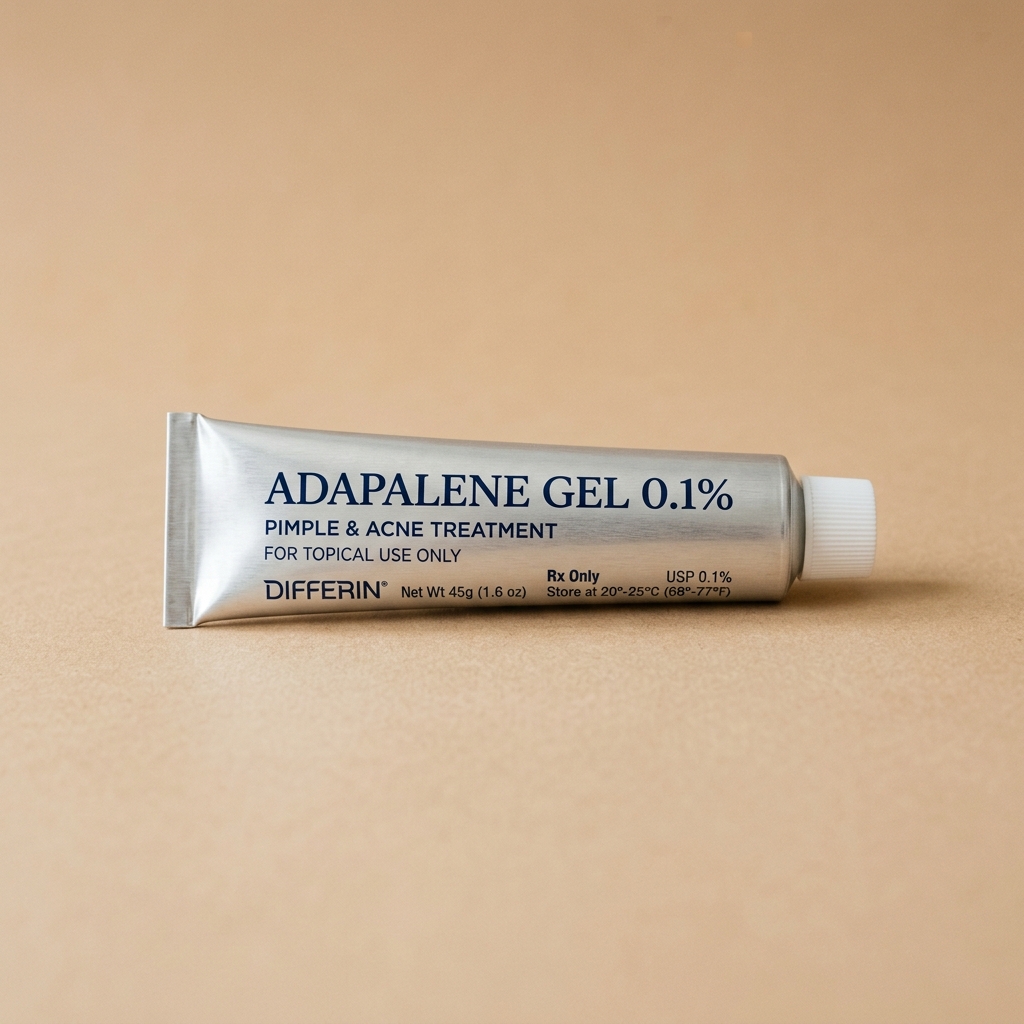
Adapalene binds selectively to nuclear retinoic acid receptors (RAR-beta and RAR-gamma) inside basal keratinocytes. Once bound, it signals DNA transcription to accelerate keratinocyte differentiation and loosen cellular cohesion. Instead of taking a month to migrate upward, follicular cells travel to the skin surface in roughly 10 to 14 days.
This biological acceleration does not manufacture new acne lesions out of thin air. Instead, it forces dozens of pre-existing, invisible microcomedones that were already brewing underneath your dermis to mature and surface simultaneously. If your pores held two dozen emerging clogs, adapalene compresses their entire three-month life cycle into a few concentrated weeks.
2. The Week-by-Week Progression
While every complexion adapts on its own clock, the vast majority of patients using 0.1% aqueous gel (such as Adaferin or Deriva) navigate four defined physiological phases over 12 weeks.
Barrier Dehydration and Surface Flaking
During the opening two weeks, your stratum corneum undergoes biochemical shock. Lipid production temporarily desynchronizes, increasing transepidermal water loss (TEWL). You will likely feel a tight, parchment-like sensation around the corners of the mouth, nasolabial folds, and under the eyes.
Applying a gentle moisturiser can create a momentary warm stinging sensation. Minor peeling begins. To prevent outright barrier collapse, keep application strictly to two evenings per week during this phase, never on consecutive nights.
Microcomedone Eruption and Surface Inflammation
This marks the critical psychological hurdle where over 60% of people abandon topical retinoids. Microcomedones rapidly mature into visible red papules and whitehead pustules. Existing stubborn blackheads on the nose and chin loosen and feel rough or bumpy to the touch.
Indian skin tones (Fitzpatrick IV–VI) carry heightened melanocyte reactivity. Squeezing or picking purging pustules during this window causes immediate post-inflammatory hyperpigmentation (PIH) that takes four to eight months to fade. Let lesions drain naturally.
Decreased Flare Frequency and Faster Healing
By week eight, cellular turnover stabilizes. The reservoir of subterranean microcomedones is largely cleared out. Newly formed pimples become smaller, superficial, and heal within two to three days rather than lingering for a fortnight.
Flaking diminishes significantly as lipid synthesis normalizes. At this junction, most dermatologists recommend stepping up application frequency to alternate evenings, observing how your skin responds over seven consecutive days.
Smooth Texture and Pigment Uniformity
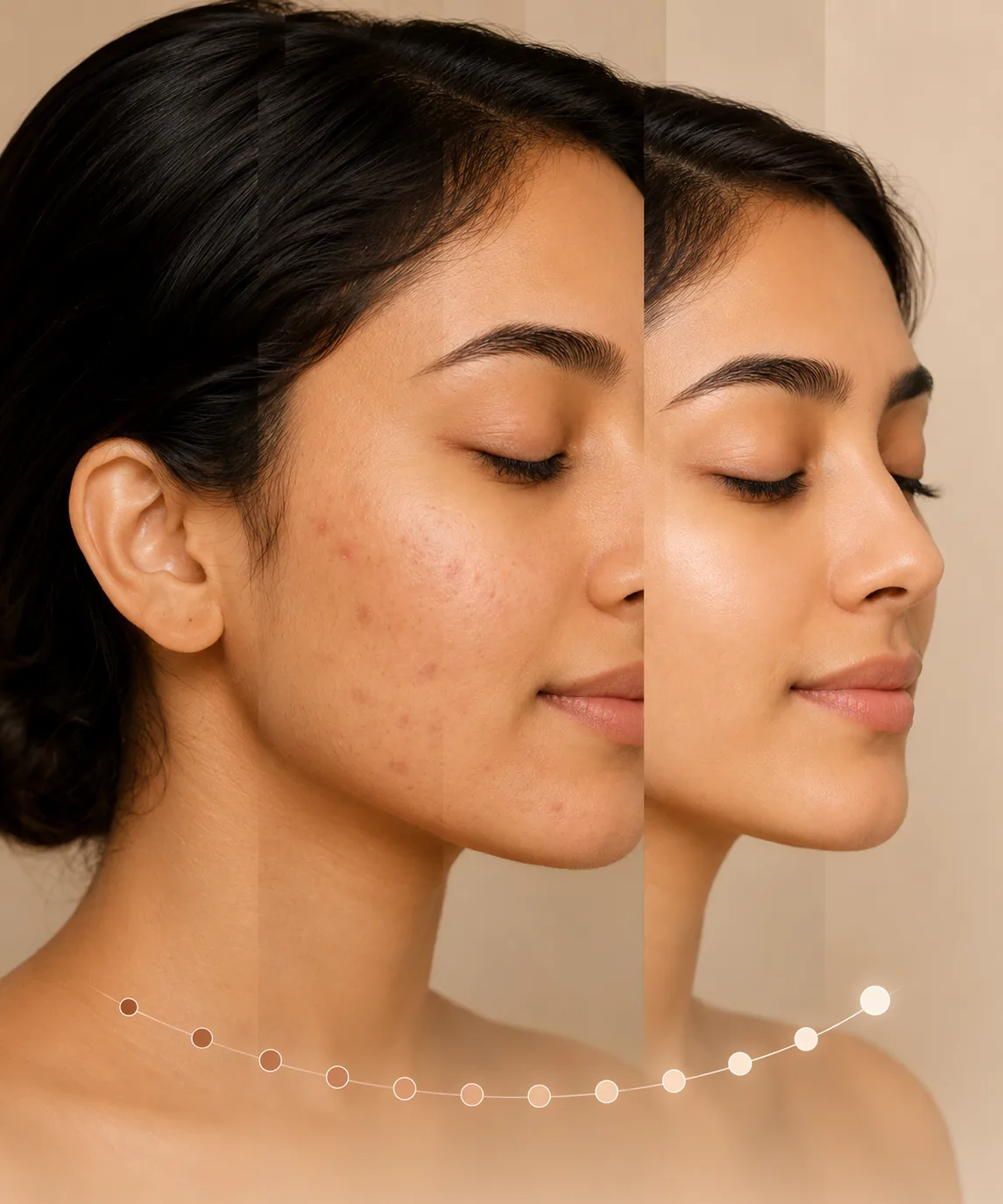
At three months, overall inflammatory lesion counts drop by 50% to 75% compared to baseline. Skin texture across the forehead and cheeks feels notably smoother, oiliness becomes balanced, and newly exposed epidermal layers exhibit the characteristic smooth light reflection commonly described as the retinoid glow.
3. How to Distinguish a True Purge from Barrier Damage
One of the most frequent clinical dilemmas is deciding whether continuing application is beneficial or whether the formulation is destroying the stratum corneum. The comparison table below highlights the diagnostic differences:
| Diagnostic Factor | Healthy Retinoid Purge | Barrier Breakdown / Allergic Reaction |
|---|---|---|
| Location of Lesions | Appears exclusively in high-congestion zones where you routinely break out (e.g. jawline, T-zone, chin). | Appears in normally calm, clear areas such as the upper cheeks, neck, or around the eyelids. |
| Lesion Presentation | Standard whiteheads and micro-papules that mature and crust over quickly in 48 to 72 hours. | Widespread itchy red rash, uniform tiny pinhead bumps, or burning hives that burn continuously. |
| Sensory Symptoms | Mild tightness after washing, localized dry patches, light sensitivity manageable with plain moisturizer. | Intense stinging even when splashing room-temperature plain water; raw, shiny, cracked skin. |
| Duration | Peaks around week 4 to 5 and progressively settles toward week 8. | Worsens week after week beyond 10 weeks without any sign of stabilization or relief. |
4. The Indian Barrier Survival Protocol
In hot, humid or dry urban climates across India, aggressive retinoid application coupled with strong sunlight can trigger severe pigmentation rebound. Dermatologists recommend these specific buffering steps to maintain comfort without weakening adapalene's efficacy:
1. The Sandwich Method (Buffer Before Potency)
Never apply adapalene to bare, freshly cleansed skin during your first month. Cleanse with a non-foaming surfactant, pat dry, and apply a thin layer of a light, fragrance-free ceramide moisturizer (such as Cipla Excela or Minimalist Ceramide). Wait 10 to 15 minutes until dry to the touch, apply a small pea-sized amount of gel across the face, and seal with a second light moisturizer coat.
2. Short Contact Therapy (SCT) for Sensitive Skin
If your skin feels raw or easily turns flushed, adopt short contact therapy for the first 14 days. Apply a pea-sized amount over clean skin, let it sit for 30 to 45 minutes to allow follicular uptake, and wash it off thoroughly with lukewarm water before your bedtime moisturizer. Clinical trials prove that follicular absorption of adapalene occurs rapidly within the first half-hour, while leaving it on overnight increases surface barrier irritation.
3. Avoid Heavy Slugging with Petroleum Ointments
Do not layer thick petroleum jelly (Vaseline) or pure occlusive ointments over adapalene. Heavy occlusives lock the retinoid against the epidermis like an airtight plastic wrap, magnifying penetration unpredictably and causing chemical peel-like burns. Reserve petrolatum only for delicate buffer zones around the nostrils and lip edges prior to applying the gel.
4. Strict Suspension of Chemical Exfoliants
While navigating the purge, discontinue salicylic acid serums, glycolic acid toners, benzoyl peroxide washes, and coarse physical scrubs. Adapalene handles cell renewal entirely on its own; stacking acids during the purging phase strips lipid ceramides and guarantees deep hyperpigmentation.
5. एडैपलीन पर्जिंग गाइड (सरल हिंदी निर्देश)
अगर आपने Adaferin या Deriva-MS लगाना शुरू किया है और 2–3 हफ्तों में चेहरे पर ज्यादा दाने, सूखापन या पपड़ी दिखने लगी है, तो घबराएं नहीं। यह पर्जिंग (Purging) का हिस्सा है:
- यह क्यों होता है? एडैपलीन त्वचा की कोशिकाओं के बनने की गति तेज करता है। जो मुंहासे 2-3 महीने में धीरे-धीरे बाहर आते, वे सब 3-4 हफ्तों में एक साथ बाहर निकल आते हैं।
- यह कब तक चलता है? पर्जिंग का असर तीसरे से छठे हफ्ते के बीच सबसे ज्यादा होता है। आठवें हफ्ते से दाने शांत होने लगते हैं और 12वें हफ्ते तक त्वचा साफ होने लगती है।
- सैंडविच तरीका अपनाएं: पहले हल्का मॉइस्चराइजर लगाएं, 10 मिनट रुकें, फिर केवल मटर के दाने (pea-size) जितनी जेल पूरे चेहरे पर लगाएं, और ऊपर से दोबारा मॉइस्चराइजर लगाएं।
- गलती न करें: दानों को कभी न फोड़ें (भारतीय त्वचा पर काले निशान/PIH बन जाते हैं), धूप में बिना सनस्क्रीन न निकलें, और इसके साथ सैलिसिलिक एसिड या विटामिन C का इस्तेमाल कुछ हफ्तों के लिए रोक दें।
6. Frequently Asked Questions
Yes, hydrocolloid patches are safe to use on whitehead pustules that have already surfaced, provided the patch contains no added active salicylic acid or tea tree oil. Hydrocolloids absorb exudate, speed wound healing, and prevent involuntary fingernail picking.
Formulations using micro-sponge technology—such as Deriva-MS—release adapalene gradually into the hair follicle over several hours. This gradual release reduces surface redness and flaking compared to conventional aqueous gels, making it ideal for reactive Indian skin.
Stinging indicates that your moisture barrier has micro-fissures from rapid lipid desynchronization. Immediately decrease adapalene frequency to once or twice a week, avoid foaming facial cleansers, and switch to a soothing barrier cream formulated with squalane, colloidal oat, or ceramides until the stinging disappears.
Yes, broad-spectrum SPF 50 is non-negotiable. Accelerated cell turnover continuously exposes young, unpigmented skin cells to daylight. In tropical Indian environments with UV indexes regularly above 7, unprotected sun exposure during retinoid treatment triggers intense dark spots and dermal hyperpigmentation.
Looking to introduce exfoliating acids once your purge resolves? Read our detailed guide on how to safely sequence Salicylic Acid with Adapalene to prevent barrier relapse.