
If you look in the mirror and notice pitted acne scars or stubborn dark spots, it is completely normal to want a quick fix. Online beauty videos often show people rolling tiny metal needles over their cheeks and waking up with smooth skin. Retail sites sell these dermaroller wheels for a few hundred rupees, claiming they erase deep acne scars at home.
In dermatology clinics across India, doctors see a very different reality. Patients regularly walk in with swollen skin, infected red cysts, and dark brown lines running across their cheeks after using a home dermaroller.
While microneedling performed by a dermatologist in a sterile clinic can be very effective for acne scars, doing it yourself with a rolling wheel at home carries high risks. Here is what happens under the skin, why dermatologists urge caution, and what you can do instead.
1. The Wheel Problem: How Angled Needles Tear Facial Skin
The main reason at-home dermarollers damage skin comes down to simple geometry: a wheel has to roll.
Think about what happens when a needle sits on a round drum. As you push the roller across your cheek, each needle enters your skin at an acute slant (around 45 degrees). As the wheel continues rolling forward, the needle pivots inside your skin and then rips backward on its way out.
Instead of creating a clean, microscopic hole, the needle works like a miniature fishhook. It drags sideways through your epidermis, producing curved tears and microscopic scratches. With dozens of needles on each roller row, rolling over your face just four times can create thousands of jagged micro-tears.
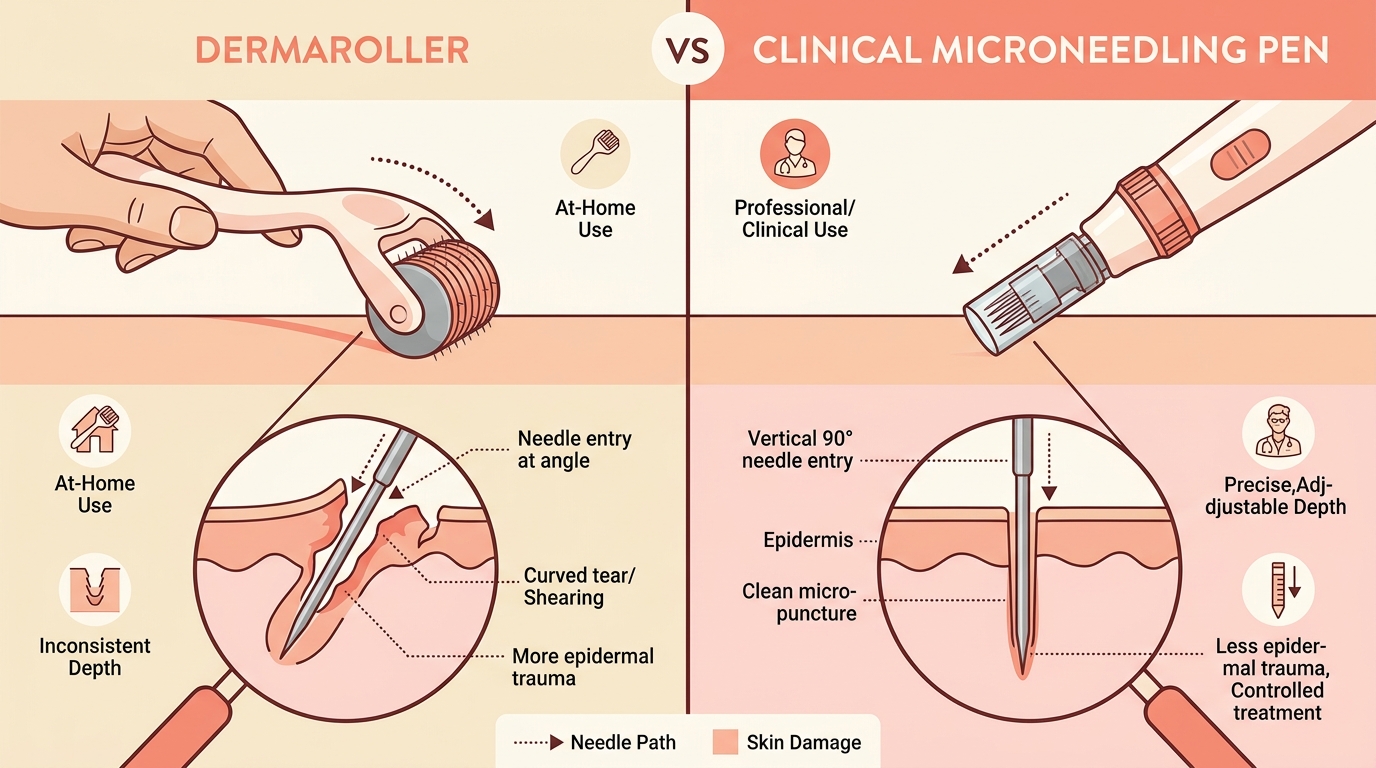
In contrast, clinical microneedling devices (such as Dermapen or SkinPen) used by dermatologists do not roll. They use an automated motor that pulses needles up and down at an exact 90-degree angle, entering and leaving straight without dragging through skin tissue.
2. Spreading Bacteria: Why Rubbing Alcohol Is Not Enough
Many home users believe that dipping their dermaroller into surgical spirit or boiling water makes it completely safe. In medical reality, home sanitizing cannot achieve true sterilization.
Dermarollers contain hundreds of tiny needles attached into a plastic core. Microscopic drops of blood, sebum, skin oils, and dead skin cells get wedged into the tiny gaps where needles meet the plastic base. Rubbing alcohol evaporates quickly on the surface, but cannot dissolve dried biological build-up deep inside those crevices.
Within days, bacteria like Staphylococcus and Cutibacterium acnes multiply inside those microscopic pockets. The next time you roll, you are pushing those bacteria directly into your open pores.
3. Indian Skin and Dark Spots: Why Friction Triggers Hyperpigmentation
Indian skin tones generally fall under Fitzpatrick skin types IV, V, and VI. These skin types have highly active pigment-producing cells called melanocytes.
When your skin experiences friction, physical scraping, or mechanical trauma, melanocytes view it as an attack. To protect the deeper layers, they produce large amounts of melanin pigment. This reaction is called Post-Inflammatory Hyperpigmentation (PIH).
When an at-home dermaroller tears the skin surface, the resulting inflammation triggers intense melanin production. Instead of filling acne scars, patients often end up with dark brown lines and discolored patches along the roller path. Clearing this deep pigment can take 6 to 18 months of intensive prescription skincare.
4. Dermatologist Video Guide: Microneedling vs. Dermarollers
To help you understand the medical differences between home devices and clinical scar treatments, watch this clinical breakdown by dermatologist Dr. Aanchal Panth MD:
Dr. Aanchal Panth MD: Dermarollers, Clinic Microneedling & Precautions
- At-home dermarollers cannot replicate in-clinic results because home needle lengths are too short to trigger deep collagen formation.
- Improper technique and unsterile tools lead to infections, irritation, and stubborn post-inflammatory dark marks.
- Deep pitted scars require structured clinical interventions such as fractional lasers, subcision, or professional microneedling.
5. Different Acne Scars Need Different Fixes
A common misconception is that all acne marks are the same. In reality, flat discolored marks are completely different from indented scars, and each type requires a specific solution:
| Scar / Mark Type | How It Looks | Does At-Home Rolling Help? | Dermatologist-Approved Treatment |
|---|---|---|---|
| Flat Red Marks (PIE) | Flat pink or red spots left after a pimple heals; caused by dilated surface blood capillaries. | Dangerous Needling irritates vessels and worsens redness. |
Topical Care Azelaic acid, Centella Asiatica, Niacinamide, daily SPF 50. |
| Flat Dark Spots (PIH) | Flat brown or black spots caused by excess melanin deposited after acne inflammation. | Dangerous Rolling creates friction that triggers even darker pigment. |
Topical Care Azelaic acid 10%–15%, Alpha Arbutin, Vitamin C, strict sun protection. |
| Rolling Scars | Wide, shallow depressions with sloping edges that make the skin look wavy or uneven. | Ineffective Tethered bands underneath hold the scar down. |
In-Clinic Subcision (cutting tight bands under the skin) plus RF Microneedling (MNFR). |
| Boxcar Scars | Round or oval pits with sharp, steep vertical edges (resembling chickenpox marks). | Ineffective Home needle depth cannot reach the base of the scar. |
In-Clinic Automated medical microneedling pen, Fractional CO2 laser resurfacing. |
| Icepick Scars | Deep, narrow, V-shaped holes that look like tiny puncture marks from an ice pick. | No Effect Pits extend deep into the skin; needles cannot fill them. |
In-Clinic TCA CROSS (placing medical trichloroacetic acid drops inside the pit). |
6. A Safe Skincare Routine for Marks and Skin Barrier Health
If you have post-acne marks or uneven skin texture, you do not need needles at home to see noticeable progress. A gentle, consistent routine focused on cell renewal and barrier protection delivers visible results without risking permanent marks:
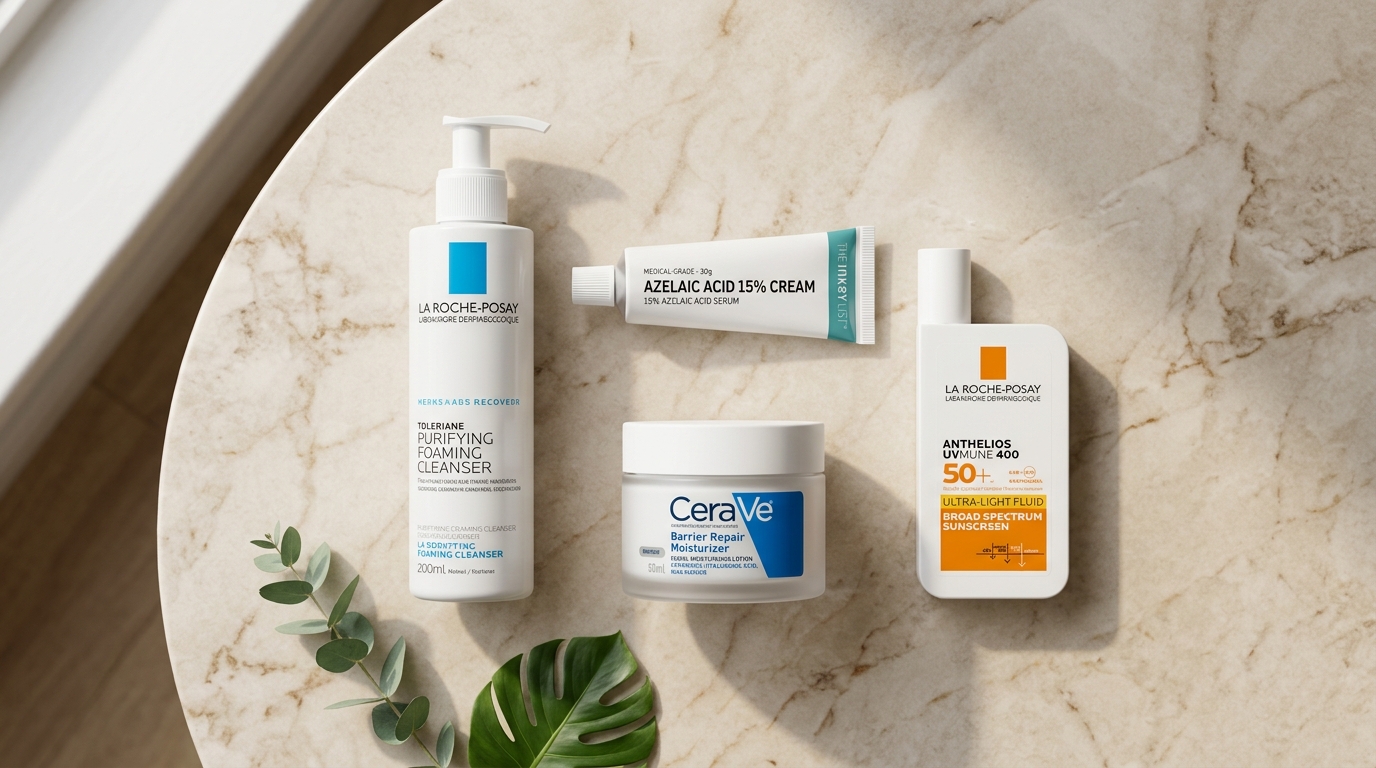
The 4-Step Morning & Night Blueprint
- Step 1: Gentle Cleanser (Morning & Night): Use a non-foaming or mild foaming cleanser with a neutral pH. Avoid harsh physical scrubs with walnut shells or beads that cause friction.
- Step 2: Azelaic Acid (10% to 15%) (Night): Azelaic acid reduces redness, fades dark melanin spots, and gently clears clogged pores without thinning your skin barrier.
- Step 3: Ceramide Barrier Cream (Morning & Night): Look for moisturizers containing ceramides, hyaluronic acid, or squalane. A healthy skin barrier prevents irritation and allows your skin to repair itself.
- Step 4: Broad-Spectrum Sunscreen (Every Morning): Ultraviolet rays stimulate melanocytes to darken acne marks. Wear SPF 50 broad-spectrum sunscreen every day, even when indoors or on cloudy days.
7. Frequently Asked Questions
No. Small needle sizes like 0.25mm to 0.5mm only reach the top dead layer of skin. Deep indented scars sit 1.5mm to 2mm deep inside the skin. Using short needles at home cannot build new collagen to fill pits, but can still tear skin and cause dark marks.
Rolling across a pimple breaks open the pocket of bacteria and pushes acne germs into dozens of open puncture wounds across the face. This can trigger a widespread breakout of red bumps and deep cystic spots within days.
Indian skin contains melanocytes that respond strongly to injury. When rolling needles enter at an angle and tear the surface, the skin reacts to the trauma by releasing excess melanin. This leads to post-inflammatory hyperpigmentation (PIH) that can take many months to fade.
A clinical microneedling pen uses a sterile motor cartridge that enters and exits vertically at an exact 90-degree angle, creating clean micro-channels without dragging. A dermaroller uses a wheel where needles enter and exit at an angle, slicing and tearing skin tissue as the wheel turns.
Creams and serums cannot replace missing skin volume in deep pits like icepick or boxcar scars. Retinoids and azelaic acid help smooth surface texture and fade flat dark marks, but structural pits require clinical treatments like subcision, RF microneedling, or lasers.
Unsure What Type of Acne Marks You Have?
Before spending money on tools or treatments, find out whether your marks are surface pigmentation, broken capillaries, or deep structural scars.
Scan Your Face in 60 Seconds