
Understanding Azelaic Acid: The Unsung Hero of Dermatology
Azelaic acid, a naturally occurring dicarboxylic acid produced by the yeast Malassezia furfur, has emerged as one of the most versatile and highly prescribed topical agents in modern dermatology. Within the Indian pharmaceutical landscape, its prominence has skyrocketed due to its tri-fold efficacy: it is antimicrobial, comedolytic, and acts as a potent tyrosinase inhibitor.
Unlike benzoyl peroxide, which primarily targets the bacterial load of Cutibacterium acnes through oxidation, azelaic acid operates through a nuanced mechanism that alters the microenvironment of the pilosebaceous unit. It significantly reduces the production of free fatty acids in sebum and normalizes keratinization, preventing the formation of microcomedones.
Furthermore, in the context of the Indian demographic—where Fitzpatrick skin types III to V are predominant—the incidence of Post-Inflammatory Hyperpigmentation (PIH) and melasma is exceedingly high. Azelaic acid selectively targets hyperactive melanocytes by inhibiting the enzyme tyrosinase, making it a cornerstone therapy for pigmentary disorders without the risks of paradoxical hyperpigmentation or exogenous ochronosis associated with long-term hydroquinone use.
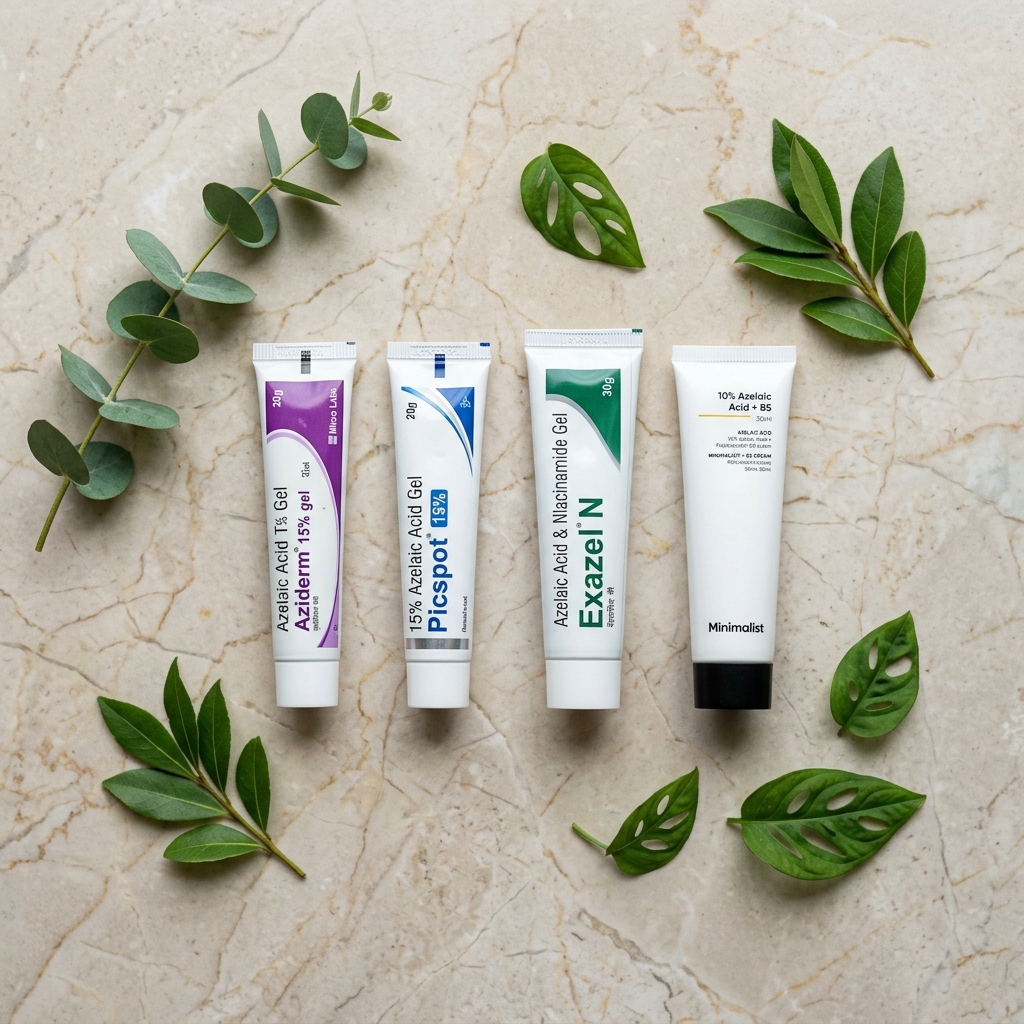
This comprehensive guide explores the clinical nuances of 15% and 20% azelaic acid formulations available in India under CDSCO Schedule H regulations, including popular brands like Aziderm, Picspot, and Exazel N. By understanding the pharmacokinetics and formulation science behind these products, patients and practitioners can optimize treatment protocols for diverse dermatological indications.
Clinical Deep Dive: Mechanism of Action
To fully appreciate the therapeutic value of azelaic acid, one must examine its molecular interactions within the epidermis and dermis. Its efficacy is not derived from a single pathway but rather a synergistic array of pharmacological effects.
1. Antimicrobial Properties
Azelaic acid exhibits a profound bacteriostatic effect, which at higher concentrations can become bactericidal. It readily penetrates the bacterial cell wall of Cutibacterium acnes (formerly Propionibacterium acnes) and Staphylococcus epidermidis. Once inside the cell, it disrupts critical cellular processes, specifically targeting the synthesis of vital proteins. Unlike topical antibiotics such as clindamycin, there is no documented bacterial resistance to azelaic acid, making it safe for prolonged, indefinite use in chronic acne management.
2. Anti-Keratinizing Activity
Hyperkeratinization—the abnormal shedding of skin cells—is a primary catalyst for comedone formation. Azelaic acid modulates the early and terminal phases of epidermal differentiation. It decreases the thickness of the stratum corneum, normalizes filaggrin expression, and reduces the synthesis of keratohyalin granules. This unblocks the follicular duct, preventing the impaction of sebum and keratin that characterizes comedonal acne.
Tyrosinase Inhibition Mechanism
Azelaic acid acts as a competitive and reversible inhibitor of tyrosinase, the rate-limiting enzyme in melanogenesis. Crucially, its cytotoxic effect is selective; it targets highly active and abnormal melanocytes (such as those found in melasma or post-inflammatory lesions) while sparing normal, healthy melanocytes. This selectivity ensures an even skin tone without the risk of hypopigmentation or depigmentation halos, a significant advantage over other bleaching agents.
3. Anti-Inflammatory Effects
Azelaic acid downregulates a variety of pro-inflammatory mediators. It inhibits the production of reactive oxygen species (ROS) from neutrophils and suppresses the release of interleukins (IL-1, IL-6) and tumor necrosis factor-alpha (TNF-α). This robust anti-inflammatory action is the primary reason azelaic acid is FDA-approved and widely used off-label in India for the management of rosacea, particularly the papulopustular subtype, rapidly reducing erythema and inflammatory lesion counts.
15% vs. 20% Concentration: Formulation Matters
In India, azelaic acid is predominantly prescribed in two strengths: 15% and 20%. While one might intuitively assume that the higher concentration is universally superior, the clinical reality is heavily dependent on the vehicle (base formulation) and the specific indication.
10% OTC (Cosmetic)
MaintenanceCosmetic formulations containing 10% azelaic acid or azelaic acid derivatives. Often formulated with soothing ingredients. Best for maintenance and mild brightening.
15% Rx Strength
ClinicalThe standard clinical dose for acne and rosacea. Deeply penetrates the pore to clear impactions. The gel formulation is highly favored in India for its cosmetic elegance.
The 15% Gel Advantage
Clinical studies have demonstrated that a 15% gel formulation can be as effective, if not more effective, than a 20% cream in certain scenarios. The gel vehicle allows for enhanced penetration of the active ingredient into the stratum corneum and the pilosebaceous unit. It is typically non-comedogenic, lightweight, and cosmetically elegant, making it the preferred choice for oily skin types, inflammatory acne, and rosacea. In India, products like Aziderm 15% Gel and Picspot 15% Gel are widely prescribed for these exact reasons.
The 20% Cream Powerhouse
The 20% cream formulations, such as Aziderm 20% Cream, offer a higher absolute concentration of the active molecule but are suspended in an emollient base. This base slows down the delivery of the acid, reducing the initial stinging or "tingling" sensation that many patients experience. The 20% cream is exceptionally effective for melasma and stubborn hyperpigmentation, particularly in patients with dry, sensitive, or mature skin whose barrier requires the lipid support provided by the cream vehicle.
Warning: Gel vs Cream on Oily Indian Skin
A patient with severe oily acne may find a 20% cream too heavy, leading to congestion and new comedones, while a patient with dry skin and melasma might find the 15% gel insufficiently moisturizing and potentially irritating. Ensure you select the correct vehicle for your specific skin type and environment.
Deep Dive into Indian Formulations
The Indian pharmaceutical market offers several robust, clinically validated azelaic acid formulations under CDSCO (Central Drugs Standard Control Organisation) Schedule H guidelines, meaning they should technically be sold under a valid prescription.
| Brand Name | Manufacturer | Strengths/Vehicles | Key Clinical Use Cases |
|---|---|---|---|
| Aziderm | Micro Labs | 10%, 15%, 20% (Cream & Gel) | Acne vulgaris, Rosacea, Mild PIH |
| Picspot | Dr. Reddy's | 15% (Gel) | Inflammatory acne, Rosacea |
| Exazel N | Dr. Reddy's | 20% Azelaic Acid + 4% Niacinamide | Melasma, Severe PIH, Acne marks |
| Ezanic | Intas Pharmaceuticals | 10%, 20% (Cream & Gel) | Maintenance therapy, body pigmentation |
Among these, Exazel N warrants special mention. The addition of 4% Niacinamide creates a multi-pathway approach to treating hyperpigmentation. While Azelaic Acid inhibits the synthesis of melanin via tyrosinase inhibition, Niacinamide prevents the transfer of melanosomes from melanocytes to neighboring keratinocytes. This dual action makes Exazel N a formidable topical treatment for recalcitrant melasma and deep acne scarring, though its thick cream base means it is best suited for evening application or dry skin types.
Routine Integration: Layering Azelaic Acid safely in India
Integrating a potent active like azelaic acid into a skincare routine requires strategy, especially in the harsh, humid, and varied climates of India. Barrier damage is a significant risk when actives are layered haphazardly.
The Morning Routine (AM)
Azelaic acid is non-photosensitizing, meaning it does not make your skin more sensitive to the sun. This makes it an excellent morning active. However, its anti-inflammatory properties can cause a characteristic "tingle" or itching sensation upon application.
- Cleanse: Use a gentle, non-stripping cleanser. Avoid cleansers with high concentrations of AHAs/BHAs in the same routine initially.
- Prep: Apply a hydrating toner or essence if your skin leans dry. Let it absorb completely.
- Treat: Apply a pea-sized amount of Azelaic Acid to the entire face. Do not spot treat.
- Moisturize: Follow with a ceramide-rich moisturizer to support the stratum corneum.
- Protect: Unconditionally apply a broad-spectrum sunscreen (SPF 30+ or 50+).
The Evening Routine (PM) and Advanced Layering
In the evening, azelaic acid can be used alone or layered with other actives, provided the skin is acclimated.
Layering with Retinoids (Tretinoin, Adapalene): The combination of azelaic acid and a retinoid like tretinoin is exceptionally potent for severe acne and deep dermal pigmentation. However, both can cause significant irritation. The safest approach is "skin cycling"—using them on alternating nights. Once the skin's tolerance is built up, they can be layered: apply the retinoid first, wait 20 minutes, then apply azelaic acid.
Layering with Vitamin C: While theoretically possible, using L-Ascorbic Acid and Azelaic Acid in the same routine can heavily compromise the skin barrier due to low pH levels. It is generally recommended to use Vitamin C in the AM and Azelaic Acid in the PM, or alternating days.
Managing Side Effects: The "Azelaic Itch" and Purging
Despite its excellent safety profile, the initiation of azelaic acid therapy is frequently accompanied by transient cutaneous side effects. The most common is the infamous "Azelaic Itch"—a pricking, stinging, or burning sensation that occurs immediately upon application.
Caution: Initial Stinging & Itching
This sensation is typically innocuous and mediated by sensory nerve fibers in the skin, not by an allergic reaction or actual barrier destruction. It usually dissipates within 15-30 minutes and significantly diminishes after 2-4 weeks of consistent use as the skin undergoes tachyphylaxis (desensitization) to the active. Use the Sandwich Method (moisturizer-active-moisturizer) to mitigate this.
Purging vs. Breakouts
Because azelaic acid has comedolytic properties and normalizes skin cell turnover, it can induce a "purge." This is an acceleration of microcomedones coming to the surface as inflammatory lesions. A purge typically lasts 4-6 weeks and occurs in areas where you normally break out. If you are experiencing new breakouts in unusual areas after 8 weeks, it may be a reaction to the vehicle (the cream or gel base) rather than a purge, and you should consult your dermatologist to switch formulations.
Mitigation Strategies
- The Sandwich Method: Apply a light moisturizer, then the azelaic acid, then another layer of moisturizer. This buffers the absorption rate and dramatically reduces stinging.
- Dry Application: Ensure the skin is bone-dry before application. Water increases the penetration rate of the acid, exacerbating irritation.
- Gradual Titration: Start by using it every third night, gradually moving to every other night, and finally to daily use over a period of 4-6 weeks.
Safety Profile: Pregnancy, Lactation, and Long-Term Use
Pregnancy & Lactation Safety
Azelaic acid is classified as an FDA Pregnancy Category B medication, meaning animal reproduction studies have failed to demonstrate a risk to the fetus, and there are no adequate and well-controlled studies in pregnant women. In clinical practice, dermatologists widely consider topical azelaic acid safe for use during pregnancy and lactation, making it a critical tool for managing pregnancy-induced acne and melasma when retinoids (Category X) and isotretinoin are strictly contraindicated.
Furthermore, because azelaic acid does not induce bacterial resistance and does not cause systemic toxicity or exogenous ochronosis, it can be used indefinitely as a maintenance therapy. For patients with chronic conditions like rosacea or recurrent adult-onset acne, azelaic acid serves as a reliable, long-term cornerstone of their topical regimen.
The landscape of dermatological treatments in India is vast, but Azelaic acid remains a steadfast, multi-tasking molecule. Whether navigating the choice between Aziderm 15% gel for inflammatory acne or Exazel N cream for recalcitrant pigmentation, the key to success lies in consistent application, barrier respect, and understanding the specific pharmacological mechanisms at play. Always consult with a board-certified dermatologist to tailor these potent CDSCO Schedule H medications to your unique skin physiology.
Frequently Asked Questions
The 15% gel formulation is often more bioavailable and penetrates the skin effectively, making it excellent for rosacea and inflammatory acne. The 20% cream provides a higher concentration in an emollient base, suitable for hyperpigmentation and patients who need extra moisturization.
Yes, but it must be introduced gradually. Due to India's varied climate, barrier support with ceramides is crucial. It is a CDSCO Schedule H drug, so usage should ideally be under dermatological supervision.