
Interactive Mirror Check: Is It Acne or Rosacea?
Before trying another face wash or medicated gel, answer these four visual questions to identify which condition matches your facial skin right now:
Quick Diagnostic Symptom Checker
Tap the description that matches what you see and feel in the mirror.
The 60-Second Mirror Test: Acne vs. Rosacea
Telling acne and rosacea apart can be confusing because both conditions cause red bumps and pustules on your face. But looking at your skin under natural daylight reveals four clear telltale clues:
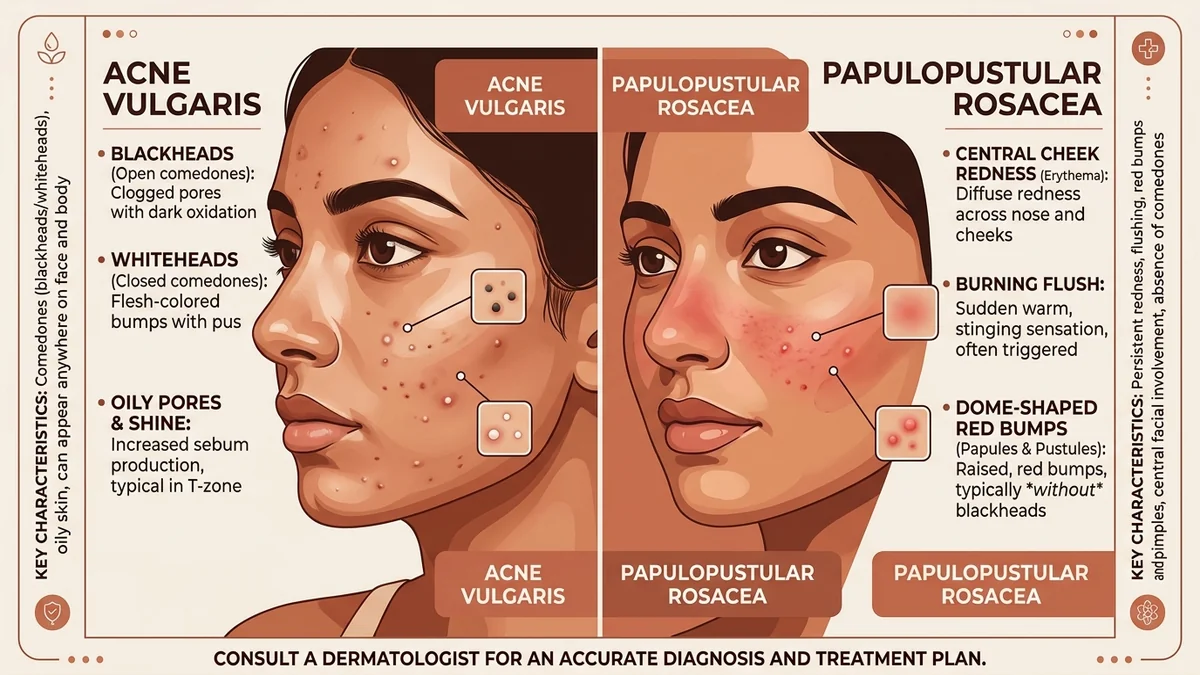
1. The Blackhead Rule (The Dead Giveaway)
Look for: Open comedones (blackheads) or tiny closed whitehead plugs on your nose, chin, or forehead.
If present: It is Acne Vulgaris. Acne is fundamentally a disease of clogged oil pores.
If absent: It is likely Rosacea. Dermatologists note that true rosacea never produces blackheads. The bumps are purely inflammatory swellings.
2. Where Are the Bumps Located?
Acne Vulgaris: Appears anywhere on your face—forehead, temples, jawline, chin, neck, chest, and back.
Rosacea: Stays tightly confined to the center of your face—the apples of your cheeks, the center of your nose, and the middle of your forehead. It rarely spreads to your jawline or temples.
3. How Does Your Face Feel?
Acne Vulgaris: Individual pimples feel tender, sore, or throbbing when pressed. Your overall skin does not burn from plain moisturizer.
Rosacea: Your cheeks feel hot, tight, and stinging. Even basic face creams or plain splash of water can cause a sharp burning sensation.
4. Do You See Tiny Spider Veins?
Acne Vulgaris: Redness is strictly confined to the circle around each pimple. Once the bump heals, the background skin is normal.
Rosacea: You see persistent background redness with tiny visible spider veins (telangiectasias) branching across your nose and cheeks.
How Rosacea Shows Up on Indian Skin & The Steroid Trap
Most online medical photos show rosacea on pale Caucasian skin with bright pink, cherry-red blushing. Because of this, thousands of Indian patients with rosacea go misdiagnosed for years, assuming they just have stubborn adult acne or a bad sun tan.
Dusky Violaceous or Copper Patches (Instead of Bright Pink)
On Fitzpatrick skin types IV, V, and VI, dense epidermal melanin masks underlying blood vessel redness. Rosacea appears as a warm, purplish, dusky copper, or brownish-red flush across the cheeks that gets mistaken for stubborn hyperpigmentation.
Sensory Symptoms Outweigh Visual Redness
Indian rosacea patients frequently complain of burning, stinging, prickling, or hot facial skin long before visible redness becomes obvious to observers. If your face burns after sipping hot chai or stepping into midday sunlight, pay attention.
High Risk of Post-Inflammatory Hyperpigmentation (PIH)
When rosacea bumps swell and resolve on melanin-rich skin, they stimulate melanocytes to dump excess pigment, leaving stubborn dark brown marks. Treating rosacea with harsh drying acne washes triggers intense barrier inflammation and makes these dark marks much darker.
Critical Clinical Warning: The "Betnovate & Panderm" Steroid Trap
Across India, millions of people visit local medical stores for facial bumps and are handed over-the-counter corticosteroid creams like Betnovate-C, Betnovate-N, Panderm, Quadriderm, Fourderm, or Dermiderm. Using these on your face triggers an insidious cycle known as Steroid-Induced Rosacea (Topical Steroid-Damaged Face):
Clinical Comparison Matrix: Acne vs. Rosacea
Compare the fundamental clinical differences side by side before deciding on your skincare routine:
| Feature | Acne Vulgaris | Acne Rosacea (Papulopustular) |
|---|---|---|
| Primary Mechanism | Pore blockage from excess oil (sebum), dead skin buildup, and Cutibacterium acnes bacteria. | Neurovascular hyper-reactivity, microscopic blood vessel dilation, and overgrowth of Demodex skin mites. |
| Comedones (Blackheads) | Present: Blackheads and whitehead plugs are the hallmark sign. | Absent: True rosacea never produces blackheads or clogged pore plugs. |
| Primary Location | Forehead, jawline, chin, temples, chest, shoulders, and back. | Strictly central: apples of cheeks, bridge of nose, and central forehead. |
| Facial Sensation | Tender or sore when pressing individual pimples. Skin barrier intact. | Hot, stinging, burning, prickly sensations. Highly sensitive to moisturizers. |
| Visible Blood Vessels | No visible spider veins; redness is restricted to active pimples. | Visible spider veins (telangiectasias) branching across nose and cheeks. |
| Reaction to Acne Washes | Responds well to Salicylic Acid, Benzoyl Peroxide, and Adapalene. | Severe burning, extreme peeling, barrier collapse, and violent flushing flares. |
| First-Line Topicals | Benzoyl Peroxide 2.5%, Adapalene 0.1%, Salicylic Acid 2%. | Azelaic Acid 15% Gel, Ivermectin 1% Cream, Metronidazole 0.75% Gel. |
| Products to Avoid | Heavy pore-clogging oils, thick comedogenic cold creams. | Benzoyl peroxide, alcohol astringents, walnut scrubs, chemical sunscreens. |
Why Standard Acne Creams Burn Rosacea Skin
One of the clearest signs that your "acne" is actually rosacea is how your face reacts to standard pimple treatments. If you bought an anti-acne face wash from the pharmacy and your cheeks felt like they were on fire, here is the medical reason why:
1. Free Oxygen Radical Damage
Benzoyl Peroxide works by releasing free oxygen radicals into pores to kill bacteria. On healthy skin, natural skin oils cushion this reaction. But on rosacea skin—where natural ceramides are depleted—these oxygen radicals burn through the skin barrier, creating acute chemical dermatitis.
2. Over-Stimulated TRPV1 Pain Receptors
Rosacea skin possesses hyper-reactive sensory nerve fibers equipped with TRPV1 receptors (the same receptors that detect heat and chili burns). Strong acids like Salicylic Acid or Glycolic Acid trigger these sensors immediately, causing sudden blood vessel dilation and burning.
3. Trans-Epidermal Water Loss (TEWL)
Rosacea skin has a leaky moisture barrier. When you use foaming sulfates or foaming acne cleansers, you wash away what little protective lipid layer remains. Water evaporates rapidly, leaving your face tight, flaky, and raw.
4. The "Demodex Mite" Factor
Patients with papulopustular rosacea often host 5 to 10 times more microscopic Demodex folliculorum mites inside their facial pores. Harsh acne scrubs irritate these mites, causing them to release inflammatory proteins that worsen pustule swelling.
Indian Kitchen & Everyday Lifestyle Trigger Decoder
Rosacea is fundamentally a vascular condition—anything that causes your facial blood vessels to suddenly expand will trigger a flare-up. In Indian households, everyday cooking and weather factors frequently cause flushing without patients realizing it:
Standing right above a sizzling pan while tempering mustard seeds, cumin, and dry red chillies radiates intense heat directly onto your cheeks and nose.
Drinking tea straight from a boiling kettle or steel tumbler stimulates heat sensors in the roof of your mouth and throat, signaling facial vessels to dilate.
Capsaicin in fresh green chillies and spicy curries binds directly to neurovascular heat receptors, sparking instant cheek flushing and perspiration.
Washing your face with municipal or borewell hard water leaves mineral salt deposits, raising facial pH from healthy acidic 5.5 to alkaline 8.0 and drying the skin barrier.
Dermatologist Video Guide: Is It Acne or Rosacea?
In this video, board-certified dermatologist Dr. Andrea Suarez (Dr Dray) explains the exact clinical markers she uses to distinguish acne vulgaris from papulopustular rosacea, and why using typical pimple treatments on rosacea can cause severe barrier damage:
"If you have rosacea, treating your skin like it is dirty or oily with aggressive scrubs and benzoyl peroxide will ruin your skin barrier. Rosacea is an inflammatory and vascular condition. The most reliable topical for both conditions is 15% Azelaic Acid because it calms inflammation without irritating sensitive blood vessels."
What Actually Works: Safe Treatment & Indian Pharmacy Options
Managing rosacea requires shifting from an "attack the pimple" mindset to a "soothe the barrier" mindset. Here is the doctor-approved daily protocol using readily accessible Indian pharmacy options:

🌟 The Dual Hero: Azelaic Acid 15% Gel
Brand Names in India: Aziderm 10% / 15% Gel, Picspot 15% Gel.
Why it works: Azelaic acid is the single most effective active that safely treats both acne and rosacea simultaneously. It kills bacteria, decreases Demodex inflammation, stops free radicals, and lightens post-inflammatory brown spots without sun sensitivity.
How to use: Apply a pea-sized amount over moisturized skin at night.
🔬 Demodex Mite Control: Ivermectin 1% Cream
Brand Names in India: Iverfil 1% Cream, Soolantra 1% Cream.
Why it works: Prescribed by dermatologists for stubborn papulopustular rosacea bumps. It eliminates excessive Demodex mite colonies while exerting potent anti-inflammatory effects.
How to use: Apply once daily at night under dermatological supervision.
🧴 Gentle Hydrating Cleansers
Indian Options: Cetaphil Gentle Skin Cleanser, Episoft Cleansing Lotion, Moiz Cleansing Lotion.
The Rule: Never use foaming salicylic acid washes on stinging cheeks. Choose soap-free, non-foaming cleansing lotions that clean without removing natural protective lipids.
🛡️ 100% Mineral Zinc Oxide Sunscreen
Indian Options: Suncros 50 Aquagel, UV Doux Mineral, La Shield Mineral SPF 50.
The Rule: Chemical sunscreens (avobenzone, oxybenzone) convert UV light into heat, triggering flushing. Physical Zinc Oxide reflects UV rays away like tiny mirrors and calms irritation.
Frequently Asked Questions
Straightforward answers to the most common questions about distinguishing and treating acne versus rosacea: