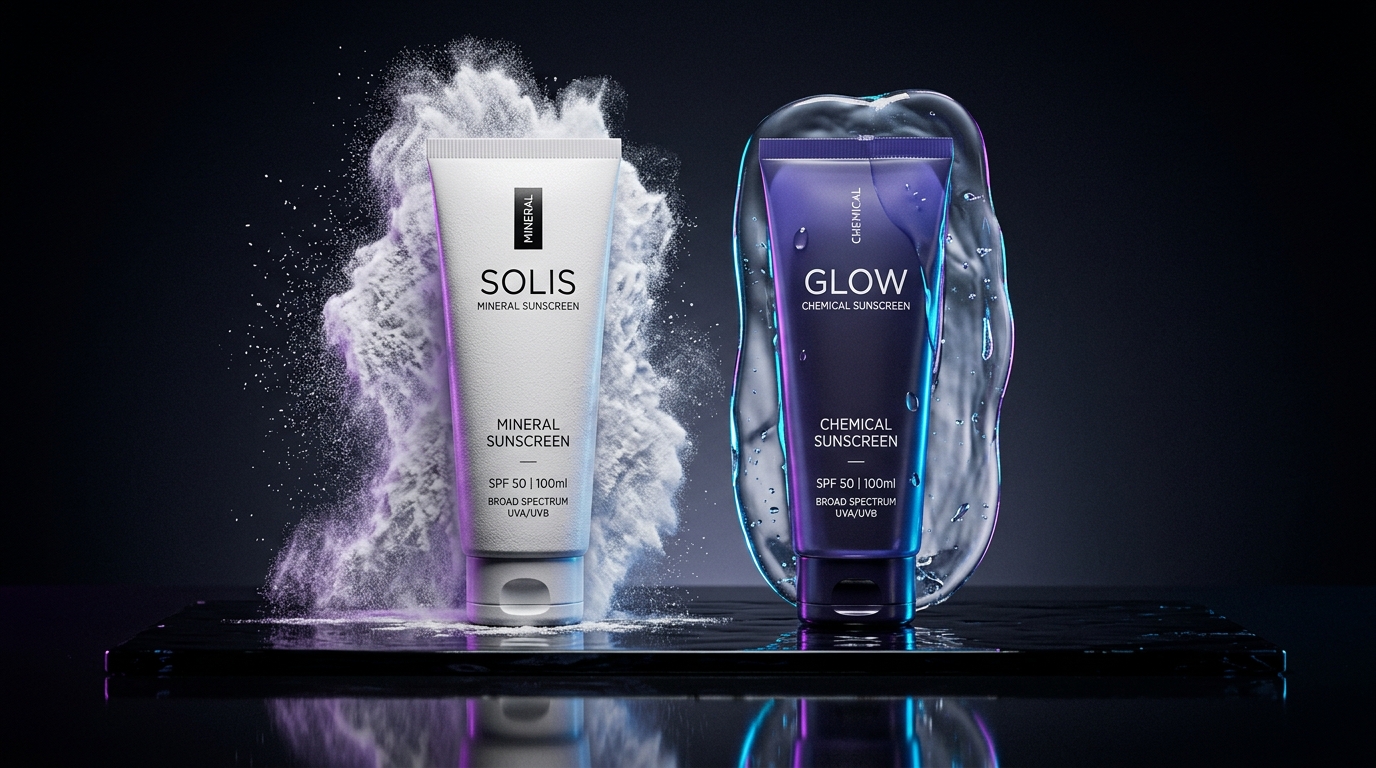
Formulating photoprotection for acne-prone skin in darker phototypes (Fitzpatrick IV-VI) presents a dual pharmacological challenge: mitigating the cosmetic morbidity of mineral filters (white cast) without exacerbating the underlying pathophysiology of acne.
1. The White Cast Dilemma & Particle Dynamics
The Optical Physics of Mineral Filters
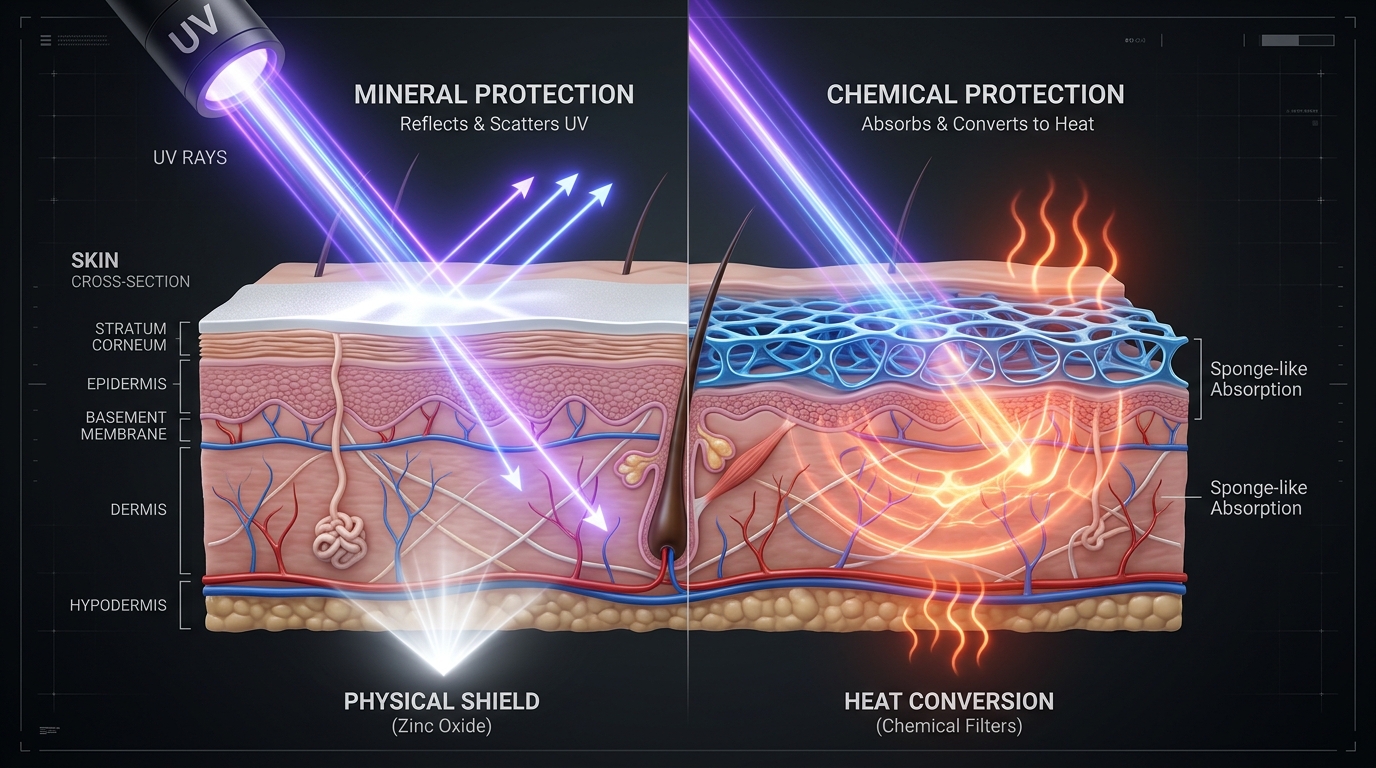
Zinc Oxide (ZnO) and Titanium Dioxide (TiO₂) function primarily by absorbing, reflecting, and scattering ultraviolet radiation. Because their refractive indices (2.0 for ZnO, 2.6 for TiO₂) are significantly higher than that of human skin (approximately 1.5), they scatter visible light rather than allowing it to pass through.
On Fitzpatrick IV-VI skin, which is rich in eumelanin, this light scattering creates a severe, clinically unacceptable chalky, grey, or purple appearance (the "white cast").
Nano vs. Non-Nano Particle Size
To counteract the white cast, the industry shifted toward nanoparticle (NP) technology:
- Non-Nano Minerals (>100nm): Offer robust broad-spectrum protection but result in a severe cosmetic penalty on darker skin.
- Nano Minerals (<100nm): Milling particles down to 10-50nm shifts their scattering profile out of the visible light spectrum, drastically reducing the white cast. Extensive dermatological data confirms that nano-ZnO and nano-TiO₂ do not penetrate intact human skin.
2. Pore-Clogging Mechanisms: Are Mineral Sunscreens Inherently Comedogenic?
A pervasive myth in dermatology is that mineral filters are inherently comedogenic. From a purely biochemical standpoint, ZnO and TiO₂ are biologically inert inorganic powders; they do not clog pores.
The Comedogenicity Lies in the Carrier Mechanism
Because zinc and titanium are dense, insoluble powders, they naturally clump together (agglomerate). To suspend them evenly and ensure a uniform SPF film, formulators are forced to use heavy carrier bases like isopropyl myristate, triglycerides, or heavy plant oils.
The Occlusion Effect (Acne Mechanica)
These lipid-heavy bases can mix with the patient's sebum, creating a viscous sludge that blocks the pilosebaceous unit. Furthermore, a dense silicone matrix combined with physical mineral powders creates an occlusive film. This occlusive barrier traps sweat, dead corneocytes, and excess sebum, creating an anaerobic microenvironment ideal for Cutibacterium acnes proliferation. The "breakout" from a mineral sunscreen is rarely an allergic reaction to the zinc itself, but rather an acneiform eruption caused by the heavy dispersal agents.
3. Chemical Filters: Legacy vs. Modern Generations
Chemical (organic) filters absorb UV radiation and convert it into low-energy heat. However, not all chemical filters are created equal, particularly regarding tolerability on compromised, acne-prone skin barriers.
Legacy Filters (Proceed with Caution)
- Avobenzone: A potent UVA absorber, but highly photounstable. It degrades rapidly in sunlight, forming cleavage products that frequently trigger contact dermatitis, erythema (redness), and severe stinging, especially around active acne lesions.
- Oxybenzone & Octocrylene: Small molecular weights allow these filters to penetrate the stratum corneum deeply, leading to a high incidence of photo-allergy and sensitization.
Modern Filters (The Gold Standard for Acne-Prone Skin)
Next-generation organic filters have revolutionized photoprotection. They are characterized by high molecular weights (preventing skin penetration and thus irritation) and exceptional photostability. Examples include Tinosorb S/M and Uvinul A Plus.
4. Actionable Product Curation for Indian Skin
Balancing biochemistry with real-world application requires selecting formulations that utilize modern filters, omit heavy occlusive carriers, and cater to the sebum production rates of Fitzpatrick IV-VI skin.
1. Acne-UV Gel (IPCA)
Mechanism: Utilizes a volatile silicone (cyclopentasiloxane) base. This evaporates upon application, leaving the UV filters behind in a matte, primer-like film without the heavy, pore-clogging occlusivity of dimethicone/triglyceride bases.
2. UV Doux Silicone Gel
Mechanism: Relies on an anhydrous, cross-linked silicone elastomer matrix. The inclusion of Uvinul A Plus ensures robust UVA protection (crucial for preventing post-inflammatory hyperpigmentation) without stinging.
3. Beauty of Joseon Relief Sun
Mechanism: Uses a high water-content emulsion base stabilized by modern polymers. Because it relies strictly on high-molecular-weight modern chemical filters, there is absolutely zero need for heavy carrier oils or silicones.
4. Blynds Emulgel SPF 40+
Mechanism: Formulated as an emulgel (emulsion + gel), it provides the spreadability of a cream but the quick-absorption of an aqueous gel.