
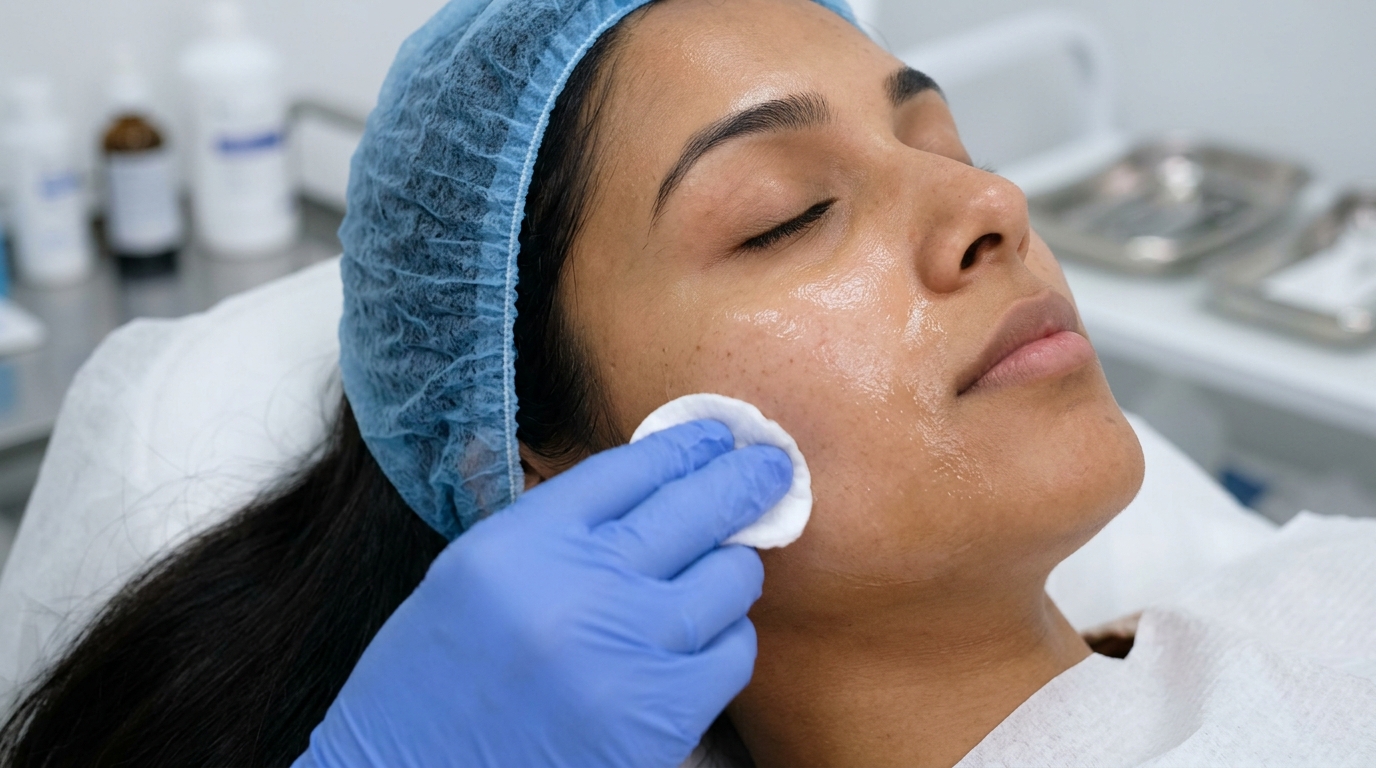
Alpha Hydroxy Acids (AHAs) are the gold standard for treating dullness, rough texture, and post-acne pigmentation. However, not all AHAs are created equal. The choice between pharmacy-staple Glyco-6 Cream and OTC-favorite Minimalist 8% Lactic Acid comes down to a fundamental rule of biochemistry: molecule size.
1. The Molecule Size Rule
The deeper an acid penetrates, the faster it works, but the more likely it is to cause severe irritation. In Indian skin types, irritation directly translates to Post-Inflammatory Hyperpigmentation (PIH).
Glycolic Acid (Smallest Molecule)
Derived from sugar cane, Glycolic Acid has the smallest molecular weight of all AHAs. It penetrates deeply and rapidly into the dermis to stimulate collagen and dissolve the bonds holding dead skin cells together. Because it penetrates so quickly, it is infamous for causing stinging and burning on compromised barriers.
Lactic Acid (Larger Molecule)
Derived from milk, Lactic Acid has a larger molecular structure. It cannot penetrate as deeply, meaning it exfoliates only the superficial epidermis. Crucially, Lactic Acid is a natural humectant—it actually draws water into the skin, making it uniquely hydrating while it exfoliates.
2. Glyco-6 vs Minimalist 8% Lactic Acid
| Feature | Glyco-6 (6% Glycolic) | Minimalist (8% Lactic) |
|---|---|---|
| Fast, aggressive fading of stubborn dark spots. | Remodels deep texture and acne marks. | Gentle surface exfoliation with hydration. |
| Cream base (macrogol). | Thick, occlusive cream. Can feel heavy. | Lightweight serum with Hyaluronic Acid. |
| High. Prone to stinging. | Not recommended for rosacea or active eczema. | Low. Safe for dry and sensitive skin. |
3. The PIH Risk for Indian Skin
Indian skin (Fitzpatrick III-V) is notoriously prone to Post-Inflammatory Hyperpigmentation. Melanocytes (pigment-producing cells) in brown skin are highly reactive to inflammation.
The Glycolic Trap
Many beginners use Glyco-6 daily to treat dark spots. The aggressive exfoliation damages the skin barrier, triggering severe inflammation. The skin responds by producing massive amounts of melanin to protect itself, making the original dark spots twice as dark as before. This is the "Glycolic Trap."
The Lactic Advantage
Minimalist 8% Lactic Acid mitigates this risk entirely. By exfoliating slowly on the surface and hydrating simultaneously, it prevents the inflammatory cascade that triggers melanocytes, making it the safest starting point for Indian skin.

4. Dermatologist Routine Rules
How to introduce these powerful AHAs into your routine without causing chemical burns.
The 1-2-3 Method
Start with 1 night the first week, 2 nights the second week, and 3 nights the third week. Never use AHAs every single night.
Sandwich Method
If using Glyco-6, apply moisturizer, then Glyco-6, then moisturizer again. This dilutes the acid slightly and protects the barrier.
No Mixing
Never use an AHA in the same routine as Retinol, Adapalene, or Vitamin C. Use them on alternate nights.
Sun Protection
AHAs thin the dead layer of the skin, making you highly susceptible to UV damage. SPF 50 is non-negotiable every morning.