
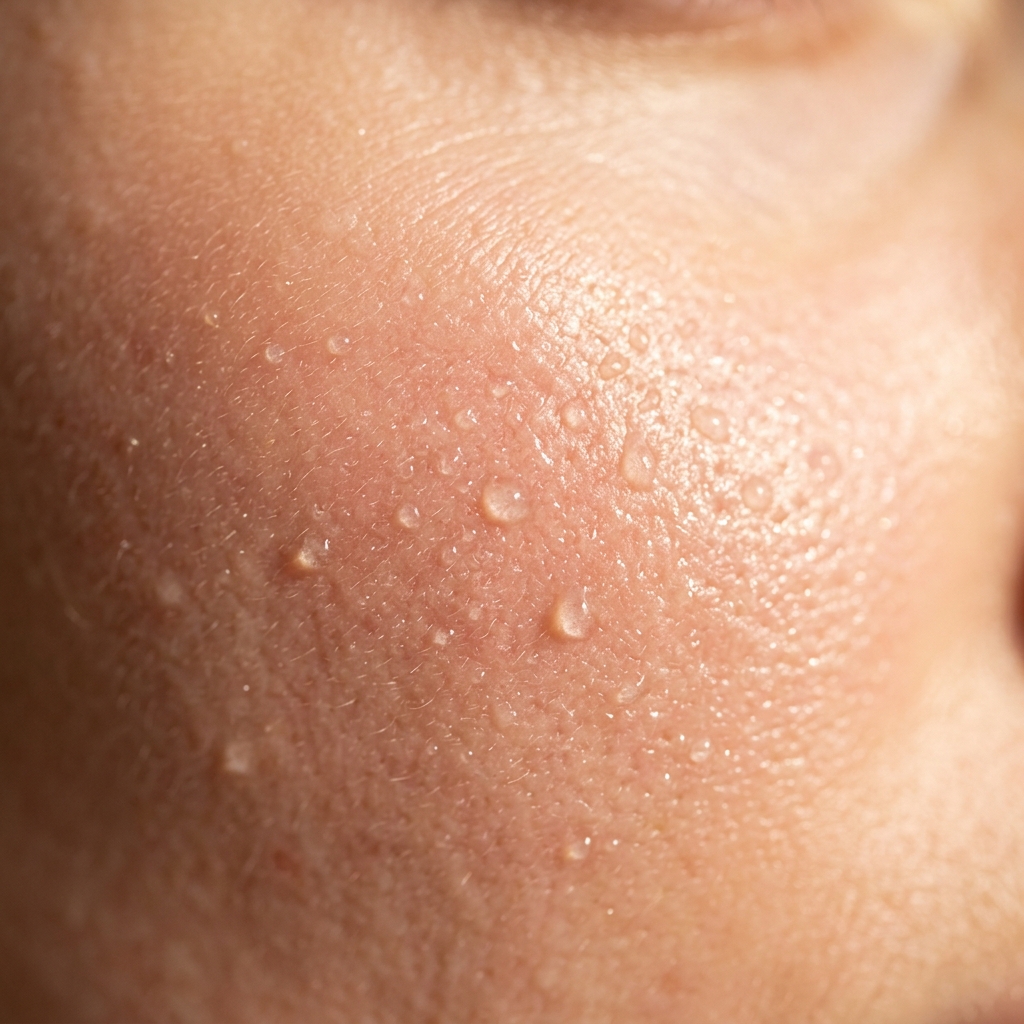
Every year, as soon as the monsoon rains hit India and the relative humidity spikes to 90%, your forehead and hairline flare up with hundreds of tiny, uniform, itchy bumps. Eager to clear your skin, you apply tea tree oil, salicylic acid, or rich barrier creams, but the bumps multiply.
Why? Because those are not regular pimples.
You are dealing with Malassezia folliculitis—commonly known as fungal acne. The humid air creates a tropical breeding ground for yeast on your skin, and your current skincare routine is likely feeding it.
Here is the science-based playbook to diagnose fungal acne and build a monsoon-proof, yeast-starving shield.
1. The Science: Why the Monsoon Triggers Fungal Acne
Malassezia is a lipid-dependent yeast (fungus) that naturally lives in the hair follicles of human skin. Under normal conditions, it remains balanced. However, the Indian monsoon introduces two factors that trigger a yeast explosion:
- Elevated Humidity (75%–95%): Fungi thrive in warm, damp, and humid conditions. High atmospheric water content hydrates the outer layer of your skin, creating a tropical greenhouse environment.
- Excess Sebum Production: As temperatures rise alongside humidity, the skin's sebaceous glands produce excess sebum (oil). *Malassezia* yeast feeds on the fatty acids in your sebum, utilizing them to replicate and colonize the hair follicles. This causes follicular inflammation, resulting in small, itchy bumps.
2. The Diagnostics: Fungal vs. Bacterial Acne
To clear your skin, you must determine whether your breakouts are caused by bacteria (C. acnes) or yeast (Malassezia). Treating fungal acne with regular bacterial acne products (like heavy benzoyl peroxide or rich ceramide creams) will often make it worse.
Perform this visual and physical check:
- Uniformity: Fungal acne bumps are monomorphic (they all look exactly the same size and shape—usually small, dome-shaped flesh-colored bumps). Bacterial acne is polymorphic (a mix of blackheads, large pustules, nodules, and cysts of varying sizes).
- Sensation: Fungal acne is itchy, especially when you sweat or when humidity levels rise. Bacterial acne is painful to pressure but rarely itchy.
- Location: Fungal acne clusters in high-sweat zones: the forehead, hairline, temples, chest, and back. Bacterial acne typically spans the cheeks, chin, and jawline.
- The Extractable Core: If you squeeze a bacterial pimple, a solid sebum plug (core) is released. Fungal acne bumps are superficial, fluid-less, and do not contain a solid comedonal core.
3. The Forbidden Skincare Ingredients
*Malassezia* yeast cannot manufacture its own fatty acids, so it must harvest them from its environment. It feeds on carbon chains of lengths C11 to C24. Unfortunately, 90% of standard moisturizers, cleansers, and sunscreens contain lipids within this range.
If you are fighting fungal acne during the monsoon, check your ingredient labels and immediately avoid these categories:
1. Natural Oils and Butters (Except Squalane)
All plant oils contain C11–C24 fatty acids. Avoid Coconut Oil, Almond Oil, Argan Oil, and Shea Butter. The only 100% fungal-safe oil is pure Squalane Oil (which is a C30 hydrocarbon that yeast cannot digest).
2. Esters (Ending in "-ate")
Esters are combinations of a fatty acid and an alcohol. They are widely used as emulsifiers and skin softeners. Look for and avoid:
- Isopropyl Myristate / Palmitate
- Glyceryl Stearate
- Polysorbate 20 / 60 / 80
- Sorbitan Trioleate
3. Pure Fatty Acids
- Lauric Acid (C12)
- Myristic Acid (C14)
- Palmitic Acid (C16)
- Stearic Acid (C18)
- Oleic Acid (C18)
4. Fungal vs. Bacterial Acne Comparison & Skincare Routines
Here is a side-by-side scientific comparison of yeast and bacterial breakouts:
| Metric | Fungal Acne (Malassezia Folliculitis) | Bacterial Acne (Acne Vulgaris) |
|---|---|---|
| Pathogen | *Malassezia* Yeast (Fungus) | *Cutibacterium acnes* (Bacteria) |
| Primary Symptom | Uniform, small itchy papules | Varied pustules, nodules, and blackheads |
| Itchiness | High (worsens with heat/sweat) | None (painful instead) |
| Preferred Location | Forehead, hairline, upper chest, back | Cheeks, jawline, chin |
| Comedone Core | Absent (superficial bumps) | Present (sebum plug) |
| Yeast Food Source | Fatty acids (C11–C24) and esters | Glycerin and sebum |
The Yeast-Starving Monsoon Routine
During the monsoon, transition to a lightweight, 100% lipid-free routine. Your goal is to starve the yeast while clearing out follicular debris.
- Step 1: Cleanse (The Ketoconazole Hack): Use a Ketoconazole 2% Shampoo (like *Nizoral* or *Scalpe Pro*) as a face wash. Wet your face, apply a small amount to the affected area, and let it sit for 3 minutes before rinsing thoroughly. Use this 3 times a week. On other days, use a soap-free, gentle BHA wash like Saslic DS.
- Step 2: Clear (Azelaic Acid): Azelaic Acid is highly antifungal against Malassezia while reducing post-acne dark marks (PIH). Apply a thin layer of Azelaic Acid 10% gel (like *Aziderm Gel*) to the forehead and cheeks.
- Step 3: Hydrate (100% Fungal-Safe Gel): Do not use heavy creams. Hydrate the skin with pure hyaluronic acid or aloe-based gels. Sebamed Clear Face Gel is 100% fungal-safe, contains hyaluronic acid and panthenol, and holds a low pH of 5.5 to support the acid mantle.
- Step 4: Protect (Hybrid / Inorganic Gel Sunscreen): Use a light, silicone-based gel sunscreen that contains zero organic esters. La Shield Fisico SPF 50 is a 100% physical sunscreen containing Zinc Oxide, which is naturally antimicrobial and fungal-safe.
5. FAQ: Fungal Acne & Monsoon Humidity
Yes. Salicylic Acid (BHA) is oil-soluble, meaning it can penetrate deep inside the hair follicle to dissolve the sticky sebum that *Malassezia* feeds on. Pair it with an antifungal wash to accelerate clearance.
No. Because fungal acne is highly superficial and does not form deep, cystic nodules, it rarely leaves behind ice-pick or boxed scars. However, due to scratching, it frequently causes post-inflammatory hyperpigmentation (PIH).
If you strictly switch to a 100% fungal-safe routine and use an antifungal wash, you will see a 50% reduction in itchiness within 48 hours and complete clearance of forehead bumps within 2 to 3 weeks.
Is Your Skincare Working Against You?
Many "acne-clearing" products actually contain ingredients that feed the fungus that causes forehead bumps. Stop the guesswork.
Scan your face with MyMirror AI to get a personalized, fungal-safe routine that finally clears your skin for good.
Start Your Free AI Skin Scan Now