
The 10-Second Touch Test: Hard Knot vs. Fluid Sac
You are washing your face, and your fingers run over your jawline or cheek. You feel a painful, swollen lump buried deep beneath the surface. There is no whitehead in sight, but pressing it sends a sharp ache through your skin.
People often call these "blind pimples," but clinically they fall into two distinct forms: Acne Nodules and Acne Cysts. You can tell them apart in seconds simply by how they feel under gentle pressure:
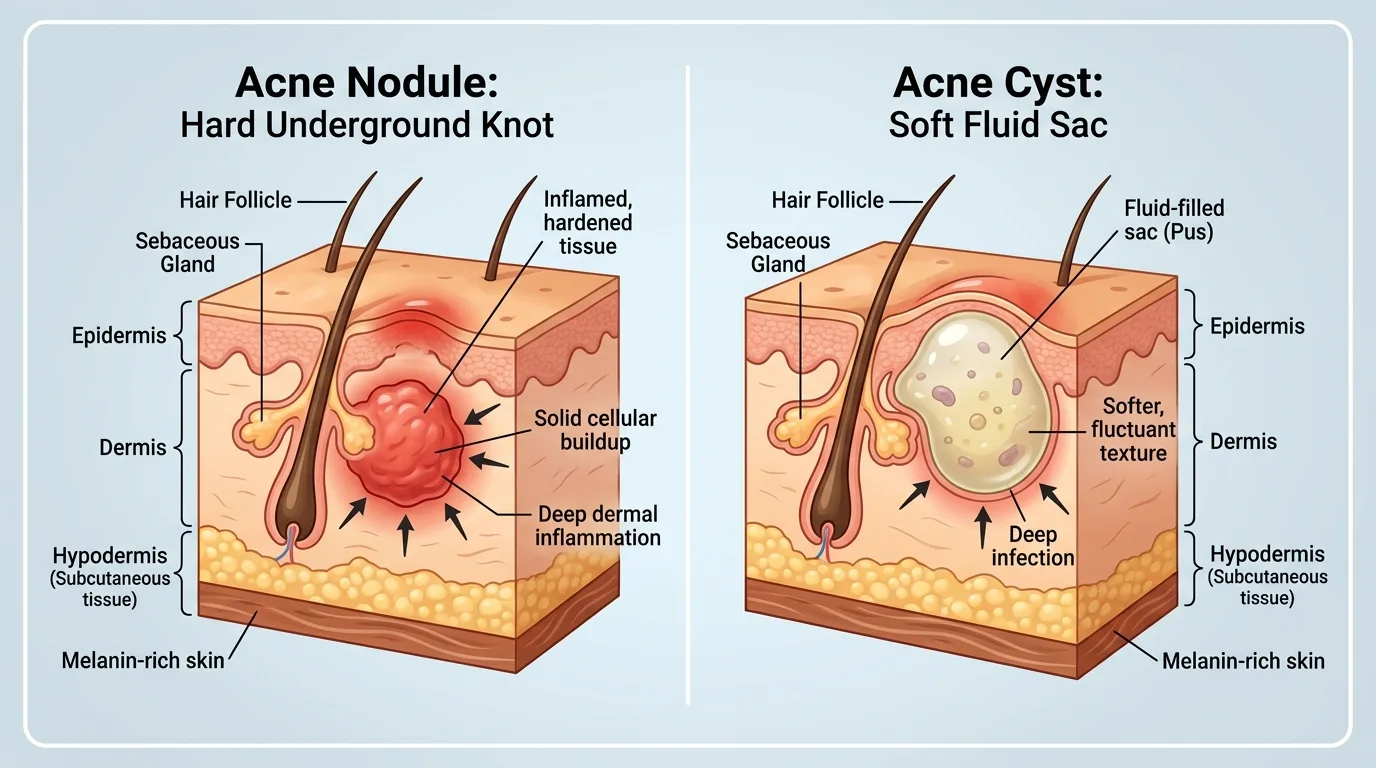
🔴 The Acne Nodule: "The Underground Rock"
How it feels: Hard, firm, and unyielding, like a small uncooked pea or pebble buried under your skin.
What is inside: Solid, swollen inflammatory cells. There is zero liquid pus inside to pop or squeeze out.
Surface appearance: A raised, angry red or purplish dome. It remains completely "blind"—it will never develop a poppable white center.
💧 The Acne Cyst: "The Underground Water Balloon"
How it feels: Softer, squishy, or rubbery. When you gently press the edge, you can feel fluid movement underneath.
What is inside: A true fluid-filled pocket containing pus, sebum, and white blood cells.
Surface appearance: A larger, swollen mound that throbs with continuous dull pressure. It sits deep under the epidermis without a natural exit pore.
What Is Actually Happening Deep Beneath Your Skin?
With surface-level blackheads or whiteheads, pore blockages happen right at the skin's surface. Washing with a salicylic acid cleanser helps dissolve that surface plug.
Nodules and cysts are entirely different. The blockage happens deep at the bottom of the hair follicle canal, near your oil glands. As oil and bacteria multiply, pressure builds until the fragile follicle wall bursts deep inside the dermis (the second, structural layer of your skin):
The Deep Follicle Rupture
Under heavy hormonal stimulation, your sebaceous glands produce thick, sticky oil. Instead of escaping to the surface, the trapped mixture ruptures sideways into the surrounding collagen layer, setting off an emergency alarm.
The Nodule Response: Building a Solid Wall
In a nodule, your immune system reacts by sending waves of defense cells that build a hard, dense fibrotic barrier around the irritated area. This creates a solid knot of swollen tissue. Trying to squeeze it is like squeezing your knuckle—you only crush healthy surrounding capillaries.
The Cyst Response: Forming a Fluid Pocket
In a cyst, your body forms a membrane-lined pocket around the infection. White blood cells pour in to fight bacteria, creating liquefied pus. Because this liquid pocket is sealed millimeters below the surface, squeezing it causes the pocket to burst deeper inside, melting nearby collagen fibers.
Neither nodules nor cysts have an exit canal to the surface. When you squeeze a deep blemish with your fingernails or metal tools, the intense mechanical pressure cannot push the contents outward. Instead, it forces infected fluid sideways into adjoining tissue planes, doubling the size of the breakout and virtually guaranteeing a permanent scar.
Clinical Comparison Matrix: Nodule vs. Cyst
Compare the fundamental differences side by side to choose the safest next step for your skin:
| Feature | Acne Nodule | Acne Cyst |
|---|---|---|
| Common Term | Blind pimple, hard underground bump. | Cystic pimple, underground fluid zit. |
| Feel to the Touch | Solid, firm, knot-like, unyielding. | Softer, squishy, rubbery, fluctuant. |
| Internal Contents | Hardened, inflamed cellular tissue (no pus). | Trapped liquid pus, oil, and cellular fluid. |
| Visible Surface Head? | Never. Completely blind. | Rarely. Deep pocket with no pore opening. |
| Scarring Risk | High risk of stubborn brown marks (PIH). | Extremely high risk of deep, pitted scars (boxcar/ice-pick). |
| Natural Healing Time | 4 to 8 weeks (body slowly absorbs tissue). | 3 to 6 weeks as internal fluid clears. |
| Best Home Comfort | Cold ice compress (shrinks throbbing swelling). | Warm damp compress (encourages blood flow). |
| Best Medical Fix | Oral retinoids, cortisone shot, topical retinoid. | Dilute cortisone injection, oral medications. |
The 24–48 Hour Acute Phase Protocol (How to Shrink It Fast)
The first 24 to 48 hours after you discover a deep, tender bump under your skin determine whether it clears smoothly or leaves a stubborn dark spot or pitted dent. Follow this hour-by-hour protocol to control pain, halt deep swelling, and protect your skin:

Hours 0–12: Calm the Throbbing & Reduce Fluid Pressure
For rock-hard nodules: Wrap an ice cube in a clean washcloth and hold it gently against the bump for 5 to 10 minutes (repeat 2 to 3 times over the day). Cold temperatures immediately constrict dilated blood vessels, cutting down inflammation and numbing the sharp nerve ache.
For soft fluid cysts: Soak a clean cotton towel in warm water and press it to the blemish for 10 minutes. The gentle warmth encourages local circulation, assisting your body's white blood cells in processing the trapped fluid pocket.
Hours 12–24: Shield the Surface & Apply Calming Actives
The Micro-Dart or Hydrocolloid Patch: Apply a blemish patch directly over the bump before bed. If you have access to micro-dart patches with self-dissolving salicylic acid or tea tree tips, they help deliver calming ingredients slightly deeper into the pore opening. More importantly, the patch acts as an impenetrable physical barrier against your fingers.
Barrier Hydration: Apply a thin layer of a ceramide-rich barrier moisturizer around the area. Do not attack the surface skin with drying pastes.
Hours 24–48: The Clinic Fast-Track (When Pain Persists)
If the lump continues to throb, expands in size, or sits in a high-visibility area (like the center of your cheek or chin), do not wait weeks hoping it fades. Book an appointment with a board-certified dermatologist for a diluted cortisone injection.
A single microscopic drop directly into the lesion halts tissue breakdown within 4 to 8 hours and flattens the mound within 24 to 48 hours, saving your skin from permanent collagen loss.
Why Indian Skin Is at Extreme Risk of Scars & Dark Marks
Deep breakouts behave differently on melanin-rich South Asian skin (Fitzpatrick types IV, V, and VI). Two major clinical vulnerabilities require immediate attention:
1. Severe Post-Inflammatory Hyperpigmentation (PIH)
Melanin-producing cells in Indian skin are hyper-reactive. When a deep nodule causes prolonged inflammation in the dermis—or when fingers pinch the skin trying to pop it—melanocytes dump excess pigment into deep dermal layers. This leaves flat, dark purple or brown marks that can take 6 to 12 months to fade.
2. Collagen Destruction & Atrophic Pitted Scars
Inside a deep cyst, white blood cells release inflammatory enzymes (such as collagenase and elastase). These enzymes dissolve the underlying collagen scaffolding of your dermis. Once the swelling finally subsides, the skin has lost its internal foundation, creating sunken ice-pick, boxcar, or rolling scars.
3. The Hormonal Clustering Pattern
In Indian women, deep nodules and cysts routinely cluster along the jawline, chin, and upper neck. This pattern strongly correlates with elevated androgen sensitivity and insulin resistance in conditions like PCOS, which over-stimulate deep oil glands right before menstrual cycles.
4. The Chemical Burn Trap
Because these blemishes hurt, many patients aggressively apply 10% benzoyl peroxide, undiluted tea tree oil, or clove paste multiple times a day. Because the blemish is underground, the active cannot reach it; instead, it causes severe chemical burns on the surface skin, turning the entire patch dark brown.
The "What to Do Tonight" Relief Protocol (Dos & Don'ts)
When you have a painful bump under your skin, what you choose *not* to do tonight matters just as much as what you apply. Follow this doctor-approved routine:

Hard Nodule: Use Cold Ice Therapy
If your bump is rock-hard, red, and throbbing, wrap an ice cube in a clean, soft cloth and hold it against the bump for 5 to 10 minutes. Cold temperature constricts swollen facial capillaries, rapidly taking down the swelling and numbing the sharp nerve ache.
Soft Cyst: Use a Warm Compress
If the bump feels softer, squishy, and fluid-filled, soak a clean washcloth in comfortably warm (not scalding) water and hold it against the area for 10 minutes. Gentle warmth increases local micro-circulation, helping white blood cells process and absorb the trapped fluid.
Wear a Pimple Patch as a Physical Shield
A plain hydrocolloid blemish patch will not pull pus out of an underground blind pimple. However, dermatologists strongly recommend wearing one because it creates a sterile physical barrier that stops your fingers from touching, picking, or unconsciously squeezing the bump.
Ditch the Overnight Multani Mitti Pastes
Avoid slathering thick clay masks, baking soda, or toothpaste over the bump overnight. These dry out your surface skin cells and compromise your protective barrier without ever penetrating into the deep dermis.
Dermatologist Video Guide: Deep Cystic Breakouts Explained
In this video, board-certified dermatologist Dr. Andrea Suarez (Dr Dray) answers patient questions regarding cystic acne, why deep blind blemishes cannot be treated like surface whiteheads, and how doctors safely intervene:
"Cystic acne and nodules originate far below the surface of the skin. Trying to scrub them away or pop them only drives inflammation deeper and breaks down collagen fibers. If you have deep, painful breakouts that keep returning or leave marks, visit a board-certified dermatologist for prescription therapies and in-office cortisone injections that flatten lesions before scarring occurs."
What Dermatologists Do That Surface Creams Cannot
Because nodules and cysts live in the deep dermis, medical treatments prescribed by a dermatologist work where surface cosmetics fail:
💉 Diluted Cortisone Injections (Intralesional Triamcinolone)
How it works: For an urgent, massive, or intensely painful bump, a dermatologist injects a tiny, diluted drop of corticosteroid directly into the center of the lesion.
Timeline: Pain drops within hours; swelling and bump size flatten within 24 to 48 hours. This stops collagen destruction early and prevents a pitted scar.
💊 Oral Isotretinoin (The Gold Standard)
How it works: For recurrent nodulocystic breakouts, oral isotretinoin permanently shrinks overactive oil glands, normalizes cell shedding, and halts deep pore ruptures at the root.
Usage: Taken strictly under dermatologist monitoring with regular liver and lipid blood tests.
⚖️ Hormonal Balancing Medications
How it works: For adult women experiencing deep jawline cysts linked to PCOS or menstrual cycles, doctors prescribe anti-androgens (like Spironolactone) or specific low-androgen oral contraceptives to prevent hormonal surges from triggering deep oil plugs.
✨ Prescription Topical Retinoids
How it works: Actives like Adapalene 0.1% or Tretinoin 0.025% accelerate cellular turnover from within pore linings, stopping micro-comedones before they can rupture into deep dermal nodules.
Frequently Asked Questions
Straightforward answers to the most common questions about distinguishing and managing nodules versus cysts: