
Interactive Pimple Identifier: Find Your Exact Type in 10 Seconds
Before buying another medicated face wash or spot treatment, tap the description that best describes the bump on your face right now to see its medical match and proven pharmacy active:
What does your bump look and feel like?
Tap the card that matches what you see in the mirror.
The 6 Types of Acne on Indian Skin: Visual Guide
Acne forms along a spectrum—from non-inflamed clogged pores to deep, painful subterranean swellings. Look at your skin under natural daylight and compare your bumps to the clinical categories below:
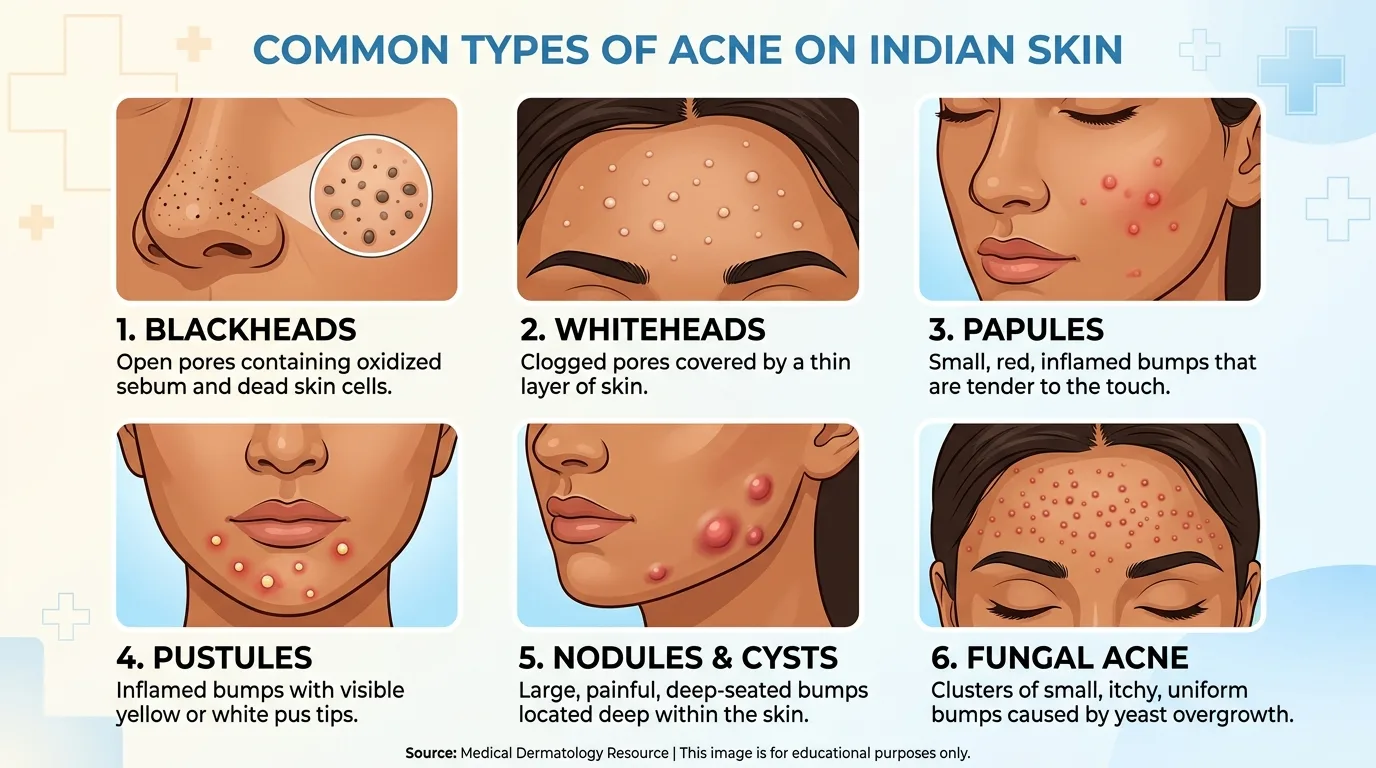
Blackheads
What you see: Tiny dark or black specks across the nose, cheeks, or chin. The pore is open, exposing trapped oil and dead skin to oxygen, which oxidizes it black (not dirt).
Whiteheads
What you see: Small, flesh-colored or whitish closed bumps. The pore opening is sealed by a microscopic layer of dead skin cells, preventing trapped sebum from oxidizing.
Red Tender Bumps (Papules)
What you see: Solid, red or purplish swollen bumps that feel sore when pressed. The pore wall has ruptured slightly beneath the surface, recruiting immune defense cells.
Pustules (Whitehead Pimples)
What you see: A classic pimple: a red, inflamed ring with a visible white or yellowish pool of pus at the very tip. White blood cells have collected at the surface.
Nodules & Cysts
What you see: Large, painful underground mounds. Nodules feel like hard solid knots (no pus); cysts feel squishy or rubbery with trapped fluid deep in the dermis.
Fungal Acne (Folliculitis)
What you see: Dozens of tiny, uniform, itchy bumps clustered on the forehead, hairline, chest, or upper back. Not caused by bacteria, but by Malassezia yeast.
Non-Inflammatory Acne: Blackheads vs. Whiteheads
Non-inflammatory acne (comedones) is the foundation of almost all breakouts. When your sebaceous glands produce excess oil and your skin cells fail to shed cleanly, they glue together inside the pore canal:
Why Blackheads Are NOT Dirt
Many people scrub aggressively with physical face washes believing blackheads are dirt trapped in pores. In reality, a blackhead is wide open to the air. The trapped oil and keratin turn dark purely through oxidation (just like an apple slice turns brown when left on the kitchen counter). Scrubbing only inflames surrounding skin.
Why Whiteheads Cannot Be Squeezed Out Easily
Unlike blackheads, whiteheads have a microscopic ceiling of intact skin covering them. Pinching a closed whitehead with fingernails cannot force the oil plug upward; instead, it ruptures the delicate follicle lining sideways, turning a harmless comedone into an angry red inflammatory papule.
Inflammatory Acne: Papules, Pustules, Nodules & Cysts
When trapped sebum inside a clogged pore becomes an oxygen-free buffet, acne bacteria (Cutibacterium acnes) multiply rapidly. Your immune system responds by sending white blood cells, creating heat, pain, and redness:
An inflammatory papule contains no pus head to extract. Pressing it only crushes surrounding capillaries, triggering a surge of melanin pigment that leaves a flat, dark purple or brown post-acne mark (PIH) that takes up to 12 months to fade on Indian skin. For deep cysts, squeezing fractures structural collagen, causing permanent atrophic pitted scars.
Fungal Acne vs. Bacterial Acne: The Critical Indian Climate Differential
One of the most frequent misdiagnoses in Indian dermatology clinics is mistaking Fungal Acne (Malassezia Folliculitis) for stubborn teenage acne:
The Indian Trigger Storm: Heat, Sweat & Hair Oil
Malassezia yeast feeds on fatty acids in human sebum and heavy plant oils. In hot, humid Indian weather, wearing tight bike helmets, working out at the gym, or practicing traditional scalp hair oiling (coconut or mustard oil champi) creates an ideal breeding ground for yeast overgrowth across the forehead and chest.
Why Antibiotics Make Fungal Acne Worse
If you apply topical antibacterial gels like Clindamycin to fungal acne, the antibiotic wipes out beneficial skin bacteria that keep yeast in check. With no bacterial competition, the yeast explodes into furious, itchy clusters.
The 5-Minute Shampoo Wash Hack
If your forehead bumps are monomorphic (all identical size) and itch when you sweat, switch from acne washes to an over-the-counter 2% Ketoconazole wash (e.g. Scalpe Pro or Nizoral). Lather over your damp forehead, leave on for 3 to 5 minutes to break down fungal cell membranes, and rinse clean twice a week.
Which Acne Active Works for Your Pimple Type?
Match each bump type to its scientifically proven active ingredient before starting a routine:

| Acne Type | Visual & Sensory Clues | Underlying Cause | Proven Active Ingredient | What NEVER to Do |
|---|---|---|---|---|
| Blackheads | Dark oxidized specks, open pore rim, non-tender. | Oxidized oil and dead cell plug inside open pore. | Salicylic Acid 2% (BHA) | Do not use pore vacuum strips (causes capillary damage). |
| Whiteheads | Flesh-colored or white micro-bumps, closed skin. | Trapped sebum covered by thin stratum corneum. | Adapalene 0.1% Gel | Do not pinch with sharp metal extraction tools. |
| Papules | Solid red tender bumps, zero visible pus core. | Early bacterial inflammation (C. acnes). | Benzoyl Peroxide 2.5% Gel | Do not squeeze; leaves dark post-inflammatory marks. |
| Pustules | Red base with visible white/yellow pus center. | Accumulated white blood cells fighting bacteria. | Hydrocolloid Pimple Patch | Do not pop with fingernails; spreads bacteria sideways. |
| Nodules & Cysts | Large, deep, painful underground swollen lumps. | Deep follicular rupture in the dermis. | In-office Cortisone Shot / Oral Retinoids | CRITICAL SCAR RISK: Never attempt to squeeze. |
| Fungal Acne | Uniform, tiny, itchy bumps strictly on forehead/chest. | Malassezia yeast proliferation in hair follicles. | Ketoconazole 2% Antifungal Wash | Do not apply heavy facial oils or topical antibiotics. |
Dermatologist Video Guide: All Types of Acne Explained
In this video, clinical experts break down the visual differences between blackheads, whiteheads, inflammatory pimples, and deep cysts, and why using the wrong treatment can worsen breakouts:
"Treating all pimples the exact same way is the number one reason acne persists. Comedonal acne needs chemical exfoliation to unclog pore linings. Inflammatory acne needs antibacterial and soothing agents. Deep cysts require medical attention, and fungal breakouts need antifungals rather than acne acids."
Indian Skin Vulnerability: Stopping Post-Acne Dark Marks (PIH)
On melanin-rich South Asian skin (Fitzpatrick types IV to VI), every inflamed pimple triggers a secondary reaction from pigment-producing melanocyte cells. To stop dark marks before they form:
Follow the Hands-Off Rule
Physical friction, pressing, or picking multiplies melanin production tenfold. Cover inflamed bumps with a hydrocolloid patch to keep fingers away.
Introduce Azelaic Acid 15% Early
Azelaic acid is a dermatologist favorite for Indian skin because it selectively inhibits tyrosinase (the enzyme that produces melanin) while calming active acne inflammation simultaneously.
Daily Broad-Spectrum Sunscreen
Ultraviolet rays darken fresh post-acne marks instantly. Wear a non-comedogenic SPF 50 sunscreen daily to prevent marks from turning dark brown.
Frequently Asked Questions
Direct answers to common questions about identifying and treating different pimple types: