The core clinical difference between Salicylic Acid and Glycolic Acid comes down to chemical solubility. Salicylic Acid is a Beta Hydroxy Acid (BHA) that is oil-soluble, allowing it to pass through sebum to deep inside pore linings. Glycolic Acid is an Alpha Hydroxy Acid (AHA) that is water-soluble, working exclusively on the skin surface to break desmosome bonds between dead skin cells.
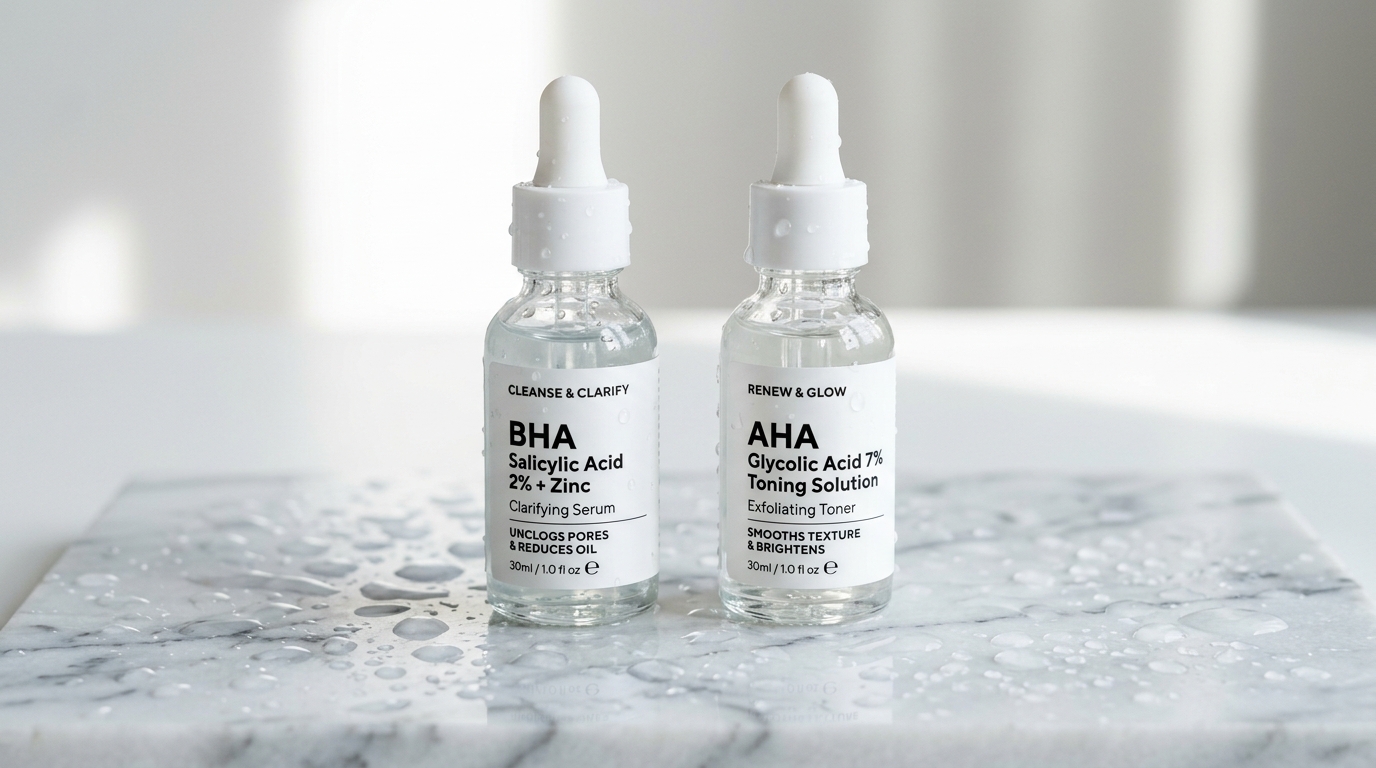
| Feature | Salicylic Acid (BHA) | Glycolic Acid (AHA) |
|---|---|---|
| Solubility | Oil-Soluble (Penetrates pores) | Water-Soluble (Surface action) |
| Primary Target | Blackheads, whiteheads, active pustules, oily T-zone | Post-acne dark marks (PIH), dullness, uneven texture |
| Anti-Inflammatory? | Yes (Calms red swollen pimples) | No (Pure exfoliation) |
| Standard Concentration | 1% – 2% in washes & serums | 5% – 10% in toners & creams |
| Best Indian Products | Saslic DS Wash, Minimalist 2% Salicylic | Glyco-6 / Glyco-12 Cream, Minimalist 8% AHA Toner |
Active Breakouts & Blackheads
If your primary skin issue is active pus pimples, oily congestion, or stubborn nose blackheads, Salicylic acid 2% is the essential active for clearing the pore lining.
Anti-Inflammatory Relief
Salicylic acid is structurally related to aspirin (salicylate), giving it natural anti-inflammatory properties that reduce swelling and redness around painful inflamed lesions.
Fading Post-Acne Dark Marks (PIH)
Glycolic acid has the smallest molecular size among AHAs, allowing it to rapidly break down stratum corneum bonds to shed hyperpigmented skin cells and reveal fresh, even skin.
Glyco-6 & Glyco-12 in India
Pharmacy favorites like Glyco-6 Cream (~₹220) are widely prescribed in India for targeted night-time application on stubborn dark spots and rough texture.
Combining both acids gives comprehensive pore + surface clearance, but doing so recklessly will disrupt your moisture barrier:
• Option A (Time-Split): Use a Salicylic acid wash (BHA) in the AM, and Glycolic acid toner/cream (AHA) 2 nights a week.
• Option B (Formulated Blends): Use a pre-formulated AHA 10% + BHA 2% chemical peel solution (e.g. Minimalist / The Ordinary peel) once every 10–14 days.