The most common mistake Indian consumers make is confusing acne marks with acne scars. An acne mark is an epidermal discolouration with zero texture change. An acne scar involves actual dermal collagen destruction or fibrous tethering that distorts the skin's surface geometry.
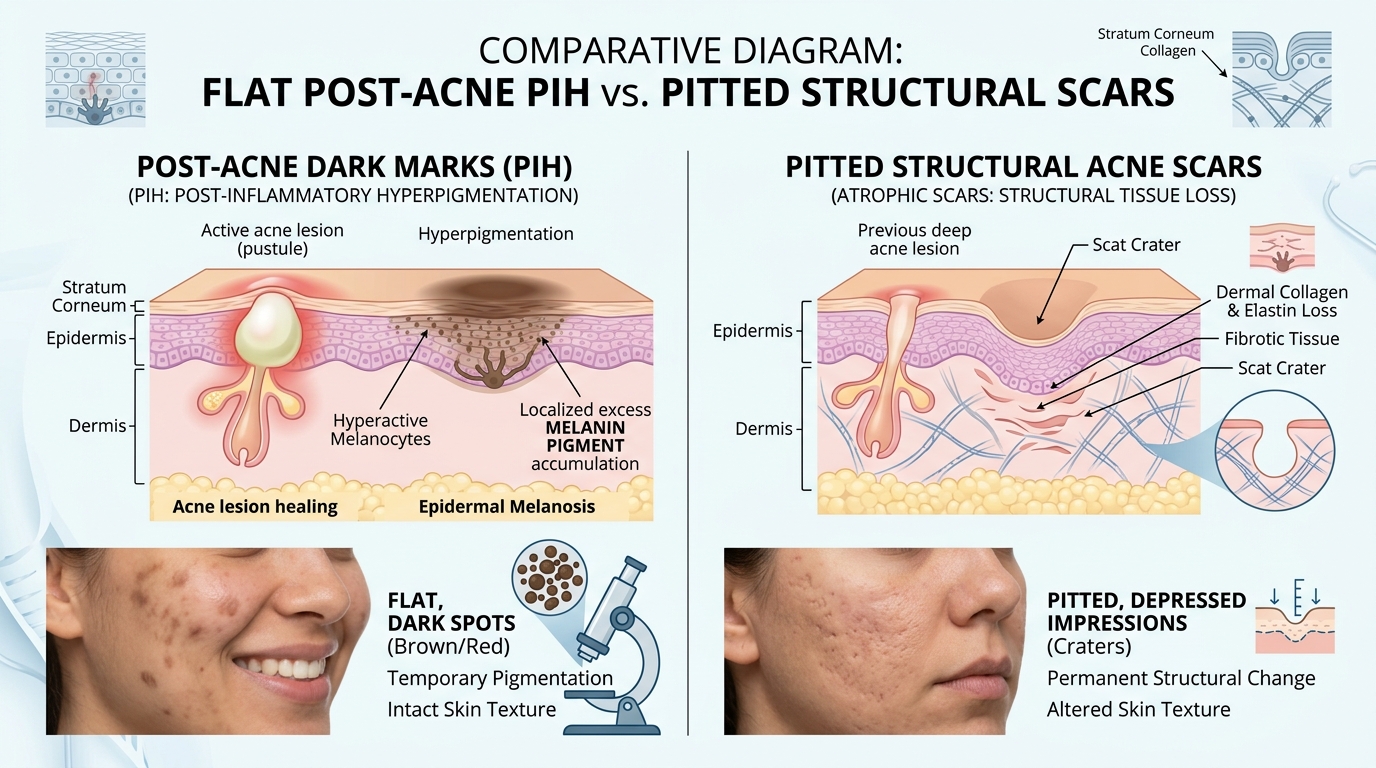
| Feature | Acne Marks (Discolouration) | Acne Scars (Structural) |
|---|---|---|
| Skin Surface Texture | Completely Smooth / Flat | Pitted, Indented, or Raised Craters |
| Underlying Pathology | Epidermal melanin buildup (PIH) or capillary dilation (PIE) | Dermal collagen fiber damage & loss (Atrophic) |
| Touch & Feel Test | Cannot feel when running finger over skin | Can feel visible dips, holes, or dips under lighting |
| Do Topicals Work? | YES (Serums, Creams, Azelaic, Kojic) | NO (Requires clinical procedures) |
| Gold Standard Solution | Azelaic Acid 15% + Niacinamide + SPF 50 | Microneedling / TCA CROSS / Subcision / Pico Laser |
PIH (Post-Inflammatory Hyperpigmentation)
Melanin deposits left behind after acne inflammation resolves. Highly responsive to topical tyrosinase inhibitors like Azelaic Acid, Kojic Acid, and Niacinamide.
PIE (Post-Inflammatory Erythema)
Damaged or dilated micro-capillaries near the skin surface. Does NOT respond to melanin fading creams; requires barrier repair (Centella, Niacinamide) or vascular lasers.
Ice-Pick Scars
Deep, narrow V-shaped pores extending into the deep dermis. Best treated with 50–100% TCA CROSS focal application.
Boxcar & Rolling Scars
U-shaped boxcar scars and wave-like rolling scars tethered by fibrous bands. Require Subcision + Microneedling RF / Fractional lasers.
• If your skin feels SMOOTH when you close your eyes and run your fingertips over it ➔ You have ACNE MARKS. Use topical serums (Azelaic acid, Niacinamide, Retinol).
• If your skin feels UNEVEN / PITTED ➔ You have STRUCTURAL SCARS. Consult a dermatologist for in-clinic dermal collagen procedures.