In outpatient dermatology clinics across North and Central India, patients presenting with chronic inflammatory acne or deep mandibular cysts frequently present with a severely disrupted stratum corneum. In routine clinical practice, young adults attempting to eliminate stubborn jawline nodules inadvertently accelerate cutaneous barrier failure by overusing caustic household remedies. Patients present with localized erythema and superficial crusting after applying crushed garlic, clove oil, or raw tea tree oil directly over closed comedones. These home remedies induce acute irritant contact dermatitis, exacerbating follicular edema and precipitating deep, disfiguring post-inflammatory hyperpigmentation across Fitzpatrick skin phototypes III through VI.
Under tropical Indian weather conditions, ambient heat and relative humidity stimulate high levels of sebaceous lipogenesis. Microscopic airborne particulate matter and vehicular exhaust settle onto facial sebum, oxidizing squalene into comedogenic squalene hydroperoxides. The follicular infundibulum becomes hyperkeratotic, obstructing the pore orifice. Deprived of oxygen, Cutibacterium acnes multiplies rapidly inside the lipid-rich follicular lumen, releasing chemotactic factors that recruit neutrophils and trigger painful, indurated dermal nodules that resist conventional washing.
When comedonal hyperkeratosis and bacterial proliferation fail to resolve with gentle salicylic acid washes, dermatologists prescribe fixed-dose combination therapy combining adapalene with benzoyl peroxide. This pharmaceutical pairing forms the therapeutic benchmark across international clinical acne consensus guidelines. By coupling the desquamative receptor-mediated activity of a third-generation retinoid with the non-specific oxidizing power of an organic peroxide, combination therapy accelerates inflammatory lesion reduction far beyond monotherapy.
However, successful clinical outcomes depend entirely on strict adherence to barrier preservation protocols. Because both active compounds alter stratum corneum moisture dynamics, improper application or premature dosage escalation frequently induces severe retinization dermatitis, diffuse desquamation, and facial erythema. Understanding the cellular pharmacodynamics of these agents allows patients to navigate therapy safely while safeguarding cutaneous barrier integrity.
The clinical efficacy of fixed-dose adapalene and benzoyl peroxide relies upon the non-overlapping biochemical mechanisms of a synthetic naphthoic acid derivative and an organic lipophilic peroxide.
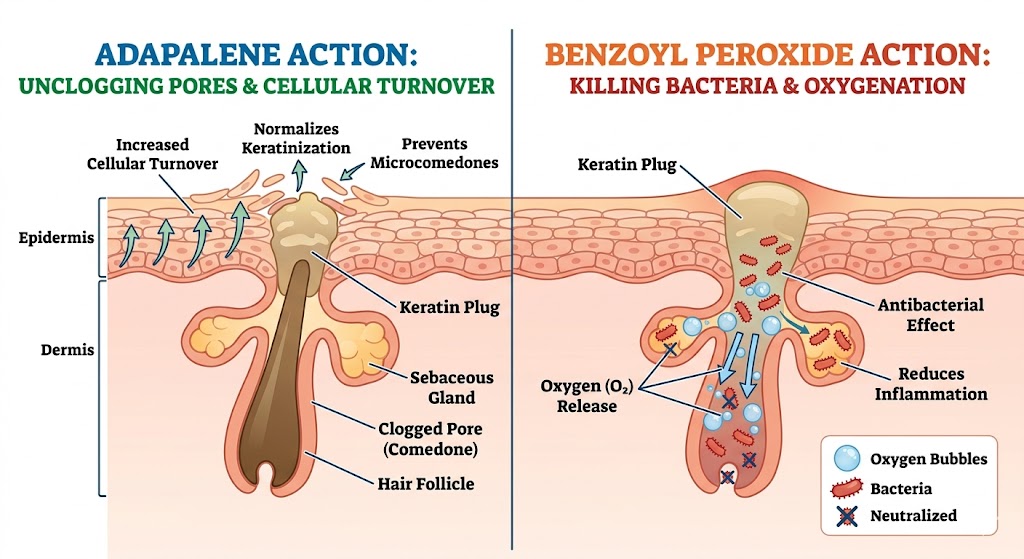
Adapalene is a third-generation synthetic retinoid engineered to display selective affinity toward nuclear retinoic acid receptor subtypes beta and gamma (RAR-beta and RAR-gamma) within human follicular keratinocytes. In healthy pilosebaceous units, keratinocytes desquamate continuously through normal proteolysis of corneodesmosomes. In acne pathology, abnormal retention hyperkeratosis blocks the follicular lumen, creating cohesive microcomedones. By binding to RAR-beta and RAR-gamma transcription factors, adapalene modulates cellular differentiation, downregulates transglutaminase expression, and restores normal desquamation within the infundibulum. This action empties impacted keratin plugs and maintains patent follicular channels. Adapalene also displays intrinsic anti-inflammatory properties by downregulating 15-lipoxygenase and inhibiting the oxidative metabolism of arachidonic acid within human polymorphonuclear neutrophils.
Benzoyl peroxide acts as a lipophilic antimicrobial oxidizer. Upon topical application, the lipophilic vehicle partitions rapidly into sebum-rich sebaceous ducts where benzoyl peroxide undergoes homolytic cleavage to generate benzoic acid and highly reactive free radical species, predominantly singlet oxygen and hydroxyl free radicals. These free radicals induce non-specific oxidative peroxidation of polyunsaturated fatty acids within the bacterial cell membrane of Cutibacterium acnes. Because bacterial death results from physical membrane lysis rather than inhibition of metabolic enzymes or ribosomal subunits, Cutibacterium acnes cannot develop plasmid-mediated or chromosomal resistance.
In Indian retail pharmacies, dermatologists prescribe three primary commercial formulations of fixed-dose adapalene (0.1%) and benzoyl peroxide (2.5%). Each formulation utilizes distinct excipient vehicles and drug-delivery technologies that influence skin tolerability and trans-epidermal penetration:
1. Epiduo (Galderma India)
The Reference Innovator: Epiduo 0.1% / 2.5% is the global reference aqueous gel manufactured by Galderma. Formulated in a clean propylene glycol vehicle, it delivers rapid epidermal drug flux with dependable bioavailability across both non-inflammatory comedones and inflammatory papules.
Epiduo Forte (0.3% / 2.5%): For severe nodular or recalcitrant trunk acne, clinicians prescribe Epiduo Forte, featuring triple the concentration of adapalene for aggressive desquamation.
Approximate Price: ₹950 – ₹1,300 (15g / 30g)
2. Deriva BPO (Glenmark Pharmaceuticals)
Porous Microsphere Delivery: Glenmark’s Deriva BPO incorporates adapalene entrapped within microscopic, porous polymer spheres. These microscopic sponges hold the synthetic retinoid in reservoir, releasing active molecules gradually over twelve hours rather than flooding the epidermis upon application.
Clinical Indication: This sustained-release kinetic curve substantially flattens peak trans-epidermal irritation, making Deriva BPO the preferred prescription for sensitive Indian phototypes III through V.
Approximate Price: ₹620 – ₹780 (15g)
3. Peroduo (Ajanta Pharma)
Hydrous Aqueous Emulsion: Ajanta Pharma’s Peroduo utilizes hydrous benzoyl peroxide suspended in an aqueous vehicle. The bound water molecules buffer the oxidizing active, minimizing localized crystal agglomeration that causes coarse graininess and flaking on dry skin.
Value Profile: Peroduo offers full pharmaceutical bioequivalence and reliable therapeutic clearance at an accessible price point for long-term multi-month maintenance protocols.
Approximate Price: ₹380 – ₹480 (15g)
| Brand Name | Manufacturer | Adapalene Format | BPO Format | Irritation Index | Approx. Price |
|---|---|---|---|---|---|
| Epiduo Gel | Galderma | 0.1% Standard Aqueous | 2.5% Micro-milled | Moderate | ₹950 – ₹1,250 |
| Deriva BPO | Glenmark | 0.1% Porous Microsphere | 2.5% Gel | Low (Slow Release) | ₹620 – ₹780 |
| Peroduo | Ajanta Pharma | 0.1% Aqueous | 2.5% Hydrous Vehicle | Moderate-Low | ₹380 – ₹480 |
In clinical practice, certain individuals exhibit heightened sensitivity to leave-on oxidizing peroxides. When combining both actives in a single leave-on film triggers sustained stinging, dermatologists frequently recommend an AM/PM split strategy using short-contact therapy.
Short-Contact Morning Protocol
In the morning routine, replace leave-on benzoyl peroxide with an over-the-counter 2.5% or 4% benzoyl peroxide wash (such as Benzac AC 2.5% or Perobar 2.5%). Massage the foaming emulsion onto damp facial skin and allow it to dwell for exactly two minutes. This dwell time allows the lipophilic peroxide to penetrate follicular funnels and eradicate superficial Cutibacterium acnes colonies. Rinse thoroughly with cool water.
By rinsing the surfactant away after two minutes, you eliminate prolonged diurnal lipid peroxidation while achieving over 90% of the antimicrobial benefit. In the evening, apply standalone adapalene 0.1% gel (such as Adaferin or Deriva MS) over well-moisturized skin. This split protocol prevents excessive cumulative irritation while preserving the distinct desquamative and antibacterial advantages of both medications.
Applying prescription adapalene and benzoyl peroxide gel requires meticulous technique. The stratum corneum must be properly conditioned to prevent sudden trans-epidermal drug spikes that precipitate chemical erythema.
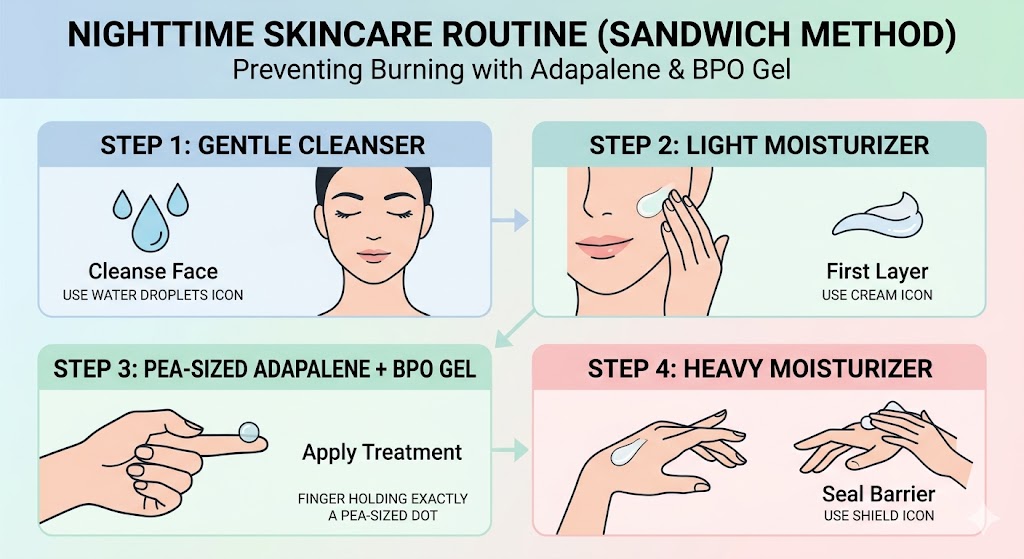
- Step 1: Gentle Cleansing & Complete Evaporation. Wash the face with a mild, fragrance-free syndet cleanser. Gently pat dry with a clean cotton towel. Wait a full ten minutes before proceeding. Applying topical retinoids to damp skin significantly enhances stratum corneum permeability, allowing rapid solvent penetration that causes acute burning.
- Step 2: Barrier Pre-Buffer (Base). Smooth a thin layer of a physiological ceramide moisturizer containing ceramides NP, cholesterol, and free fatty acids over the entire face. This initial lipid coat buffers exposed epidermal nerve endings without impeding drug diffusion into follicular infundibula.
- Step 3: The Exact Pea-Sized Allotment. Dispense a single 5mm pea-sized sphere of gel onto your index fingertip. Dot this exact amount across the forehead, both cheeks, chin, and nose. Distribute the gel in a feather-light film across the entire facial field. Avoid spot-treating solitary pustules, as adapalene works preventatively by clearing precursor microcomedones across the entire skin surface.
- Step 4: Protect the Three Danger Zones. Strictly avoid applying the formulation within 1 centimeter of the oral commissures (lip corners), the periorbital sulcus (eye contours), and the alar nasolabial creases. In these anatomical transition zones, the stratum corneum is fragile and prone to agonizing fissures.
- Step 5: Stepwise Frequency Titration.
- Weeks 1 and 2: Apply twice weekly on non-consecutive evenings (e.g., Monday and Thursday).
- Weeks 3 and 4: Increase application to alternate nights (every 48 hours).
- Month 2 onward: Transition to nightly application only if the skin exhibits zero persistent desquamation, stinging, or redness.
During the initial four weeks of fixed-dose combination therapy, the stratum corneum undergoes accelerated cell turnover. In outpatient dermatology follow-ups, distinguishing between expected retinization and true type-IV contact allergy requires evaluating three physical parameters:
First, evaluate anatomical distribution. A physiological retinization purge occurs exclusively in facial zones where subclinical microcomedones previously resided, predominantly the mandibular margin, chin, and central cheeks. In contrast, allergic contact dermatitis to benzoyl peroxide produces diffuse, confluent erythema that spreads beyond application borders, routinely involving the thin periorbital sulcus and anterior neck.
Second, assess sensory morphology. Normal retinoid desquamation presents with superficial scaling, localized tightness, and transient thermal tingling lasting less than ten minutes following application. Conversely, allergic contact sensitization provokes severe, unremitting pruritus, cutaneous edema, and micro-vesicular weeping.
Third, monitor progression timelines. Microcomedonal purges emerge between days fourteen and twenty-eight as impacted keratin plugs are expelled, resolving fully by week eight. Allergic hypersensitivity develops within forty-eight hours of re-exposure. If facial swelling, periorbital edema, or intense itching manifests, patients must immediately wash the face with cool water and suspend therapy.
Before dispensing your first pea-sized dose of prescription adapalene and benzoyl peroxide, dermatologists advise a strict three-step regimen audit:
First, inspect all concurrent topical bottles on your bathroom counter. Look for ascorbic acid, glycolic acid, lactic acid, or salicylic acid listed in the top six ingredients. Because benzoyl peroxide rapidly oxidizes ascorbic acid and chemical exfoliants compromise stratum corneum integrity, set these active bottles aside. The only concurrent active clinically documented to synergize safely is niacinamide at two to five percent, which stimulates endogenous ceramide synthesis.
Second, inspect your morning photoprotection. Verify that your daily sunscreen provides broad-spectrum defense with an SPF rating of 50 and PA++++ protection. Because adapalene compacts the outer stratum corneum, ultraviolet radiation easily stimulates melanocyte hyperactivity across Fitzpatrick skin phototypes III through VI, inducing post-inflammatory hyperpigmentation.
Third, audit your contact surfaces and ambient storage. Benzoyl peroxide cleaves synthetic azo dye bonds in colored cotton, causing permanent fabric discoloration. Switch to plain white pillowcases and white face towels. Store the pharmaceutical tube inside an interior bedroom drawer below twenty-five degrees Celsius, keeping the cap fastened tightly to protect the peroxide emulsion from ambient thermal degradation.
Why does benzoyl peroxide continue working without developing bacterial resistance?
Topical benzoyl peroxide operates through immediate physical oxidation rather than biological pathway interference. Inside the follicular canal, peroxide bonds dissociate rapidly upon lipid contact, releasing high concentrations of singlet oxygen and hydroxyl free radicals. These reactive oxygen species destabilize the unsaturated lipid envelopes of Cutibacterium acnes, causing irreversible cell membrane rupture within forty-eight hours. Because this bactericidal clearance is purely structural, microbial colonies cannot evolve defensive counter-measures or transmit plasmid-based tolerance, allowing the compound to retain consistent clinical potency through years of maintenance therapy.
Why does applying a combination retinoid to damp skin cause sudden facial erythema?
Following facial cleansing with tap water, corneocyte keratin absorbs water molecules, expanding intercellular lipid spaces and opening transit pathways across the stratum corneum. Applying a lipophilic formulation over this temporarily hydrated surface provokes a rapid trans-epidermal flux of both adapalene and benzoyl peroxide. This steep concentration spike stimulates unmyelinated epidermal C-nerve fibers, provoking acute burning sensations, focal edema, and visible erythema. Allowing the skin to dry completely for ten minutes restores normal intercellular lipid packing, establishing an effective diffusion buffer.
How do porous polymer microspheres in Glenmark Deriva BPO reduce desquamation?
Deriva BPO suspends micronized adapalene within insoluble cross-linked polymer microspheres measuring between ten and twenty-five micrometers in diameter. These microscopic porous particles cannot penetrate through the stratum corneum into living epidermal layers. Instead, they remain on the cutaneous surface, releasing dissolved retinoid along a sustained, linear kinetic curve across twelve hours. This controlled delivery flattens peak trans-epidermal drug spikes, preserving deep follicular comedolysis while reducing visible peeling and cutaneous erythema by roughly forty percent.
Why does benzoyl peroxide bleach dyed fabrics while leaving melanin pigment unaffected?
Commercial fabric dyes rely on synthetic azo compounds and aromatic rings with reactive double bonds that peroxide radicals cleave on contact. In contrast, epidermal melanin in human skin is synthesized within melanocytes, sequestered inside protective melanosomes, and shielded by stratified layers of mature keratinocytes. Benzoyl peroxide cannot degrade these dense insoluble eumelanin polymers, meaning it will strip chemical dyes from colored cotton pillowcases without altering your baseline skin tone.