
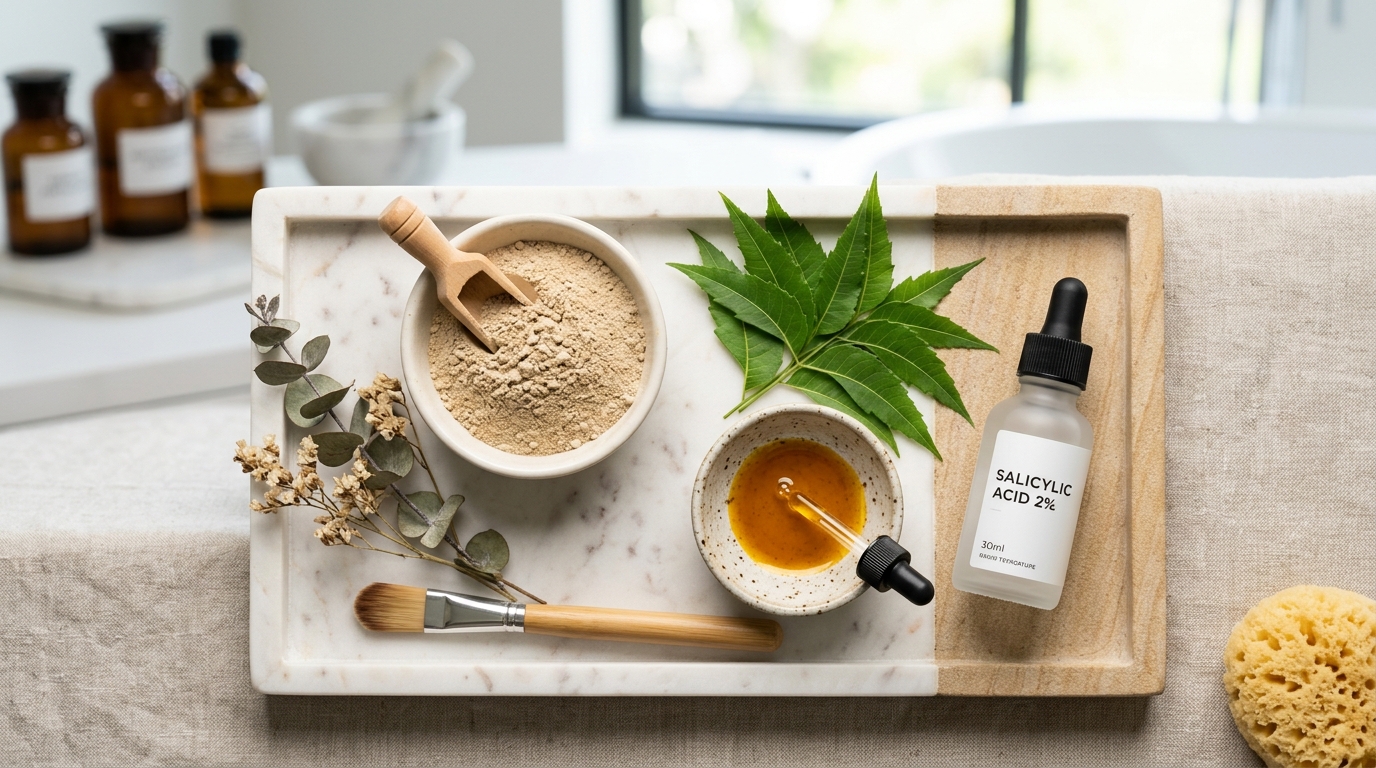
1. The Truth About Homemade Face Packs for Acne
When an angry red pimple pops up right before an event, your first instinct is often to raid the kitchen cabinet for Multani Mitti, turmeric, or honey. But can a homemade face pack truly clear acne?
Homemade face packs can temporarily absorb midday surface oil, calm superficial redness, and soften rough skin, but they cannot cure deep inflammatory acne or cystic bumps[1]. Clays like Multani Mitti (Fuller's Earth) and colloidal oatmeal work solely on the top stratum corneum layer of skin to sop up excess sebum[1]. However, they lack the molecular ability to penetrate deep into oil glands to unclog hardened dead skin cells or eradicate acne bacteria[9]. Homemade face packs should be treated as gentle soothing supplements—never left on past 8 to 10 minutes—while chronic blackheads, inflamed papules, and deep hormonal breakouts require clinically proven pharmacy topicals like Salicylic Acid or Adapalene[5][9].
A homemade mask can feel wonderfully cooling on an oily, overheated face. But using the wrong ingredients—or leaving a clay mask on until it dries rock-hard and cracks—can do far more damage than good, stripping your skin barrier and leaving long-lasting dark spots.
2. How Face Packs Work: 3 Simple Rules to Know
Before applying anything from your pantry to your breakouts, here are three simple analogies dermatologists use to explain how your skin behaves:
The "Kitchen Sponge" Rule (The 8-Minute Moisture Limit)
Multani Mitti and bentonite clay behave like a damp kitchen sponge. When lightly moist, the sponge easily wipes away grease and oil from a countertop. But if you press a dry, dehydrated sponge against wet paper, it violently pulls all the moisture right out of the paper. Leaving clay on your face until it turns chalky, tight, and cracked sucks essential water out of your skin cells, causing acute barrier irritation and rebound oiliness[1].
The "Hot Chili" Rule (Why Kitchen Acids Burn)
Raw lemon juice, undiluted apple cider vinegar, and pure tea tree oil act just like spicy chili on an open scrape. Many people assume a sharp sting means the pimple is "drying up." In reality, that stinging sensation is a chemical burn destroying your skin's protective acid mantle[7]. On melanin-rich Indian skin, chemical irritation causes pigment cells to hyper-produce melanin, leaving dark brown spots that take up to a year to fade[6].
Surface Polish vs. Drain Cleaner (DIY vs. Pharmacy)
A homemade face pack is like washing a dirty window—it removes surface dust and grime so your face looks fresh and matte. But an acne pimple starts 3 millimeters deep inside your pore duct like a clogged pipe. A surface mask cannot dissolve that underground plug. To clear the drain, you need pore-penetrating pharmacy keratolytics like Salicylic Acid or Benzoyl Peroxide[5][9].
3. 5 Dermatologist-Approved Homemade Face Packs
If you want to use natural home ingredients safely without irritating active breakouts, these 5 tested recipes use gentle, non-irritating kitchen staples:
1. Multani Mitti & Pure Rosewater Mask
Best For: Very oily skin, greasy afternoon shine, and congested T-zones.
- Mix the clay and rosewater in a clean glass or ceramic bowl until it forms a smooth, creamy paste.
- Smooth an even layer over your oily zones (forehead, nose, and chin). Avoid the sensitive skin around your eyes and lips.
- Set a timer for 8 minutes. Rinse with cool tap water while the mask is still slightly damp and pliable. Do not wait for it to crack.
- Pat dry and immediately apply a light, oil-free moisturizer.
2. Raw Forest Honey & Chilled Green Tea Pack
Best For: Red, throbbing, inflamed pimples that feel tender to the touch.
- Brew a cup of plain green tea and allow it to cool completely in the refrigerator.
- Stir 1 tablespoon of cooled green tea with 1 tablespoon of raw organic honey until well blended.
- Gently spread the mixture over your face using clean fingertips. Raw honey provides natural antimicrobial hydration while green tea polyphenols soothe swelling[2][3].
- Leave on for 12 to 15 minutes, then rinse gently with lukewarm water.
3. Colloidal Oatmeal & Fresh Curd (Dahi) Buffer
Best For: Dry, sensitive, irritated skin, or flaking from acne creams (like retinoids or benzoyl peroxide).
- Grind rolled oats into a silky fine powder in a clean blender, or buy pure colloidal oatmeal powder.
- Whisk together with fresh, unflavored curd to form a comforting creamy paste. Curd provides gentle lactic moisture while oat beta-glucan calms itching and restores barrier resilience[4].
- Smooth over irritated areas and leave on for 10 to 12 minutes.
- Rinse gently with cool water without scrubbing or tugging your skin.
4. Pure Aloe Vera Gel & Diluted Tea Tree (1-Drop Rule)
Best For: Small cluster pimples and localized oily pustules.
- Spoon 1 tablespoon of clear, fragrance-free aloe vera gel into a small glass dish.
- Add exactly one single drop of pure tea tree essential oil. Mix thoroughly for 30 seconds until the oil is completely dispersed into the gel.
- Dab a thin layer directly onto pimple clusters to suppress blemish bacteria safely without causing peeling or skin damage[5]. Never apply across your entire face or near the eyes.
- Leave on for 10 minutes, then wash off with cool water.
5. Micronized Neem & Kasturi Turmeric Paste
Best For: Superficial post-acne blemishes and lingering surface bacteria.
- Combine the neem leaf powder with a pinch of Kasturi Manjal (wild cosmetic turmeric).
- Slowly add clean room-temperature water until a spreadable paste forms.
- Apply thinly across blemish-prone areas. Neem provides natural antibacterial action while wild cosmetic turmeric calms post-acne redness without staining skin yellow[3].
- Rinse off after 8 to 10 minutes with plain water.
4. Kitchen Hazard Alert: 5 DIYs That Wreck Your Skin
Dermatology clinics across India regularly treat severe skin irritation, chemical burns, and deep pigmentation caused by viral home remedies. If you see these recommended online, keep them far away from your face:
🍋 Raw Lemon Juice
Lemon juice is extremely acidic (pH 2.0). It burns your protective acid mantle and contains psoralen compounds that react under sunlight (phytophotodermatitis), causing dark brown patches that last for months[6].
🧂 Baking Soda (Meetha Soda)
Baking soda is a harsh alkali (pH 9.0). It neutralizes your skin's natural acidic defense, stripping protective lipids and leaving skin raw, stinging, and open to severe bacterial invasion[7].
🧄 Crushed Raw Garlic Cloves
Garlic contains concentrated allicin and diallyl disulfide oils. Rubbing raw crushed garlic onto pimples causes acute chemical blistering, severe burning pain, and permanent pitted scars[8].
🪥 Fluoride Toothpaste
Toothpaste contains foaming agents (SLS), strong menthol, and abrasive calcium. Dabbed onto a pimple, it triggers intense contact redness, skin flaking, and painful burning[7].
🍎 Undiluted Apple Cider Vinegar
Raw ACV contains harsh acetic acid. Applying it directly to broken pimples dissolves living skin tissue, creating chemical scabs that heal into dark hyperpigmentation[6].
5. Interactive Tool & 4-Step Visual Application Protocol
Applying a homemade face pack safely requires following strict contact timing to prevent dehydration and barrier burns. Review the visual steps below, then use the interactive matcher to select your custom recipe:

Find Your Personalized Home Pack Recipe
Customized for Indian skin types (Fitzpatrick IV–VI) to prevent barrier irritation.
🥣 Multani Mitti & Rosewater
Mix 1 tablespoon of Multani Mitti with pure rosewater into a smooth paste. Apply exclusively to oily zones and wash off while still damp.
6. Realistic Comparison: Home Packs vs. Pharmacy Topicals
Knowing what homemade packs can and cannot do saves you months of wasted time and frustration. Here is how home ingredients compare to pharmacy-grade acne treatments:
| Treatment | How It Works | Pore Penetration | Best For | Average Cost (India) |
|---|---|---|---|---|
| Multani Mitti Clay | Physically soaks up surface grease | 0.0 mm (Surface only) | Excess midday shine & surface oil | ₹50 – ₹120 |
| Raw Honey & Green Tea | Calms swelling & provides mild antimicrobial moisture | < 0.1 mm (Epidermal surface) | Red, angry surface pimples | ₹100 – ₹200 |
| Sebogel (Salicylic Acid 2% + Niacinamide 6%) | Oil-soluble BHA dissolves deep sebum plugs inside pores | 0.5 mm (Deep follicular pore duct) | Blackheads, whiteheads & clogged pores | ₹290 – ₹340 |
| Perobar 2.5% Soap | Releases oxygen inside pores to wipe out acne bacteria | Deep follicular canal | Inflammatory pimples & back/chest acne | ₹140 – ₹195 |
| Deriva-MS (Adapalene 0.1%) | Retinoid that stops microcomedones from forming | Cellular level pore regulation | Chronic hormonal acne & comedones | ₹280 – ₹380 |
Clinical Bottom Line: If you suffer from deep hormonal bumps, stubborn blackheads, or cystic acne, homemade face packs will not clear them. Transitioning to a gentle, dermatologist-vetted pharmacy active like 2% Salicylic acid or Benzoyl peroxide will yield noticeable results without skin-damaging trial and error.
7. Dermatologist Video Masterclass
Watch board-certified dermatologists explain the real science behind home remedies, clay masks, and avoiding common skincare mistakes:
Home Remedies That Harm Skin
Dr. Aanchal Panth MD outlines why lemon, garlic, and over-drying clay masks damage brown skin barriers and create long-term dark spots.
Bentonite Clay Mask Review
Dr. Dray breaks down how clay masks absorb oil, why mixing them with raw vinegar causes burns, and how to prevent barrier dehydration.
Medically Reviewed by Dr. Lipy Mehta, MD
Dr. Lipy Mehta is a board-certified dermatologist with extensive clinical experience treating acne vulgaris, post-inflammatory hyperpigmentation (PIH), and barrier dermatitis in Indian skin. This guide reflects verified clinical protocols for safe domestic skincare.
8. Frequently Asked Questions
No. Homemade face packs work only on the skin's surface to absorb midday grease or calm light redness. Deep, painful hormonal acne cysts originate several millimeters under your skin within blocked oil glands. Natural clays cannot reach this depth or unclog hardened sebum plugs. Cysts require clinical topical keratolytics like Adapalene or doctor-prescribed oral treatments.
Raw lemon juice is intensely acidic with a pH of 2.0, which chemically scorches your protective skin barrier. It also contains compounds called psoralens that react aggressively under sunlight (phytophotodermatitis). On Indian skin (Fitzpatrick IV–VI), this chemical burn triggers heavy melanin production, leaving stubborn dark brown or grey marks that linger for months.
Wash it off after 8 to 10 minutes while it is still soft and pliable. Letting clay dry completely until it cracks into a tight, powdery mask pulls healthy water out of your living skin cells. This sudden dehydration damages your moisture barrier and triggers your oil glands to pump out even more grease.
Limit clay face packs like Multani Mitti to once a week for combination skin, and up to twice a week for very oily skin. Using clay masks daily strips healthy skin lipids, leaving your barrier dry, tight, and vulnerable to more breakouts.
Avoid packaged kitchen cooking turmeric. Grocery store haldi often contains added food colorings, starches, or spice dust that clog pores and leave a stubborn bright yellow stain. If you want the soothing benefits of turmeric, use cosmetic wild turmeric known as Kasturi Manjal (Curcuma aromatica), which calms inflammation without yellowing your face.
Gently pat your face with a clean towel while skin is still slightly damp, and immediately apply a soothing, non-comedogenic ceramide moisturizer. If you applied the pack in the morning or are heading outdoors, follow with broad-spectrum SPF 50 sunscreen to shield fresh skin from sun damage.
9. Clinical References & Medical Evidence
All therapeutic guidelines, timing protocols, and safety warnings in this article are anchored in peer-reviewed dermatology research and clinical trials:
- 1 Meier L, Kemmler R, Vogel W, et al. (2012). Clay jojoba oil facial mask for lesioned skin and mild acne—results of a clinical trial. Forschende Komplementärmedizin, 19(2): 75–79. DOI: 10.1159/000338076 ↗
- 2 Yoon JY, Kwon HH, Min SU, et al. (2013). Epigallocatechin-3-gallate (EGCG) improves acne in humans by modulating intracellular molecular targets and inhibiting Cutibacterium acnes. Journal of Investigative Dermatology, 133(2): 429–440. DOI: 10.1038/jid.2012.292 ↗
- 3 Molan PC. (1992). The antibacterial activity of honey: 1. The nature of the antibacterial activity. Bee World, 73(1): 5–28. / Kwakman PHS, et al. (2011). PLoS ONE, 6(3): e17709. DOI: 10.1371/journal.pone.0017709 ↗
- 4 Sur R, Nigam A, Grote D, et al. (2008). Avenanthramides, polyphenols from oats, exhibit anti-inflammatory and anti-itch activity. Archives of Dermatological Research, 300(10): 569–574. DOI: 10.1007/s00403-008-0858-x ↗
- 5 Bassett IB, Pannowitz DL, Barnetson RS. (1990). A comparative study of tea-tree oil versus benzoylperoxide in the treatment of acne. The Medical Journal of Australia, 153(8): 455–458. DOI: 10.5694/j.1326-5377.1990.tb126150.x ↗
- 6 Hankinson A, Lloyd B, Alweis R. (2014). Lime-induced phytophotodermatitis. Journal of Community Hospital Internal Medicine Perspectives, 4(4): 25090. DOI: 10.3402/jchimp.v4.25090 ↗
- 7 Ali SM, Yosipovitch G. (2013). Skin pH: From basic science to basic skin care. Skin Pharmacology and Physiology, 26(2): 85–97. DOI: 10.1159/000346017 ↗
- 8 Farrell AM, Staughton RC. (1996). Garlic burns via domestic topical application. British Journal of Dermatology, 135(4): 658–659. / Garty BZ. (1993). Pediatrics, 91(3): 658–659. DOI: 10.1111/j.1365-2133.1996.tb03862.x ↗
- 9 Thielitz A, Gollnick H. (2008). Topical retinoids in acne prevention and maintenance therapy. American Journal of Clinical Dermatology, 9(6): 369–381. DOI: 10.2165/0128071-200809060-00003 ↗