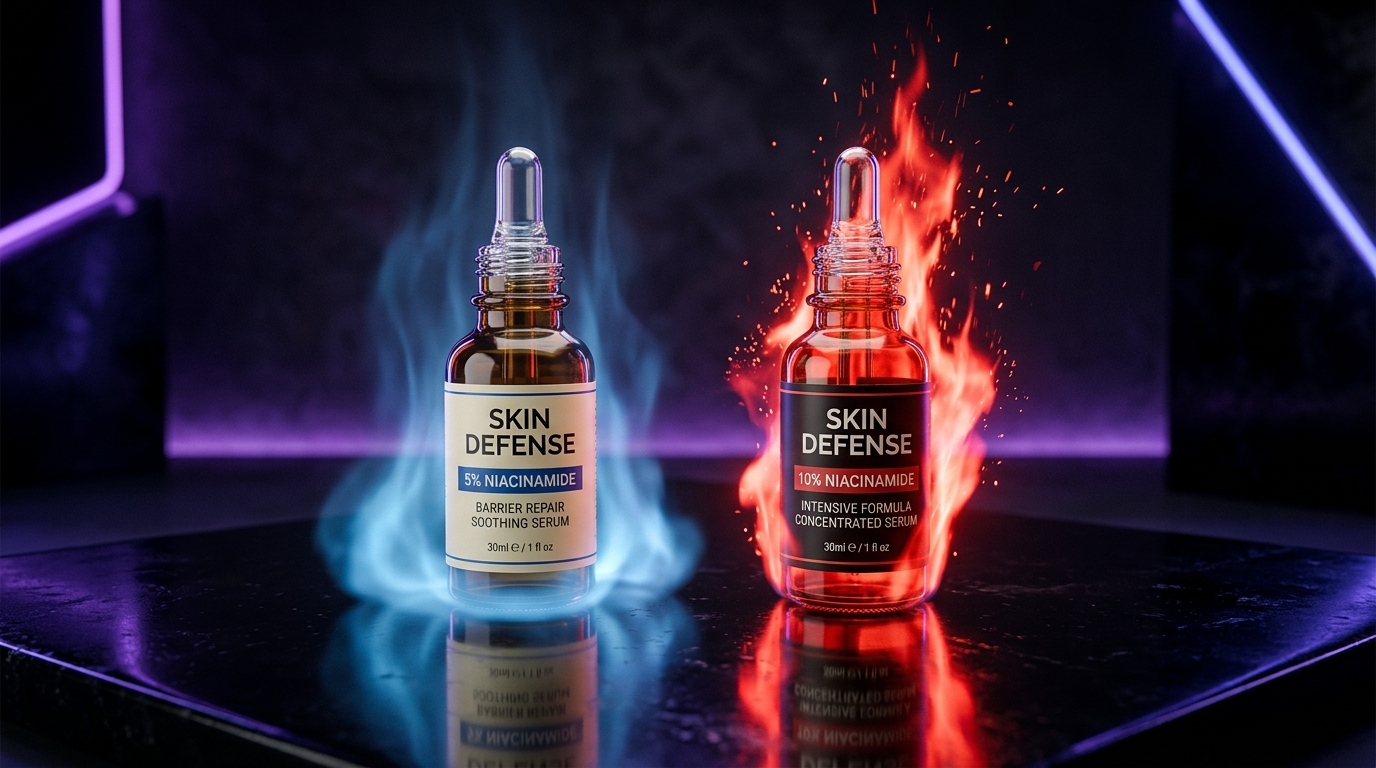
1. Exfoliation vs. Biochemical Function: The "Purging" Myth
Is Niacinamide an Active Exfoliant?
No. Niacinamide (pyridine-3-carboxamide, Vitamin B3) is an essential water-soluble amide, not a keratolytic or chemical desquamating agent.
- Mechanism of True Purging Agents: Retinoids (Tretinoin, Adapalene, Tazarotene) bind nuclear retinoic acid receptors to upregulate basal keratinocyte mitosis. Hydroxy acids (AHAs/BHAs like Glycolic, Lactic, Salicylic) cleave ionic and desmosomal bonds between dead skin cells. Both accelerate cell turnover, forcing preexisting subclinical microcomedones up to the surface in an accelerated timeframe.
- Why Niacinamide Cannot Biochemically Cause Purging: Niacinamide does not accelerate desquamation, cleave corneodesmosomes, or accelerate basal layer turnover. Instead, it exerts cytoprotective, anti-inflammatory, and barrier-restorative functions (inhibiting nuclear factor kappa B, downregulating pro-inflammatory cytokines, and normalizing follicular sebum composition).
Clinical Reality: There is no Niacinamide Purge
Any sudden outbreak of papulopustules, micro-bumps, erythema, or irritation following Niacinamide application is not a "purge" or "detoxification phase". It is an adverse reaction: Subclinical Irritant Contact Dermatitis (ICD), Barrier Disruption, GPR109A-Mediated Flushing, or Vehicle-Induced Comedogenicity.
2. Pathomechanisms of 10% Niacinamide Adverse Reactions
When patients apply high concentrations (≥ 10%, equivalent to ~0.82 M solute density), three primary adverse biochemical pathways are triggered, leading to what many mistake as a "purge."
1. Nicotinic Acid Impurity & GPR109A (HCAR2) Prostaglandin Flushing
Niacinamide raw materials frequently contain trace residues of free Nicotinic Acid (Niacin). Furthermore, when exposed to low formulation pH (< 4.0) or elevated storage temperatures, Niacinamide slowly hydrolyzes into Nicotinic Acid.
Unlike Niacinamide, Nicotinic Acid is a potent agonist of the G-protein coupled receptor GPR109A (also termed HCAR2) expressed on epidermal Langerhans cells and keratinocytes. Activation of GPR109A triggers the arachidonic acid pathway, driving a surge of Prostaglandin D2 (PGD2) and Prostaglandin E2 (PGE2). This produces rapid arteriolar vasodilation, profound erythema, tingling, and a severe burning sensation—the classic "Niacin Flush".
2. Hyperosmotic Stress & Keratinocyte Dehydration
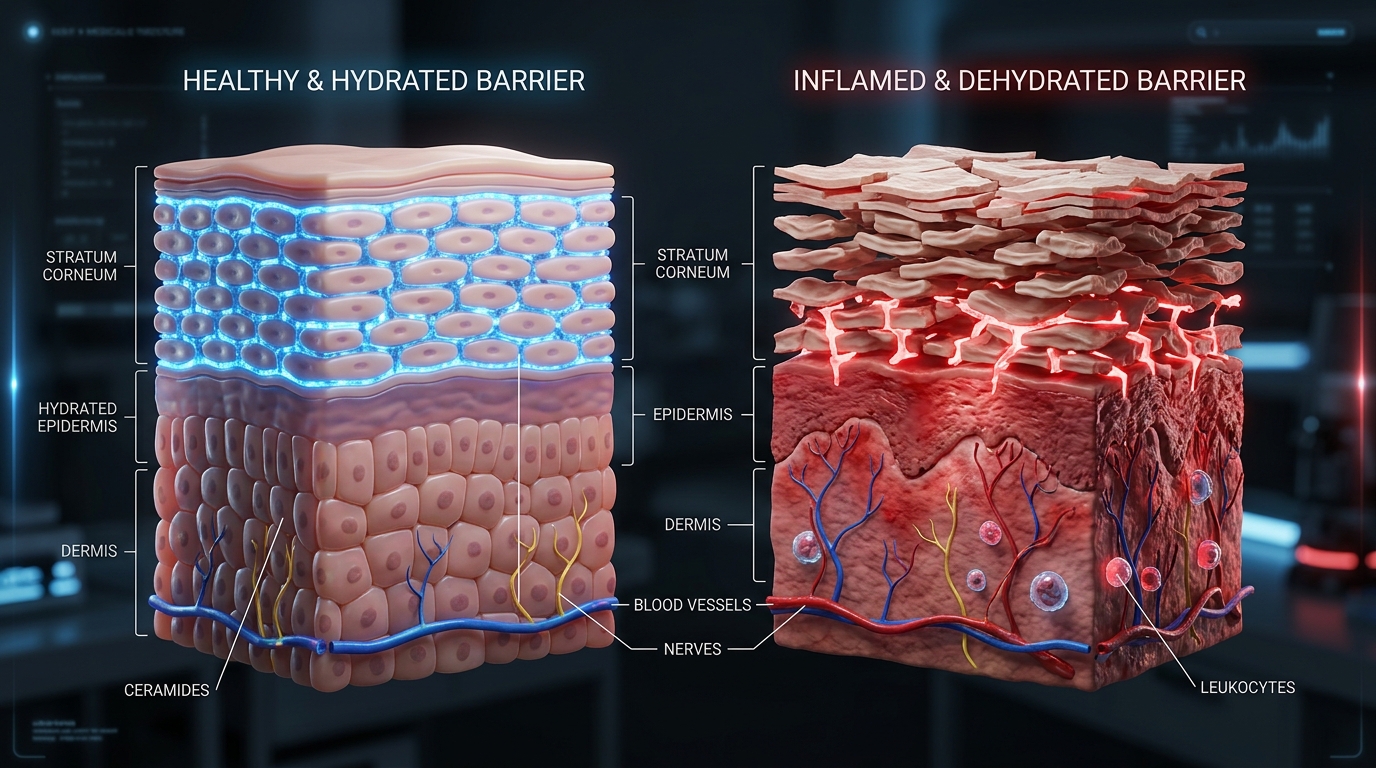
At 10% concentration (100 mg/mL), topical Niacinamide introduces a massive hyperosmotic load. When applied without sufficient physiological emollients, this hypertonic surface gradient creates an osmotic draw, extracting intracellular water from superficial keratinocytes into the vehicle layer. This induces cellular shrinkage, micro-fissuring of the stratum corneum lamellar lipids, and activation of stress pathways.
3. Subclinical Irritant Contact Dermatitis (ICD)
The therapeutic ceiling for Niacinamide in human epidermis is reached at 2%–5%. Exceeding this threshold oversaturates cellular mechanisms without clinical gain. Excess uncomplexed active serves as a chemical irritant, provoking non-allergic, irritant follicular papules.
The Danger for Indian Skin: In melanin-rich Indian skin (Fitzpatrick IV-VI), this subclinical erythema directly activates surrounding melanocytes, triggering rapid Post-Inflammatory Hyperpigmentation (PIH).
3. Differential Diagnostic Matrix: 10% Irritation vs. True Active Purging
How do you know if you're purging from a retinoid or reacting poorly to 10% Niacinamide? Use this clinical diagnostic matrix.
| Diagnostic Parameter | True Active Purging (Retinoids / AHAs / BHAs) | 10% Niacinamide Irritation / Barrier Breakdown |
|---|---|---|
| Primary Etiology | Accelerated keratinocyte desquamation & rapid unroofing of preexisting subclinical microcomedones. | Subclinical Irritant Contact Dermatitis (ICD), GPR109A prostaglandin flush, or osmotic barrier disruption. |
| Lesion Morphology | Discrete comedones, inflammatory papules, and pustules directly reflecting previous impactions. | Diffuse polymorphous erythematous micro-papules, follicular erythema, non-comedonal pruritic bumps, urticarial patches. |
| Anatomical Distribution | Restricted strictly to habitual acne-prone areas (T-zone, chin, jawline; pre-existing clogged pores). | Widespread/generalized across treated field, including historically clear areas (cheeks, periorbital, perioral, neck). |
| Onset & Evolution | Begins at 1–2 weeks; peaks at 3–4 weeks; completely resolves by 6–8 weeks with baseline skin clearance. | Immediate to rapid onset (hours to 3–5 days); persists or worsens monotonically as long as product is used. |
| Barrier Integrity | Mild localized scaling; skin barrier remains largely functional; stinging on water is minimal or absent. | Acute Transepidermal Water Loss (TEWL) spike; severe stinging/burning upon applying basic water or bland ceramide moisturizer. |
| Cutaneous Sensation | Mild tenderness localized to deep inflammatory acne nodules; no generalized pruritus (itching). | Intense burning, heat sensation, tight/crepey stratum corneum, diffuse itching/pruritus. |
4. Ideal Therapeutic Concentration (2%–5%) for Indian Skin
Unique Vulnerabilities of Fitzpatrick IV–VI Cutaneous Phenotypes
Melanocytes in Fitzpatrick IV–VI skin possess higher basal melanin production and larger, singly dispersed eumelanosomes. Subclinical erythema, TEWL spikes, or minor chemical irritation trigger keratinocyte release of specific factors (α-MSH, Endothelin-1, Prostaglandin E2), leading to hyperactive tyrosinase upregulation and prolonged, stubborn Post-Inflammatory Hyperpigmentation (PIH). The 10% Niacinamide irritation pipeline is a direct trigger for this.
The Biochemical Magic at 2%–5%
- De Novo Ceramide Synthesis: At a 2% concentration, Nicotinamide significantly upregulates mRNA expression of Serine Palmitoyltransferase (SPT), the key rate-limiting enzyme in the ceramide pathway. This produces a 4–5x increase in total stratum corneum Ceramides, a 7.4x increase in Glucosylceramides, and a 2.3x increase in Free Fatty Acids.
- Reversible Melanosome Transfer Blockade: At a 5% concentration, Niacinamide downregulates the transfer of melanosomes from melanocytes to surrounding keratinocytes by 35%–68%. Crucially, it achieves this without inhibiting tyrosinase enzyme kinetics and without melanocyte cytotoxicity.
The 10% Fallacy
The clinical curve for melanosome transfer inhibition and ceramide synthesis plateaus completely at 5%. Increasing the concentration to 10% yields 0% additional efficacy in barrier synthesis or melanogenesis reduction. It only serves to multiply your risk of irritation.
5. Active Stacking Protocols & Biochemical Compatibility
1. The Synergistic Barrier Repair Triad: Niacinamide (2–5%) + Ceramides + Hyaluronic Acid
🟢 SYNERGISTIC BARRIER MATRIX
Niacinamide acts internally by stimulating keratinocyte SPT transcription, enhancing endogenous production of long-chain Ceramides. Exogenous Ceramides (1:3:1 ratio) provide instantaneous, physical biomimetic patching of the stratum corneum lamellar bilayers. Hyaluronic Acid binds extracellular water. Flawless tolerability for Indian skin.
2. Stacking with Retinoids (Tretinoin, Adapalene)
🟢 CLINICAL BUFFERING (at 2-4%) | 🔴 DUAL BARRIER STRESS (at 10%)
Combining 10% Niacinamide with Retinoids compounds osmotic irritation and retinoid-induced epidermal desquamation, precipitating severe retinoid dermatitis and dark PIH. However, applying a physiological 2%–4% Niacinamide serum prior to the topical retinoid counteracts retinoid-induced TEWL and prevents barrier breakdown.
3. Stacking with Strong Acids (AHA Glycolic Acid, BHA Salicylic Acid)
🟡 POTENTIAL GPR109A FLUSHING (pH Instability)
Direct low-pH co-formulation catalyzes the cleavage of the amide bond, converting Niacinamide into free Nicotinic Acid. This triggers GPR109A receptor-mediated vasodilation and intense burning. Protocol: Split application (Niacinamide AM; AHA/BHA PM).
4. Stacking with Pure L-Ascorbic Acid (pH < 3.5)
🟡 CHARGE-TRANSFER COMPLEX FORMATION
In unbuffered solutions at pH < 3.5, Niacinamide and L-Ascorbic Acid form an electrostatic 1:1 Niacinamide Ascorbate salt complex. This temporarily reduces free acid bioavailability and can induce localized GPR109A-like erythema. Protocol: Use stable Vitamin C derivatives at neutral pH or separate by routine.