
Identify Your Nose Bump (The 4 Types)
Before touching any product, take a close look in the mirror. Not every bump on your nose is a standard pimple. Treating a deep blind lump like a blackhead will only irritate your skin, while scrubbing an infected pustule will spread bacteria across your T-zone.
1. The Red Surface Pimple (Pustule)
What you see: A raised red bump with a distinct white or yellowish center near the tip or side of your nose.
What caused it: Surface sebum and dead skin cells trapped bacteria near the top of the pore, triggering mild localized pus.
Best approach: Dab a dot of 2.5% benzoyl peroxide and cover it with a hydrocolloid patch to drain fluid safely.
2. The Deep Blind Lump (Nodule)
What you see: A painful, hard red knot under the skin with NO visible white head. It throbs when you touch your nose.
What caused it: Deep inflammation inside the oil duct pressing directly against the cartilage underneath.
Best approach: Cold compress for 90 seconds to reduce throbbing, followed by azelaic acid. Never squeeze—there is no exit pore.
3. Blackheads & Dark Dots (Comedones)
What you see: Tiny flat black or dark grey dots spread across the bridge and sides of your nose.
What caused it: Natural oil and dead skin exposed to the air. The dark color is oxidized melanin, not trapped dirt.
Best approach: 2% Salicylic Acid (BHA) wash twice weekly. Avoid sticky pore strips that tear your barrier.
4. The Bump Inside the Nostril
What you see: A tender, stinging red bump just inside your nostril rim. It stings when you smile or blow your nose.
What caused it: Nasal folliculitis—a mild staph bacterial infection in an inner hair follicle from trimming or picking.
Best approach: Warm moist compress against the outer nose plus OTC mupirocin 2% applied with a clean swab.
Why Does a Nose Pimple Hurt Way More Than Elsewhere?
If you have ever had a pimple on your cheek, you probably barely felt it until you touched your face. But when a bump develops on your nose, you feel a sharp, throbbing ache every time you smile, wash your face, or put on your sunglasses. There are three straightforward anatomical reasons for this:
No Cushion Layer (Tightly Stretched Skin)
Your cheeks have a soft cushion of subcutaneous fat that gives swelling room to expand outward harmlessly. On your nose, your skin is shrink-wrapped tightly over hard nasal cartilage. When inflammation starts, fluid cannot expand outward easily, creating intense internal pressure.
Dense Nerve Network
Your nose is one of the most sensitive sensory areas on your body, fed directly by branches of the trigeminal nerve. The tight mechanical pressure from even a tiny inflammatory bump fires these nerve endings constantly, producing that familiar thumping heartbeat sensation.
Largest Oil Glands on the Face
The skin over your nose contains the highest density of multi-lobed sebaceous glands on your body. In India's warm weather, these glands pump continuous sebum, feeding acne bacteria and sparking deeper inflammatory reactions than other facial zones.
The Facial "Danger Triangle" Explained in Plain English
You may have heard doctors or online videos refer to the "Danger Triangle" of the face (also nicknamed the triangle of death). While the name sounds dramatic, the medical caution behind it is completely real.
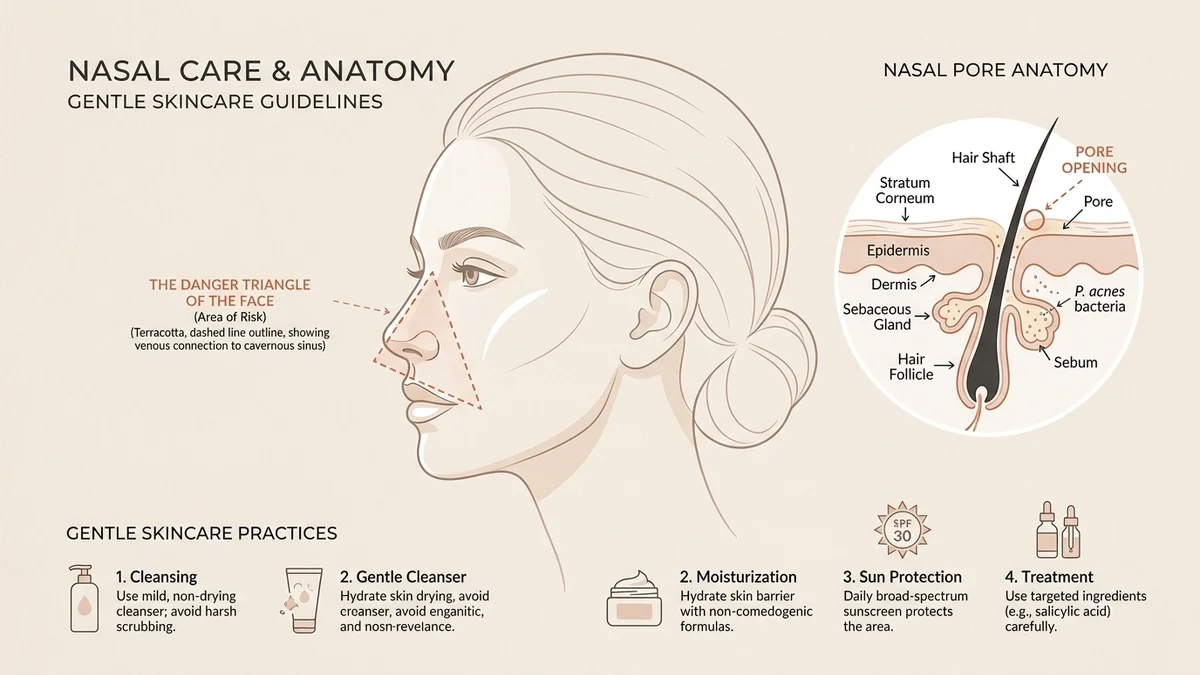
The veins draining the central part of your nose and upper lip do not have the normal one-way valves found elsewhere in your body. When you pinch a pimple against firm cartilage, the enormous inward pressure can rupture the follicle wall backward instead of popping outward. That forces bacteria and pus into the angular and ophthalmic veins, which drain straight back into the cavernous sinus—a major venous network near the base of the brain.
While life-threatening brain infections like cavernous sinus thrombosis are rare today thanks to modern antibiotics, the cosmetic and physical damage from squeezing is virtually guaranteed:
- Sunken Boxcar & Ice-Pick Scars: Because nose skin is thin and anchored to cartilage, deep tissue rupture destroys collagen. Once healed, it leaves a permanent pit or depression that creams cannot fix.
- Broken Red Capillaries (Telangiectasia): Pinching pressure easily crushes the fragile micro-blood vessels on your nasal wings, leaving permanent spider-like red lines that only vascular lasers can remove.
- Spreading Facial Cellulitis: Popping a bump with fingernails pushes surface bacteria (like Staphylococcus) into the deeper dermis, causing swelling and redness to spread across your entire cheek.
The 3-Step Overnight Relief Routine (What to Do Tonight)
When you want a painful nose bump to calm down by tomorrow morning, skip the internet hacks like applying toothpaste, raw garlic, or pure tea tree oil—these will chemically burn the thin skin on your nose. Follow this evidence-backed 3-step routine instead:

Step 1: The 90-Second Cold Compress
Take a clean ice cube and wrap it in a clean cotton handkerchief or paper towel (never apply bare ice directly to skin, which causes ice burn). Hold it gently against the swollen bump for 90 seconds. The cold temperature instantly constricts dilated blood vessels, reduces fluid accumulation, and numbs the throbbing nerve pain.
Step 2: Micro-Dab 2.5% Benzoyl Peroxide
Why 2.5% instead of 10%? Clinical studies show a 2.5% benzoyl peroxide gel kills acne bacteria just as effectively as a harsh 10% gel, but without the redness, burning, and severe peeling common on Indian skin. Place a tiny pinhead-sized speck directly on the center of the bump using a clean fingertip or cotton bud. Let it dry for two minutes.
Step 3: Cover with a Hydrocolloid Patch
Once the spot treatment is dry, place a small sterile hydrocolloid pimple patch directly over the bump. The patch works in two critical ways: it gently absorbs fluid and pus as it rises, and it creates a physical barrier that stops you from touching, scratching, or picking the spot while you sleep or work.
| Method | How It Works | Safety Level | Best Used For |
|---|---|---|---|
| Cold Ice Wrap (90s) | Constricts capillaries and numbs throbbing nerves | Very Safe | Painful blind lumps & red active bumps |
| 2.5% Benzoyl Peroxide | Introduces oxygen into the pore to kill bacteria | Safe (Micro-dab) | Red surface pimples with white heads |
| 2% Salicylic Acid (BHA) | Oil-soluble acid dissolves trapped sebum deep in pores | Safe (2-3x / week) | Blackheads and clogged nose pores |
| Adhesive Pore Strips | Rips away topmost skin cells with adhesive glue | Harmful | Avoid: breaks capillaries and enlarges pores |
Dermatologist Video Guide: Clearing Nose Pores Safely
Many people assume the dark speckles on their nose are blackheads that must be aggressively scrubbed away. In this video, board-certified dermatologist Dr. Andrea Suarez (Dr Dray) explains the truth about nose pores and why physical extraction destroys skin:
Key Video Takeaways from Dr. Dray
- Sebaceous Filaments vs. Blackheads: Most dark nose dots are normal oil channels. Squeezing them only makes the pore walls lose elasticity and stretch wider.
- Chemical Dissolution: Salicylic acid penetrates through sebum to break down plugs gently without physical friction.
- Long-Term Maintenance: Nighttime topical retinoids (like adapalene) regulate cell turnover so pores stay clear naturally.
Special Cases: Spectacles Friction & Nostril Bumps
Two very common nose breakout scenarios require tailored management: pimples that develop right under glasses nose pads, and painful bumps that hide inside the rim of your nostril.
Pimples Under Glasses (Acne Mechanica)
If you wear spectacles or sunglasses daily, the silicone nose pads press against the bridge of your nose for 10 to 14 hours. In warm weather, sweat, face oil, sunscreen, and foundation get trapped under the pads. The constant tiny movements of your frames rub these trapped impurities directly into your pores.
The Solution: Wash your glasses nose pads every night with a drop of gentle soap and water. Clean the bridge of your nose with micellar water or a gentle wipe halfway through your workday.
Bumps Inside the Nostril (Nasal Folliculitis)
A bump tucked just inside the nostril opening is usually not acne—it is nasal folliculitis. The nasal vestibule is lined with coarse hairs and naturally harbors Staphylococcus bacteria. Aggressive nose-picking, plucking hairs with tweezers, or dry air can cause a micro-tear that turns into a painful swollen boil.
The Solution: Hold a warm, damp cloth against the outside of your nose for 5 minutes. Apply a thin smear of over-the-counter mupirocin 2% or antibiotic cream with a cotton swab. Never pluck nose hairs with tweezers—use round-tip grooming scissors instead.
While most nose bumps clear up within a few days, seek immediate medical attention if you notice any of these warning signs: swelling or redness rapidly spreading to your cheeks or under your eyes, a high fever, severe throbbing headache, blurred or double vision, or if the bump feels like a hard, growing boil that makes it difficult to breathe through that nostril.
Frequently Asked Questions
Quick, clear answers to the most common questions about nose pimples, blackheads, and healing times: