
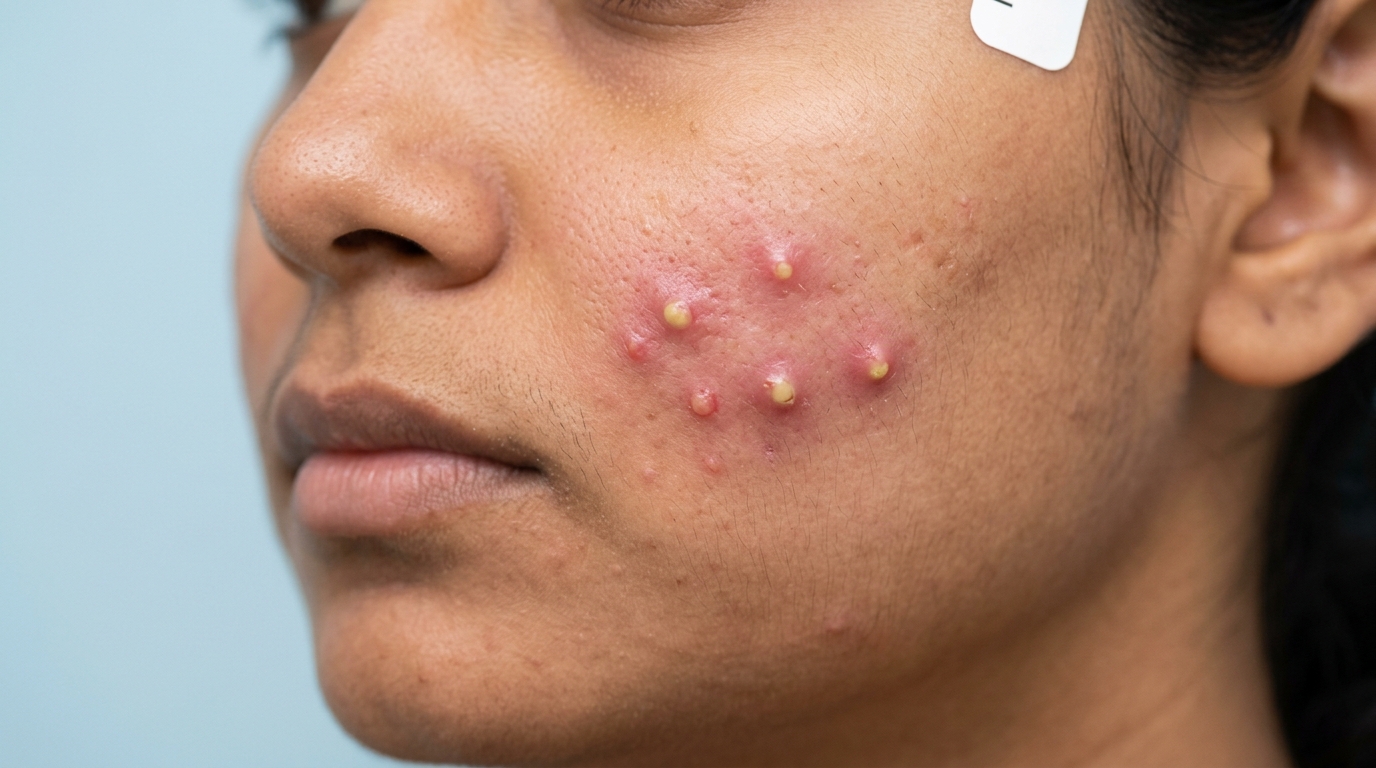
1. Anatomy of a Pustule: What Is Inside That White/Yellow Bump?
In dermatological classification, acne lesions progress from non-inflammatory comedones (blackheads and whiteheads) to inflammatory papules, and subsequently to pustules.
A pustule is a small, circumscribed, elevated lesion containing purulent exudate (pus). Unlike a solid red papule, a pustule features a visible central white or yellowish cap surrounded by an erythematous (red) halo of active inflammation.
Biological Composition of Pustule Exudate
The pus inside a facial pustule is not "dirty skin." It is a concentrated biological mixture of dead neutrophils (white blood cells), cellular debris, extracellular lipids, and dead Cutibacterium acnes bacteria. Neutrophils swarm the follicle to neutralize bacteria, releasing hydrolytic enzymes that turn the follicular core into liquid purulent exudate.
2. 4 Primary Causes of Facial Pustules in India
Pustules are not caused by a single factor. In the Indian climate, four distinct dermatological conditions present with pus-filled facial bumps:
Anaerobic Cutibacterium acnes feed on excess sebum inside clogged pores. Their metabolic byproducts (lipases and chemotactic factors) trigger an immune response, drawing neutrophils into the pore to form localized pustules.
In hot coastal cities (Mumbai, Chennai, Kolkata), high humidity causes Malassezia yeast to proliferate inside hair follicles, triggering uniform, intensely itchy pustules across the forehead and hairline.
Subtype 2 Rosacea causes recurrent red pustules across the central face (cheeks, nose). Unlike acne, rosacea pustules lack comedones (blackheads/whiteheads) and are accompanied by facial flushing and telangiectasia.
Clusters of tiny pinpoint pustules around the mouth, chin, and nose nostrils. Frequently triggered by topical steroid misuse (like Betnovate/Pandin), heavy fluorinated toothpastes, or thick occlusive creams.
3. Differential Diagnosis: Bacterial vs Fungal vs Rosacea Pustules
Treating a fungal pustule with topical antibiotics will fail, just as treating rosacea with harsh BPO will worsen redness. Here is how to distinguish them:
Warning: Misusing Topical Steroid Creams (Betnovate/Panderm) on Pustules
In India, over-the-counter sales of Schedule H steroid creams (Betnovate, Panderm, Dermovate) lead many to apply steroids to pimples. Steroids suppress local skin immunity, initially shrinking redness for 24 hours, before causing explosive steroid-induced pustular acne and permanent skin thinning (atrophy).
4. Dermatological Diagnosis Matrix Table
Use this clinical reference table to diagnose your facial pustules and select the correct target active:
| Pustule Type | Visual & Sensory Markers | Underlying Pathogen | Gold Standard Active | What to Avoid |
|---|---|---|---|---|
| Bacterial Acne Pustule | Varying size, red halo, tender to touch, comedones present | Cutibacterium acnes | Benzoyl Peroxide 2.5% or Hydrocolloid Patch | Squeezing, popping, picking, heavy coconut oil |
| Fungal Folliculitis Pustule | Monomorphic (all same size), intensely itchy, forehead/hairline | Malassezia furfur / globosa | 2% Ketoconazole Wash or Zinc Pyrithione Cleanser | Topical antibiotics (Clindamycin), lipid-rich oils |
| Papulopustular Rosacea | Central face flushing, burning sensation, zero comedones | Vascular neuro-inflammation & Demodex mites | Azelaic Acid 15% Gel or Ivermectin 1% Cream | Harsh BHA scrubs, hot water, spicy food, alcohol |
| Perioral Dermatitis | Clusters around mouth/nostrils, dry flaking red base | Epidermal barrier disruption / Steroid withdrawal | Zero therapy (stop steroids) + Metronidazole 0.75% gel | Topical corticosteroids, SLS toothpastes, heavy ointments |
5. The Danger of Popping Pustules on Dark Indian Skin (Fitzpatrick IV-VI)
When a yellow pus head forms on a pimple, the urge to pop it is immense. However, squeezing facial pustules is the single primary cause of deep, pitted acne scars and dark post-inflammatory hyperpigmentation (PIH) in India.
Micro-Tear Cascade: Why Popping Forces Pus Deeper
Squeezing a pustule exerts lateral pressure on the hair follicle. Instead of expelling pus outward through the pore opening, lateral pressure ruptures the fragile follicular wall downward. Purulent bacteria, dead neutrophils, and digestive enzymes leak directly into the surrounding reticular dermis, escalating an localized blemish into a deep tissue abscess that destroys dermal collagen.
On melanin-rich Indian skin (Fitzpatrick IV–VI), this deep dermal trauma activates melanocytes to overproduce melanin, leaving behind persistent dark brown marks that take 6 to 12 months to fade (read Acne Marks vs Acne Scars Difference).
6. Evidence-Based Clinical Protocol to Clear Pustules Fast
Follow this 3-step dermatological regimen to treat active facial pustules without popping or scarring:
- Step 1: Short-Contact Benzoyl Peroxide (Morning): Wash affected area with Benzoyl Peroxide 2.5% Cleanser. Leave foam on skin for 2 to 3 minutes before rinsing thoroughly. BPO releases free-radical oxygen that sterilizes C. acnes instantly without inducing bacterial resistance.
- Step 2: Hydrocolloid Pimple Patch Absorption (Night): For surfaced pustules with a white head, apply a medical-grade hydrocolloid patch overnight (read Hydrocolloid Pimple Patches India Guide). Hydrocolloid vacuum-draws purulent exudate safely without skin trauma.
- Step 3: Anti-Inflammatory Barrier Maintenance: Layer Clindamycin + Nicotinamide 4% Gel or Azelaic Acid 15% Gel to calm inflammatory redness and inhibit melanocytes from forming PIH.
7. Frequently Asked Questions
A papule is a solid, inflamed red bump without visible pus. A pustule is an advanced inflammatory lesion containing a visible central core of white or yellow pus (dead neutrophils, cellular debris, and bacteria).
No. Squeezing pustules ruptures the follicular wall, forcing purulent material deeper into the reticular dermis. This causes severe tissue destruction, prolonged inflammation, and dark post-inflammatory hyperpigmentation (PIH) on Indian skin.
Benzoyl Peroxide 2.5% gel or wash is the fastest OTC active. It releases free-radical oxygen species directly into the pore, killing anaerobic C. acnes bacteria within minutes without risk of bacterial resistance.
Bacterial pustules vary in size, are painful, and are associated with blackheads/whiteheads. Fungal pustules (Malassezia folliculitis) are uniform in size, intensely itchy, lack comedones, and worsen in hot, humid monsoon weather.