
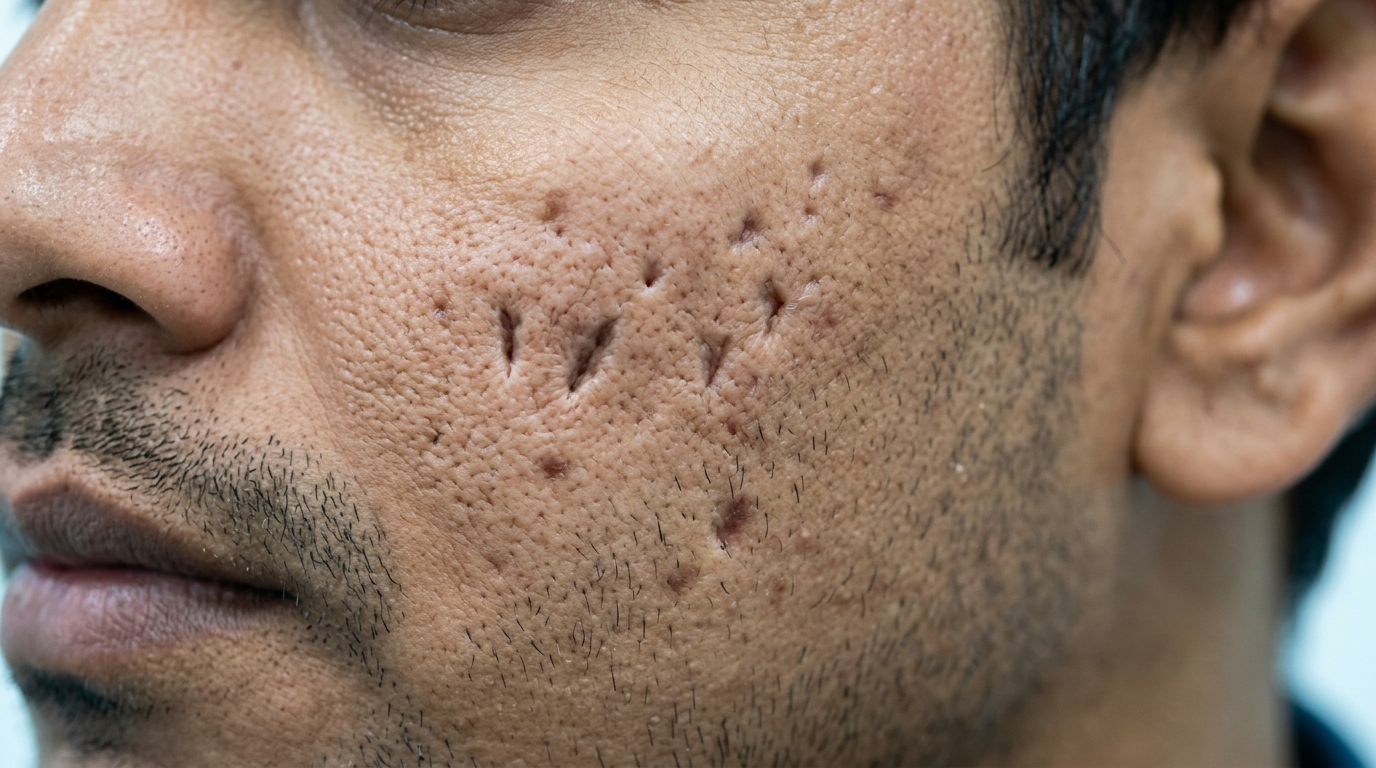
1. Anatomy & Depth: What Makes Ice Pick Scars So Resistant?
Atrophic acne scars are broadly categorized into three clinical morphotypes: rolling scars, boxcar scars, and ice pick scars. Among these, ice pick scars account for 60% to 70% of all atrophic scars in patients suffering from severe inflammatory acne vulgaris.
Anatomically, an ice pick scar presents as a narrow (less than 2mm wide), deep, sharply marginated epithelial tract that extends vertically into the deep reticular dermis or subcutis. They resemble deep punctures made by an ice pick, with the base of the scar wider at the dermal junction than at the epidermal pore opening.
Biological Mechanism: Why Collagen Degenerates Vertically
When a deep comedone or inflamed cystic nodule ruptures within the pilosebaceous unit, localized enzymatic destruction (matrix metalloproteinases) destroys extracellular collagen bundles. As the acute inflammation resolves, dense fibrotic scar tissue contracts vertically, pulling the epidermal floor downward into a steep V-shaped funnel.
2. At-Home Treatments for Ice Pick Scars: Myth vs Reality
Millions of Indian consumers spend thousands of rupees on OTC anti-scar creams, serums, and home microneedling rollers hoping to erase deep ice pick depressions. Here is the clinical reality:
Cosmetic ingredients (Vitamin C, Niacinamide, Retinol, Scar Removal Creams) only affect the upper epidermis (0.1mm deep). They cannot reach the 2–3mm deep reticular dermis to rebuild dense structural collagen.
Home rollers (0.25–0.5mm) enter skin at an angle, failing to penetrate the 2mm deep scar base. On Fitzpatrick IV–VI Indian skin, roller dragging creates micro-tars and severe post-inflammatory hyperpigmentation.
Dermatological Myth Buster: Chemical Peels At Home
At-home Glycolic (10–20%) or Salicylic (2%) toners smooth micro-texture but cannot elevate ice pick scar floors. Attempting high-strength DIY chemical peels (like 70% TCA bought online) without medical supervision results in severe chemical burns, keloid scarring, and permanent skin discoloration.
3. Dermatologist Clinical Gold Standards for Ice Pick Scars
Because ice pick scars are deep and narrow, generalized skin resurfacing (like gentle laser or superficial peels) fails to reach the scar base. Effective dermatological management relies on targeted, focal scar reconstruction procedures:
1. TCA CROSS (Chemical Reconstruction of Skin Scars)
TCA CROSS is the single most effective, clinically validated procedure for ice pick scars. A dermatologist uses a wooden toothpick or fine 30-gauge needle to focal-apply high-concentration (70% to 100%) Trichloroacetic Acid strictly inside the base of each ice pick scar.
The concentrated acid induces local coagulation necrosis (frosting), triggering intensive dermal wound healing. Over 3 to 5 sessions spaced 4 weeks apart, new collagen synthesis elevates the scar base toward the surrounding skin surface, achieving 60% to 80% scar improvement.
2. Microneedling Fractional Radiofrequency (MNRF)
MNRF uses gold-insulated micro-needles to deliver high-frequency radiofrequency energy directly into the dermis at precise depth settings (up to 3.5mm). The heat thermal zone stimulates neocollagenesis and elastin remodeling without overheating the epidermis, making it exceptionally safe for dark Indian skin tones.
3. Punch Excision & Subcision
For exceptionally deep, stubborn ice pick scars that fail to respond to TCA CROSS, dermatologists perform a punch excision using a small circular biopsy punch matching the scar diameter. The scar tract is excised completely, and the skin margins are closed with a fine micro-suture.
Why Subcision Alone Is Not Enough for Ice Pick Scars
While subcision (releasing tethered fibrotic bands with a Nokor needle) is the gold standard for rolling scars, it has limited utility for ice pick scars because ice pick scars are narrow vertical tracts rather than broad tethered depressions. Subcision is usually combined with TCA CROSS for mixed scar patterns.
4. Treatment Comparison Matrix & Cost Expectations in India
Compare the clinical efficacy, depth target, downtime, and cost of ice pick scar procedures across Indian dermatological clinics:
| Procedure Name | Target Scar Depth | Expected Efficacy | Downtime & Recovery | Cost Range (INR / Session) |
|---|---|---|---|---|
| TCA CROSS (70-100%) | 2.0 – 3.0 mm (Reticular Dermis) | 60% – 80% scar elevation | 3–5 days white micro-crusts | ₹3,500 – ₹7,000 |
| MNRF (Microneedling RF) | 1.5 – 3.5 mm (Deep Dermis) | 40% – 60% texture smoothing | 2–3 days redness & edema | ₹6,000 – ₹15,000 |
| Punch Excision | Full thickness excision (>3mm) | 80% – 90% scar removal | 5–7 days (suture removal) | ₹5,000 – ₹12,000 |
| Topical Rx Retinoids (Adapalene/Tretinoin) | 0.1 mm (Epidermis only) | 10% – 15% micro-smoothness | Transient flaking (week 2–4) | ₹250 – ₹600 (tube) |
5. Pre & Post-Procedure Skin Conditioning for Indian Dark Skin (Fitzpatrick IV-VI)
Indian skin tones have hyper-reactive melanocytes. Procedural inflammation from TCA CROSS or lasers can trigger post-inflammatory hyperpigmentation (PIH) if skin is not pre-conditioned.
- Pre-Procedure Conditioning (4 Weeks Prior): Dermatologists prescribe tyrosinase inhibitors like Azelaic Acid 15% Gel or Alpha Arbutin 2% for 4 weeks prior to procedure to quiet melanocytes.
- Immediate Post-Procedure Care (Day 1–5): Apply sterile Petrolatum or Ceramide healing ointment twice daily. Never pick or scratch the dark micro-crusts formed by TCA CROSS.
- Strict Photoprotection: Apply broad-spectrum mineral SPF 50 sunscreen every 3 hours. Read our guide on Best Sunscreen for Acne Prone Indian Skin.
6. Comprehensive Multi-Modal Scar Routine
For best results, clinical scar protocols pair focal procedures with active topical maintenance:
- Nightly Retinoid Maintenance: Use Adapalene 0.1% Gel at night to maintain cell turnover and boost dermal collagen fibers.
- Pigment Brightening: Layer Niacinamide 5% Serum to fade residual red/brown marks.
- Barrier Support: Use a ceramide-rich moisturizer (see Cica Barrier Repair Moisturizer Guide).
7. Frequently Asked Questions
No. Ice pick scars extend 2 to 3mm deep into the reticular dermis with a narrow V-shaped tract. Topical cosmetics (Retinol, Vitamin C, Niacinamide) only act on the epidermis and upper papillary dermis and cannot rebuild deep collagen tracts.
TCA CROSS (Trichloroacetic Acid Chemical Reconstruction of Skin Scars) using 70% to 100% TCA is the gold standard clinical treatment for ice pick scars, producing 60% to 80% scar elevation over 3–5 sessions.
TCA CROSS typically costs ₹3,500 to ₹7,000 per session in India. Microneedling RF (MNRF) ranges from ₹6,000 to ₹15,000 per session depending on the clinic, technology, and city.
No. Standard at-home dermarollers (0.25mm–0.5mm) enter skin at an angle, failing to reach the 2mm depth required for ice pick scars while risking severe micro-tearing, infection, and post-inflammatory hyperpigmentation (PIH).