
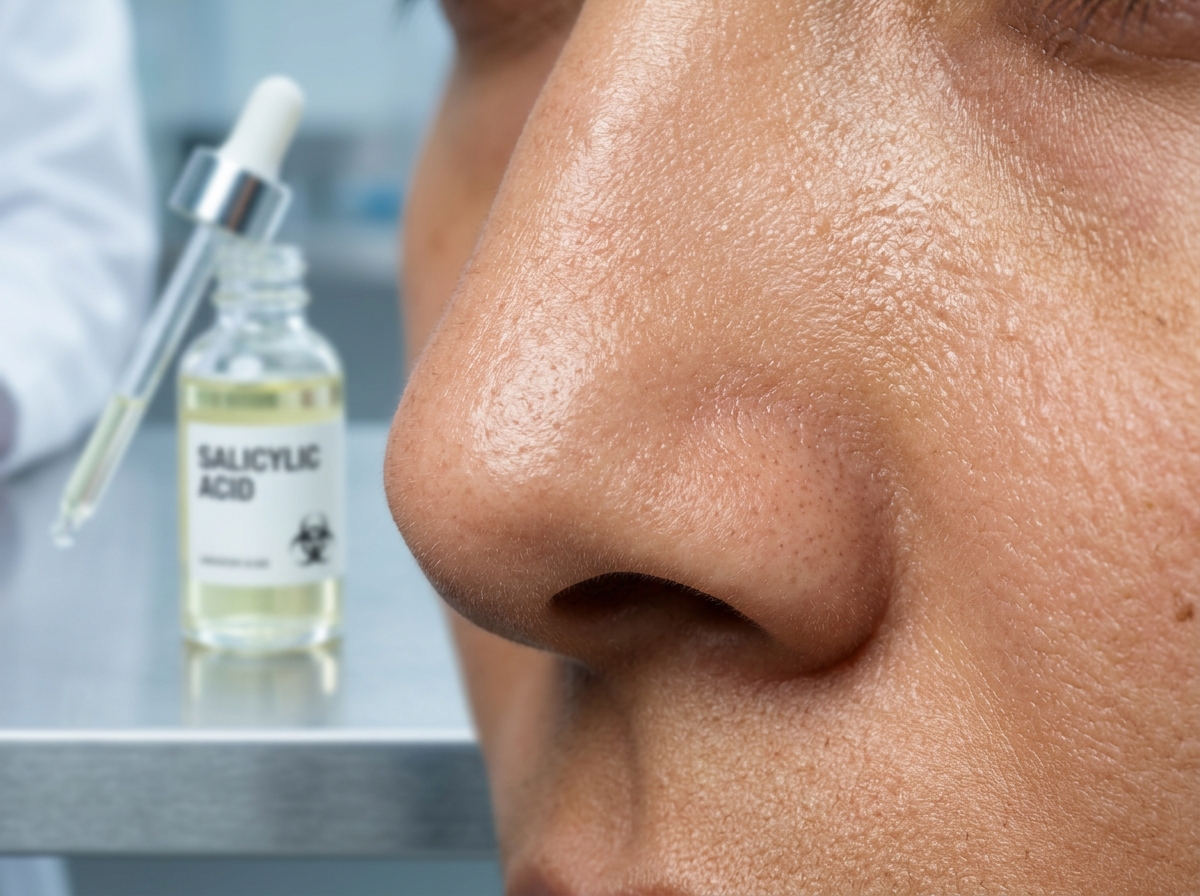
Pore Anatomy: Filament vs Blackhead Histology
Almost everyone who complains about "stubborn blackheads across my nose" actually has sebaceous filaments. Understanding the biological distinction is essential to treating your skin without causing permanent pore dilation:
A natural, microscopic cylinder composed of 10–30 layers of dead keratinocytes, triglycerides, and squalene lining the pore wall. Its job is to channel sebum from the sebaceous gland to lubricate the skin barrier. When squeezed, it yields a soft, yellowish-white string that refills in 48–72 hours.
A pathological acne lesion. Occurs when a follicular opening becomes completely blocked with compacted dead cells and sebum. The melanin in the plug oxidizes upon air contact, forming a hard, raised, dark brown or black cap. It does not refill immediately once extracted.
Clinical Head-to-Head Comparison Matrix
Use this diagnostic table to determine whether your nose dots are sebaceous filaments or blackheads:
| Diagnostic Feature | Sebaceous Filaments | Blackheads (Open Comedones) |
|---|---|---|
| Visual Appearance | Flat, pinpoint grey, light brown, or yellow dots | Elevated, dark black or dark brown plugs |
| Distribution | Even, uniform pattern across the entire nose and chin | Random, scattered single lesions |
| Tactile Texture | Smooth to the touch (flush with skin surface) | Rough, raised, textured bump |
| Extraction Behavior | Soft, malleable, translucent white/yellow thread | Hard, dense, compacted plug with dark cap |
| Recurrence Timeline | Refills in 48–72 Hours | Does not refill unless pore gets clogged again |
| Can Be Permanently Erased? | No (Normal Biology) | Yes (With Retinoids/BHA) |
The Pore Strip Trap: Why Squeezing Enlarges Pores
Adhesive pore strips and vacuum suction extractors are marketed as quick fixes. However, dermatologists advise against them for three crucial reasons:
🚨 1. ELASTIN BREAKDOWN & PERMANENT PORE ENLARGEMENT
Pores do not have muscles to "open" or "close." Repeatedly ripping adhesive strips pulls on the delicate elastin fibers surrounding the follicular infundibulum. Over time, the pore walls lose structural elasticity, remaining permanently dilated and stretched.
⚠️ 2. BROKEN CAPILLARIES (TELANGIECTASIA)
The lateral sides of the nose have extremely fragile micro-capillaries. The violent mechanical force of peeling adhesive strips or metal comedone extractors causes micro-trauma, resulting in permanent spider veins that can only be removed via vascular laser.
💡 3. THE 48-HOUR REBOUND SEBUM CASCADE
When you physically rip out a sebaceous filament, you create a vacuum inside the pore. Your sebaceous glands immediately accelerate sebum production to restore the moisture conduit, refilling the pore with fresh sebum within 2 to 3 days.
The 3-Step Clinical Chemical Dissolution Protocol
Instead of ripping pores open physically, dermatologists use chemical dissolution. This method melts sebum plugs gently, draws them to the surface, and rinses them away, keeping nose pores refined for 5–7 days:
BHA 2%
Lipophilic Sebum Penetration (Salicylic Acid)
Apply 3–4 drops of a leave-on 2% Salicylic Acid serum (or BHA liquid) across your clean nose and T-zone. Wait 15–20 minutes without washing off. Because Salicylic Acid is oil-soluble, it penetrates deep into the follicular lipid core, breaking down intercellular bonds holding dead cells together.
Clay Mask
Adsorption of Loosened Impurities
Without washing off the BHA, apply a thin layer of Kaolin or Bentonite clay mask directly over your nose and T-zone. Leave for 8–10 minutes until semi-dry. The negatively charged clay minerals act like a magnet, adsorbing the chemically loosened sebum plugs toward the surface. Rinse with lukewarm water.
Cleansing Oil
"Like Dissolves Like" Oil Cleansing Massage
Apply 1–2 pumps of an emulsifying cleansing oil to completely dry skin. Gently massage in circular motions around your nose for 60 seconds. You will often feel tiny hard plugs (sebum "grits") dislodge effortlessly under your fingertips. Add water to emulsify into milk, and rinse cleanly.
🩺 FREQUENCY ADVICE: Perform this 3-step chemical dissolution protocol once every 7 to 10 days. On daily maintenance days, follow with a gentle oil-free gel moisturizer to keep skin hydrated without clogging pores.
Why Indian Humidity & Pollution Turn Pores Dark Grey
In Indian cities with high UV indices and airborne particulate matter (PM2.5), sebum sitting in open pores undergoes Squalene Peroxidation:
Human sebum naturally contains ~12% squalene. When exposed to outdoor sunlight and urban pollution, squalene oxidizes rapidly into squalene monohydroperoxide (SQOOH). This chemical oxidation causes two problems:
- Color Darkening: It transforms clear sebum into dark yellowish-grey dots, making sebaceous filaments mimic blackheads.
- Comedogenic Irritation: Oxidized squalene is highly comedogenic, triggering localized inflammation and transforming harmless filaments into active acne papules.
The Dermatologist Solution: Apply an antioxidant like Vitamin C Serum or Niacinamide in your morning routine before sunscreen to prevent lipid peroxidation on your nose.
Top Indian Formulations for Nose Pore Care
The Clinical Verdict: Formulated with lipophilic BHA and gentle lipo-hydroxy acid (LHA). Penetrates deep into the sebaceous matrix to dissolve sebum buildup without stripping the skin barrier.
The Clinical Verdict: A proven Indian dermatological staple. Best used in the shower by massaging onto the nose and letting it sit for 60 seconds before rinsing.
The Clinical Verdict: Rinses off 100% cleanly with water. Perfect for Step 3 oil cleansing to dislodge loosened sebum grits without leaving a pore-clogging film.
Frequently Asked Questions
No. Sebaceous filaments are natural physiological structures essential for channeling sebum to lubricate your skin barrier. While they cannot be permanently eliminated, using a 2% Salicylic Acid serum and the 3-step chemical dissolution method reduces their diameter and prevents sebum from oxidizing into dark grey dots.
The white/yellow string is a healthy column of sebum and dead skin cells from inside the sebaceous filament. Squeezing forces this sebum out prematurely, damaging the surrounding pore elastin and leading to enlarged, stretched pores.
Yes. Niacinamide (Vitamin B3 at 5%) helps regulate the rate of sebum excretion from sebaceous glands and improves skin elasticity around pore walls, visually tightening the appearance of enlarged pores over 6 to 8 weeks.
Not if you use an emulsifying cleansing oil designed to wash off cleanly with water. Mineral oils or pure kitchen coconut oil will clog pores. A properly formulated cleansing oil bonds with excess sebum and dissolves it on contact.