
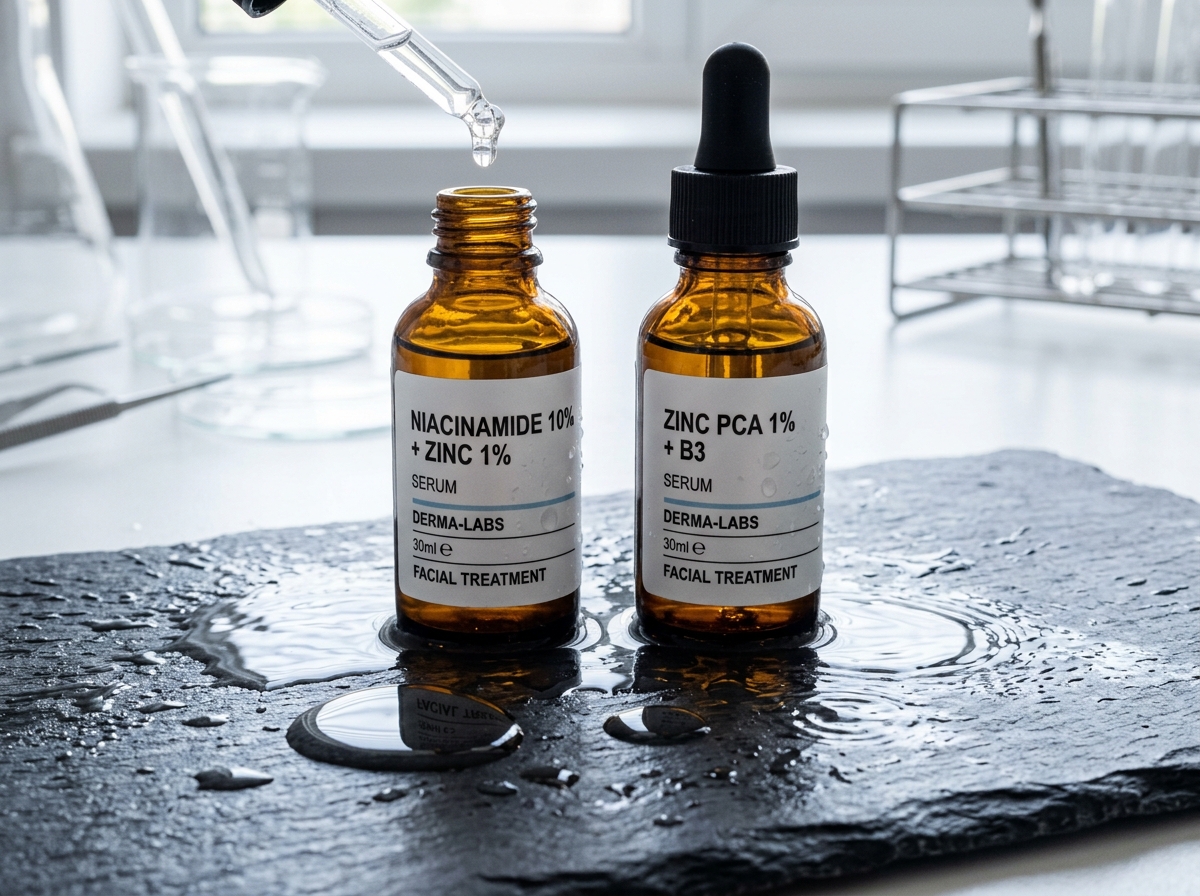
The Pharmacological Mechanisms: Zinc PCA vs Niacinamide
Zinc PCA and Niacinamide are frequently paired together in Indian serums, but they operate through completely different biological pathways in human sebocytes and keratinocytes:
Zinc Pyrrolidone Carboxylate binds zinc to L-PCA (a natural component of the skin's Natural Moisturizing Factor). The zinc ion directly inhibits 5-alpha reductase type 1, the enzyme that converts testosterone into DHT in sebocytes. By blocking DHT, Zinc PCA reduces the rate of sebum secretion at the biological source while delivering oil-free hydration.
Nicotinamide (Vitamin B3) is a precursor to cellular coenzymes NAD+ and NADPH. It stimulates epidermal ceramide and free fatty acid synthesis to repair damaged acid mantles, while simultaneously blocking the transfer of melanosomes from melanocytes to keratinocytes by 35–68%, fading dark post-acne marks (PIH).
💡 THE CLINICAL TAKEAWAY: Think of Zinc PCA as the oil tap regulator (turning down midday grease and killing C. acnes), while Niacinamide is the structural repairer (tightening pore walls, restoring ceramides, and erasing dark spots).
The "10% Niacinamide Trap": Why Higher Isn't Better in India
Due to viral social media trends, many Indian consumers assume that a 10% Niacinamide serum must be twice as effective as a 5% serum. In clinical practice, the opposite is frequently true for Indian skin tones:
🚨 THE 10% CONTACT FLUSHING CASCADE:
Published dermatological trials establish that the maximum efficacy plateau for Niacinamide occurs at 2% to 5%. Formulations containing 10% or higher concentration frequently trigger nicotinic acid conversion on the skin, causing severe flushing, erythema, burning, and clusters of tiny inflammatory papules—often misdiagnosed as "acne purging."
✨ THE DERMATOLOGICAL GOLD STANDARD:
Pairing 5% Niacinamide with 1% Zinc PCA delivers 100% of the sebum-regulating, mark-fading, and pore-tightening benefits with virtually 0% risk of contact dermatitis or flushing, even during humid Indian summers.
Head-to-Head Clinical Comparison Matrix
Compare how Zinc PCA and Niacinamide perform across 8 core dermatological benchmarks for oily Indian skin:
| Dermatological Metric | Zinc PCA (1%) | Niacinamide (2–5%) | The 5% + 1% Combo 🏆 |
|---|---|---|---|
| Primary Target | Extreme sebum flow & acne bacteria | Post-acne marks (PIH) & barrier repair | Total oily & acne-prone coverage |
| Midday Shine Reduction | Immediate (Day 3–5) | Moderate (Week 2–3) | Fastest & Most Sustained |
| Post-Acne Mark Fading (PIH) | Mild (via wound healing) | High (Melanosome Block) | High + Prevents New Marks |
| Pore Tightening Effect | Prevents pore stretching from oil | Restores Pore Wall Collagen | Maximum Pore Refinement |
| Antimicrobial (C. acnes Kill) | Direct Zinc Ion Inhibition | Indirect (via barrier strength) | Direct + Barrier Shield |
| Irritation & Flushing Risk | Near Zero Risk | Low at 5% (High at 10%) | Extremely Well Tolerated |
| Monsoon / Summer Fit | Excellent (Matte, non-greasy) | Excellent | Best Indian Climate Match |
The 4-Step AM/PM Active Layering Protocol
Zinc PCA and Niacinamide are among the most versatile actives in skincare. Here is how to incorporate them into your routine alongside active acne medications:
Cleanse with a gentle face wash. Apply 2–3 drops of 5% Niacinamide + 1% Zinc PCA serum. Follow with a lightweight oil-free gel moisturizer and matte SPF 50 sunscreen.
Apply Salicylic Acid 2% first on dry skin to dissolve pore plugs. Wait 5 minutes, then layer Niacinamide + Zinc PCA on top to soothe irritation.
Apply Niacinamide + Zinc PCA as a protective buffer on clean skin. Let absorb for 3 minutes, then apply pea-sized Adapalene 0.1% Gel to eliminate retinoid peeling.
Use Vitamin C in the morning on bare dry skin, and use Niacinamide + Zinc PCA in the evening to prevent potential flush reactions in sensitive skin.
Top Indian Formulations Evaluated
The Clinical Verdict: Formulated with pharmaceutical-grade Lonza Niacinamide and Zinc PCA. Exceptional oil-control and pore-clearing power for resilient, thick oily skin. Beginners should patch test to ensure tolerance to 10% concentration.
The Clinical Verdict: Dermatologically optimal 5% concentration blended with calming Centella and Zinc PCA. Completely eliminates flushing risk while controlling oil and reinforcing ceramides.
The Clinical Verdict: Features a higher ratio of Zinc PCA (1%) relative to gentle Niacinamide (2%). Excellent for controlling daytime shine under makeup and sunscreens in humid monsoon conditions.
Frequently Asked Questions
Yes. Zinc PCA is available as a standalone active in select toner mists and lightweight serums. It is especially beneficial for individuals whose skin is sensitive to Niacinamide but who still require powerful 5-alpha reductase oil inhibition and antimicrobial acne defense.
Neither Zinc PCA nor Niacinamide accelerates skin cell turnover (unlike Retinoids, Salicylic Acid, or Glycolic Acid). Therefore, neither ingredient causes true biological purging. If you develop red bumps or itching after starting a 10% Niacinamide serum, it is an irritation reaction to excessive concentration, not a purge.
Yes. Formulations with 2% to 5% Niacinamide and 1% Zinc PCA are safe and highly effective for twice-daily application (AM and PM) on clean skin to maintain all-day matte oil control and overnight barrier repair.
Yes, 100% safe. In fact, zinc ions possess proven antifungal properties that actively inhibit the proliferation of Malassezia yeast, making Zinc PCA one of the best hydrators for fungal acne in humid Indian climates.