What Causes Uneven Skin Tone on Indian Faces? (The "Two-Tone" Reality)
Uneven skin tone on an Indian face (the "two-tone" face) is not a sign of poor hygiene, unwashed dirt, or flawed skin. In South Asian individuals (Fitzpatrick phototypes IV–VI), facial melanocytes are larger, denser, and hyper-responsive. Different anatomical zones of the face possess different skin thicknesses, blood vessel densities, sun exposure angles, and hormonal receptor distributions. Consequently, the forehead and the area around the mouth (perioral zone) naturally synthesize more melanin than the central cheeks and nose, creating a multi-toned appearance that requires targeted zone-specific management rather than harsh bleaching.
Stand in front of a natural window mirror, and you will likely observe a pattern familiar to over 80% of Indians: your cheeks may appear relatively bright and even, but your forehead seems one to two shades darker, while a distinct dusky shadow encircles your mouth, chin, and jawline. When taking photos, this creates the classic "two-tone face" effect that foundation makeup struggles to blend seamlessly.
In dermatology, this is categorized as regional facial dyschromia. Unlike isolated dark spots (like an individual acne mark), an uneven facial tone is a dynamic mosaic of three biological forces:
Anatomical Sun Geometry
The upper third of your face sits at a 45- to 90-degree angle to incoming overhead solar rays. It absorbs up to 250% more ultraviolet and infrared heat radiation than vertical planes like the cheeks.
High Baseline Eumelanin Density
Indian skin produces predominantly eumelanin (dark brown-black pigment) rather than pheomelanin (reddish-yellow pigment). Even microscopic environmental stressors trigger significant visible darkening.
Regional Barrier Differences
Sebum secretion is high in the T-zone (forehead and nose) but low around the perioral mouth zone. These micro-climate variations alter how actives penetrate and how easily the skin barrier inflames.
Vascular & Textural Light Scattering
Uneven texture—such as enlarged pores on the nose, rough dead cell buildup on the forehead, and post-acne indentations—scatters light erratically, creating an optical illusion of blotchy shadow.
The 4 Facial Pigment Zones: Anatomy & Regional Biology
To balance an uneven face, dermatologists divide the face into 4 distinct anatomical pigment zones, each governed by different biological rules:
Forehead & Temples
The Solar & Friction Zone: Highest perpendicular UV-A exposure, helmet/sweat friction during commuting, and hair oil/pomade seepage causing photocontact melanosis.
Perioral & Chin Complex
The Motion & Barrier Zone: Constant movement from speaking and eating, frequent lip-licking enzymes, harsh SLS toothpaste residue, and post-threading/shaving irritation.
Malar Prominences & Cheeks
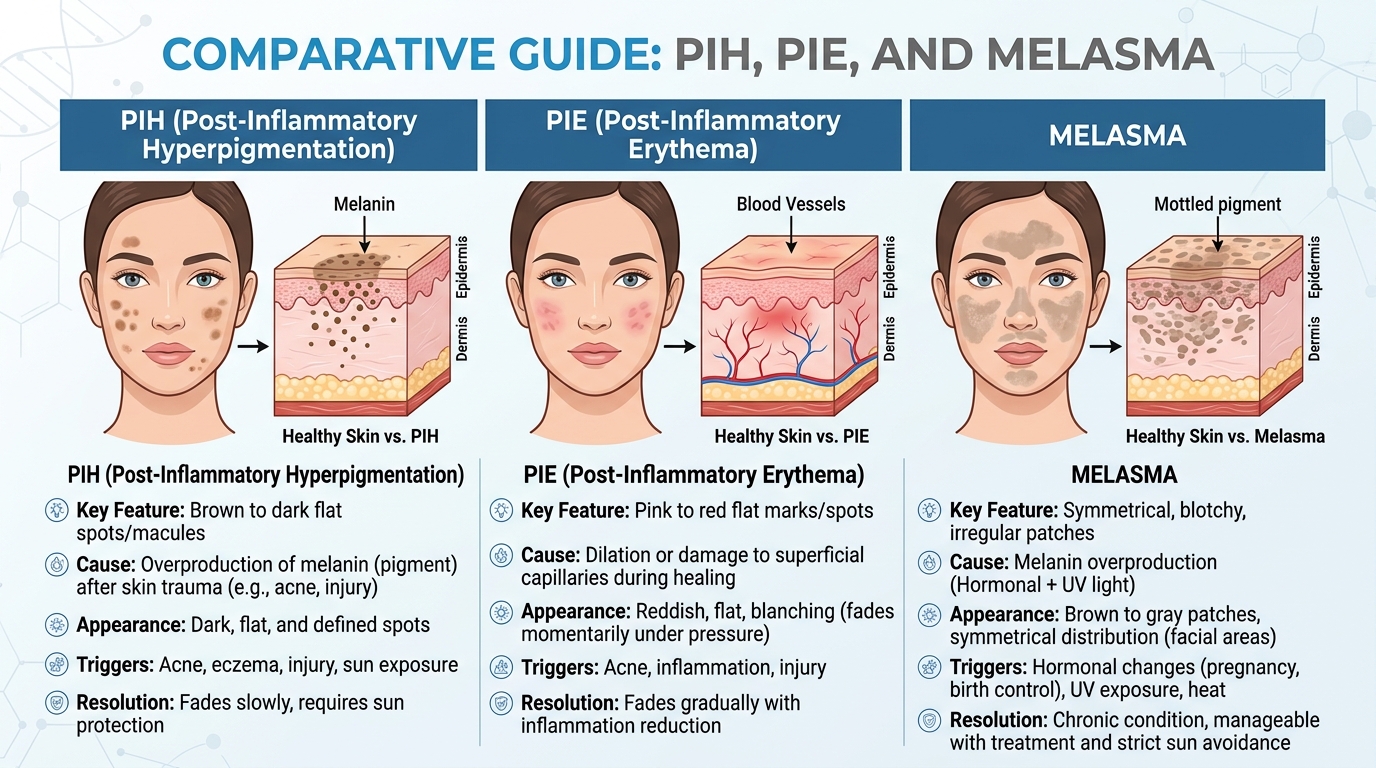
The Hormonal & Acne Zone: High estrogen receptor density predisposing to butterfly melasma, acne breakouts leaving stubborn PIH dark marks, and barrier redness.
👁️ Zone 4: The Periorbital (Under-Eye & Tear Trough) Zone
The skin under your eyes is the thinnest on your entire body (barely 0.5 mm thick) and completely devoid of oil glands. In South Asians, structural shadowing, visible blue-purple blood vessel pooling, genetic melanin deposition, and digital screen strain make this zone appear distinctly darker than surrounding cheeks. Learn more in our guide to dark circles under eyes in Indian skin.
Treating all four zones with the exact same heavy-handed active will inevitably over-irritate delicate zones (like the perioral ring) while failing to penetrate resilient zones (like the forehead). A zoned strategy is mandatory.
Pigmentary Demarcation Lines (PDL): Why Your "Dual-Tone" May Be Genetic
One of the most profound revelations for Indian patients is discovering that their "patchy, two-toned face" may not be a skincare problem at all, but a natural human biological trait known as Pigmentary Demarcation Lines (PDL), or the Lines of Matzumoto.
Facial PDL Type F (Chevron Lines)
Presents as V-shaped or chevron-like hyperpigmented borders extending from the temples diagonally inward toward the outer orbital rim and cheekbones. It gives the appearance of a darker "outer frame" around the face.
Facial PDL Type G (W-Shaped Lines)
Presents as W-shaped demarcated bands of darker pigmentation curving from the zygomatic arches down toward the corners of the mouth and jawline.
🧬 The Evolutionary Embryonic Origin
During embryonic development in the womb, neural crest melanocytes migrate across the skin along neuroectodermal pathways. In skin of colour (especially South Asian, Middle Eastern, and African populations), physiological lines of sharp color transition form where dorsal and ventral nerves meet. Over 60% of Indian adults naturally possess facial PDLs. They often become more pronounced after puberty or during pregnancy due to hormonal modulation.
Why this matters: Millions of Indian women and men spend fortunes on salon chemical bleaches, steroid fairness creams, and aggressive peels attempting to "rub off" their facial PDLs, believing they are dirt or sun damage. You cannot bleach away your embryonic genetics. Attempting to do so inflicts chemical burns, destroys your lipid barrier, and creates permanent post-inflammatory hyperpigmentation.
Environmental & Lifestyle Triggers: Kitchen Heat, Hard Water & Pollution
In addition to UV sunlight, several lifestyle and environmental factors unique to India actively drive facial tone unevenness:
Thermal Melanogenesis (Kitchen & Stove Heat)
Cooking chapatis, tadkas, and curries over open gas stoves exposes the face to intense infrared heat (temperatures exceeding 40°C). Heat stimulates TRPV4 ion channels on melanocytes, triggering melanin synthesis without a single ray of sunlight.
Commuter Smog & PM2.5 Micro-Pollution
Urban Indian air (in Delhi NCR, Mumbai, Bengaluru, Kolkata) contains high levels of airborne particulate matter and polycyclic aromatic hydrocarbons (PAHs). These bind to AhR receptors in skin cells, driving oxidative stress and blotchy pigmentation.
Alkaline Tap Water (High TDS)
Bathing and washing your face with high-TDS municipal or borewell water disrupts the acid mantle (raising pH from 5.5 to >7.5). The compromised barrier suffers moisture loss, making dry areas look dull, ashen, and dark.
Salon Threading, Waxing & Razor Friction
Upper lip threading, facial waxing, or dry shaving pulls and lacerates delicate follicle margins. In brown skin, this acute mechanical friction triggers localized upper-lip mustache pigmentation.
Diagnostic Matrix: Uneven Tone vs. Melasma vs. Acanthosis vs. PIH
Before designing an active protocol, verify whether your facial unevenness is general dyschromia or a specific underlying condition:
| Diagnostic Category | Visual Pattern & Distribution | Primary Biological Trigger | Surface Texture | Best Dermatological Approach |
|---|---|---|---|---|
| General Uneven Tone ("Two-Tone Face") | Gradient shading; forehead and mouth 1–2 shades darker than cheeks | Sun angle, cumulative photoaging, thermal heat, mild barrier dehydration | Normal to slightly rough; dull light reflectance | Quadruple pathway actives (Niacinamide, Alpha Arbutin, Vitamin C) + SPF 50 |
| Melasma (Chloasma) | Symmetrical, well-demarcated brown/grey patches across malar cheeks and nose | Estrogen/progesterone shifts, thyroid imbalance, UV-A and visible light | Smooth; flat epidermal/dermal pigment deposits | Oral/topical Tranexamic Acid, Azelaic Acid, strict Iron Oxide mineral sunscreen |
| Facial Acanthosis Nigricans | Velvety, thickened dark brown/black patches on lateral forehead, temples, jawline | Insulin resistance, hyperinsulinemia stimulating IGF-1 receptors, PCOS | Thickened, velvety, leathery with accentuated skin lines | Metabolic correction, low-GI diet, weight optimization, topical Urea / Lactic acid |
| Post-Acne Dark Marks (PIH) | Discrete, circumscribed dark spots corresponding to previous acne papules | Melanocyte hyperactivity following inflammatory acne wound healing | Flat spots; occasionally paired with textural acne scars | Adapalene 0.1%, Azelaic Acid 15%, chemical peels (Mandelic/Salicylic) |
The Dermatological Quadruple-Pathway: How to Correct Uneven Tone
Single-ingredient serums (such as using Vitamin C alone or Niacinamide alone) almost always produce disappointing results for Indian skin. Melanin production is a complex cascade. To achieve uniform radiance, dermatologists employ a quadruple-pathway synergy:
Pathway 1: Inhibit Tyrosinase at the Source (The Enzyme Factory)
Active Agents: Alpha Arbutin (2%), Kojic Acid (1%–2%), Azelaic Acid (10%–15%)
Tyrosinase is the copper-dependent rate-limiting enzyme that converts L-tyrosine into dopaquinone (the precursor of melanin). Alpha Arbutin and Kojic acid safely compete for tyrosinase active sites, downregulating melanin production without killing melanocyte cells.
Pathway 2: Block Melanosome Transfer to Skin Cells (The Transport)
Active Agent: Niacinamide (Vitamin B3) at 5%
Even when melanin is formed inside melanocytes, it must be packaged into cellular vesicles called melanosomes and transferred into surrounding epidermal keratinocytes. Niacinamide at a 5% concentration effectively shuts down this transfer pathway by up to 68%, preventing dark pigment from reaching visible surface layers.
Pathway 3: Accelerate Epidermal Cell Shedding (The Exfoliation Engine)
Active Agents: Adapalene (0.1%), Retinol (0.3%), Lactic Acid (5%–10%)
Melanized skin cells in an uneven face linger on the surface for weeks. Topical retinoids accelerate the mitotic rate of basal cells, pushing fresh, non-pigmented cells to the surface, while gentle Lactic Acid dissolves dull intercellular glue without physical scrubbing.
Pathway 4: Quench Vascular & Thermal Inflammation (The Firefighter)
Active Agents: Tranexamic Acid (3%–5%), Centella Asiatica (Cica)
Tranexamic acid inhibits the plasminogen/plasmin system, preventing inflammatory prostaglandins and arachidonic acid cascades from triggering melanocytes after sun, kitchen heat, or friction exposure.
The Complete AM/PM Routine for Uneven Facial Tone in India
Here is an evidence-backed daily protocol structured specifically for Indian urban climates and skin sensitivity:
Morning Routine: Protect & Shield
1. Cleanse: Mild soap-free amino acid cleanser (pH 5.5).
2. Antioxidant Serum: 10% Ethyl Ascorbic Acid (Vitamin C) + Ferulic Acid to neutralize commuter pollution free radicals.
3. Hydrate: Lightweight, oil-free ceramide gel moisturizer.
4. Sun Protection: Broad-spectrum SPF 50+ PA++++ with Iron Oxides. Reapply every 3 hours outdoors.
Evening Routine: Correct & Renew (Skin Cycling)
Night 1 (Exfoliation): Lactic Acid 5%–10% or Mandelic Acid serum + ceramide cream.
Night 2 (Retinoid): Pea-sized Adapalene 0.1% gel (buffered with moisturizer).
Nights 3 & 4 (Barrier Recovery): 5% Niacinamide serum + rich ceramide & squalane moisturizer.
Repeat the 4-night cycle continuously.
✅ The Zone-Buffering Trick for Perioral Darkness
Because the area around your mouth is more prone to irritation and peeling, always apply a thin layer of plain moisturizer around your mouth before applying your retinoid or exfoliant (the "Sandwich Buffer"). This protects delicate perioral skin from getting inflamed and turning paradoxically darker.
In-Clinic Procedures: Q-Switched Lasers, Peels & Medi-Facials
For patients who want faster, clinical-grade correction of deep two-tone discolouration, procedural dermatology offers safe, non-invasive solutions:
| Procedure | How It Evens Out Tone | Safety for Indian Skin | Recommended Sessions |
|---|---|---|---|
| Q-Switched Nd:YAG Laser (1064 nm Laser Toning) | Photoacoustic shockwaves shatter fragmented melanin deposits across darker zones without thermal heat damage to surrounding skin. | High Safety Gold standard for Fitzpatrick IV–VI skin when low fluences and large spot sizes are used. | 4 to 6 sessions spaced 3 weeks apart |
| Superficial Combination Peels (Mandelic / Lactic / Arginine) | Gently dissolves surface hyperkeratinized cells, evens out skin light reflection, and enhances cellular turnover. | High Safety Very mild, no downtime, minimal risk of post-inflammatory hyperpigmentation. | 4 to 6 sessions spaced 2 to 3 weeks apart |
| The Carbon Laser Medi-Facial ("Hollywood Peel") | A liquid carbon lotion penetrates pores; the 1064 nm laser evaporates the carbon, clearing surface sebum, dead cells, and superficial pigmentation. | High Safety Excellent pre-event brightening treatment with zero peeling. | 1 session every 4 to 6 weeks |
| High-Strength TCA (>30%) or Phenol Peels | Causes deep chemical necrosis through the reticular dermis. | Forbidden Severe risk of permanent depigmentation (leukoderma) or disfiguring rebound hyperpigmentation. | NEVER USE ON BROWN SKIN |
Common Myths & Mistakes: Why Home Bleaching Worsens Uneven Skin
Frequently Asked Questions About Uneven Facial Skin Tone in India
In Indian skin (Fitzpatrick IV–VI), the forehead and perioral (mouth) area darken faster due to three distinct biological and anatomical reasons: (1) Sun Exposure Angle: The forehead is positioned perpendicular to the overhead tropical sun, receiving up to 2.5 times more UV radiation and infrared heat than the vertical cheeks; (2) Mechanical Movement & Barrier Stress: The mouth area experiences continuous mechanical stretching from talking, eating, and facial expressions, alongside salivary enzyme leakage, lip-licking habits, and friction from hair removal (threading/waxing); and (3) Natural Pigmentary Demarcation Lines (PDL): Over 60% of South Asians possess genetic embryonic pigment borders (Lines of Matzumoto, Types F and G) where melanin density naturally increases around the face perimeter.
Pigmentary Demarcation Lines (PDL), also known as the Lines of Matzumoto, are physiological, genetically determined boundary lines between hyperpigmented and lighter skin. On the face, Type F lines present as V-shaped or chevron-like darker bands on the lateral temples and cheeks, while Type G lines present as W-shaped demarcations across the lateral cheeks. PDLs are not a disease and cannot be permanently 'bleached away.' Attempting to remove them with harsh bleaching creams, hydroquinone, or aggressive peels inflicts severe chemical burns and rebound post-inflammatory hyperpigmentation (PIH).
Standing over hot gas stoves, frying pans, or ovens for extended periods exposes facial skin to intense infrared radiation and thermal heat. Human melanocytes possess heat-sensitive ion channels known as Transient Receptor Potential Vanilloid 4 (TRPV4). When heated above 38°C (100°F), these receptors stimulate melanocyte tyrosinase activity directly, triggering melanin synthesis without any direct ultraviolet light exposure. This is why many individuals who work indoors or cook regularly develop patchy, dark uneven facial skin despite avoiding the sun.
Dermatologists recommend a multi-target 'quadruple pathway' approach rather than relying on a single active: (1) Tyrosinase Inhibitors (Alpha Arbutin 2% or Kojic Acid 1%) to suppress melanin synthesis; (2) Melanosome Transfer Blockers (Niacinamide 5%) to stop pigment packages from transferring into skin cells; (3) Cellular Renewal Stimulators (buffered Retinoids like Adapalene 0.1% or Retinol, paired with mild Lactic Acid 5%–10%) to accelerate the shedding of pigmented cells; and (4) Vascular/Inflammatory Calmers (Tranexamic Acid 3%–5%) to quiet micro-inflammation.
Commercial salon bleach kits contain hydrogen peroxide and ammonium hydroxide that chemically oxidize superficial melanin and strip the stratum corneum. In melanin-rich South Asian skin, this chemical trauma triggers an immediate, aggressive inflammatory response, causing melanocytes to produce excess melanin (Post-Inflammatory Hyperpigmentation). Similarly, walnut or apricot facial scrubs create microscopic tears on already sensitized, uneven skin, leading to chronic low-grade friction and deepening the 'two-tone' appearance.
Because the natural epidermal cell turnover cycle in adults is approximately 28 to 40 days, visible improvements in skin radiance, texture, and light reflectance typically become apparent within 4 to 6 weeks of a consistent dermatological protocol. Significant, measurable balancing of two-toned pigment between the forehead, cheeks, and perioral zones requires 3 to 6 months of disciplined active usage, daily broad-spectrum sun protection, and barrier maintenance.
Yes. Standard clear chemical sunscreens only filter UV-A and UV-B rays, but fail to block High-Energy Visible Light (HEVL / blue light from the sun and computer screens). Research shows that visible blue light stimulates deep, long-lasting hyperpigmentation specifically in Fitzpatrick IV–VI skin. Dermatologists recommend using a broad-spectrum SPF 50+ PA++++ sunscreen formulated with mineral Zinc Oxide and Iron Oxides (tinted), which physically block both UV and visible blue light.
Yes, when performed by an experienced dermatologist using superficial, pigment-friendly formulations. Superficial chemical peels containing large-molecule acids like Mandelic Acid (20%–30%), Lactic Acid (20%), Arginine, or specialized Yellow Peels gently loosen dead pigmented cells without triggering deep thermal or chemical necrosis. Deep TCA peels or aggressive ablative lasers should be strictly avoided due to the high risk of post-inflammatory hyperpigmentation in Indian skin.