
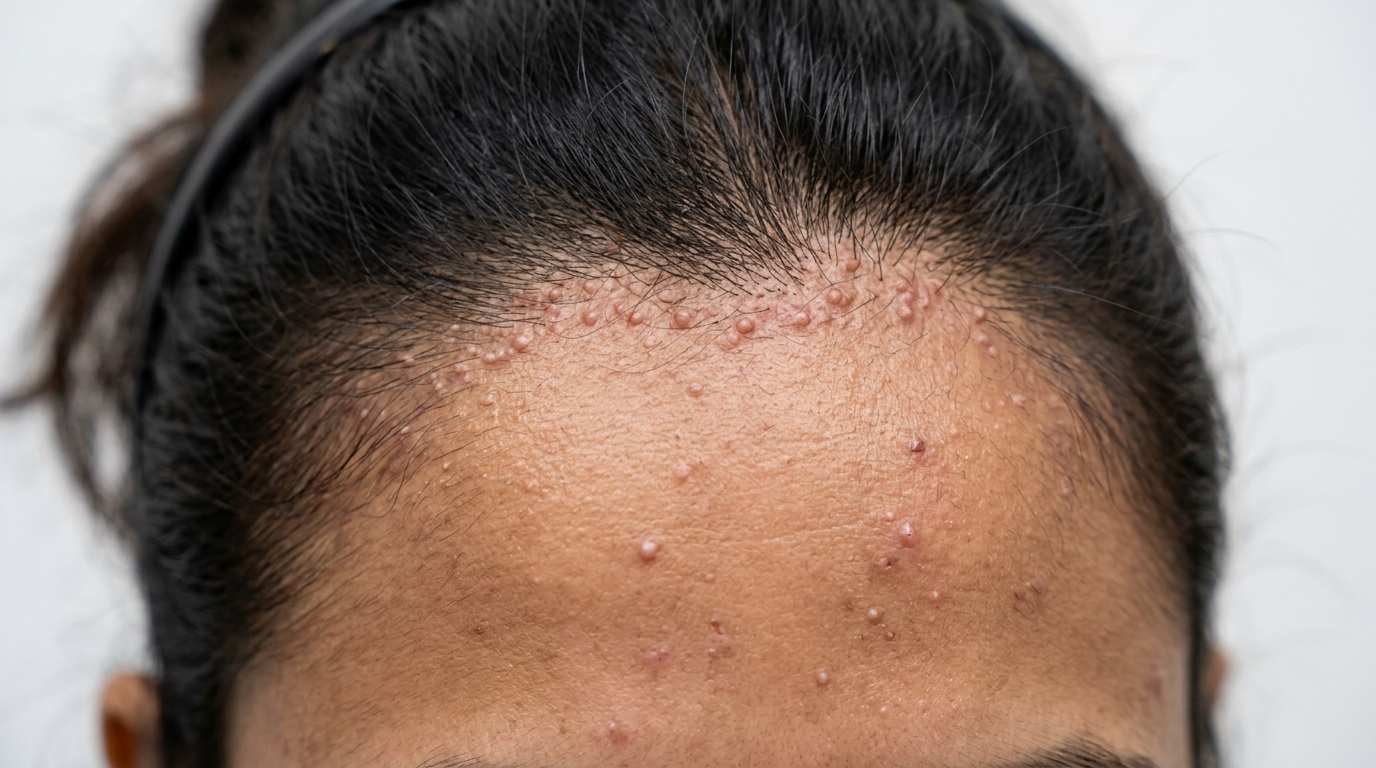
1. Forehead Sebum Physiology & T-Zone Vulnerability
The forehead forms the top of the facial T-Zone, an anatomical area with the highest density of sebaceous glands on the human body (~400 to 900 glands per square centimeter).
Because of this intense oil secretion, the forehead is uniquely susceptible to pore clogging. When excess sebum combines with environmental pollution, hair products, or sweat trapped under hair bangs, it forms stubborn closed comedones (whiteheads) or triggers fungal yeast overgrowth.
The Hair Oil "Champi" Trap
In Indian culture, applying warm coconut oil, mustard oil, or herbal hair oils (*champis*) overnight is a widespread tradition. However, dermatologists note that heavy oils (Comedogenic Rating 4/5) naturally migrate down the forehead during sleep. These lipid chains plug hair follicles, trapping Cutibacterium acnes and causing severe Pomade Acne.
2. 4 Primary Root Causes of Forehead Pimples in India
Dermatological evaluation categorizes forehead breakouts into four primary root causes:
Caused by heavy coconut oil, hair waxes, or conditioners dripping onto the forehead. Presents as dense clusters of non-inflamed whiteheads right along the upper hairline.
Frequent in two-wheeler riders. Helmet inner padding rubs against sweaty forehead skin, causing mechanical trauma, pore occlusion, and red inflammatory papules.
Triggered by hot, humid weather and trapped sweat. Appears as uniform, tiny, intensely itchy red bumps across the forehead that do not respond to acne creams.
High-glycemic diets (refined carbs, sugary sweets, dairy) spike IGF-1 hormone levels, signaling forehead sebaceous glands to overproduce thick sebum.
3. Differential Diagnosis: Fungal Acne vs Comedonal Forehead Bumps
Distinguishing fungal yeast bumps from regular comedonal acne is critical for successful treatment:
Fungal Acne vs Bacterial Comedones Diagnostic Test
• Fungal Acne: All bumps are identical in size (monomorphic), intensely itchy under sweat, have zero whiteheads/blackheads, and flare up after using antibiotics or heavy moisturisers.
• Comedonal Acne: Varied sizes of blackheads and whiteheads, non-itchy, and responds to Salicylic Acid 2% (BHA) and Adapalene 0.1% Gel.
4. Clinical Diagnosis & Active Treatment Matrix Table
Compare forehead acne root causes, visual markers, and gold-standard active treatments:
| Forehead Cause | Visual & Sensory Markers | Underlying Trigger | Gold Standard Active | Key Prevention Step |
|---|---|---|---|---|
| Hair Oil Pomade Acne | Dense whiteheads along hairline, non-itchy | Coconut / Mustard oil migration | Salicylic Acid 2% (BHA) Wash | Wash oil off scalp before sleep; wear headband |
| Fungal Acne (Malassezia) | Uniform tiny red bumps, intensely itchy | Yeast overgrowth in humid sweat | Ketoconazole 2% Antifungal Shampoo Wash | Avoid heavy oils; wash forehead after workouts |
| Acne Mechanica (Helmet) | Tender red papules where helmet pad presses | Sweat + mechanical friction | Benzoyl Peroxide 2.5% Gel | Disinfect helmet liner with alcohol wipes weekly |
| Seated Comedonal Acne | Blackheads & whiteheads scattered across T-zone | Excess T-zone sebum + dead cells | Adapalene 0.1% Gel | Use oil-free gel moisturizer (Acnemoist) |
5. 4-Step Clinical Forehead Clearance Sequence
Follow this daily recovery sequence to clear forehead pimples safely:
- Step 1: Targeted BHA Cleansing (AM & PM): Wash your forehead with Salicylic Acid 2% Face Wash. Let the lather sit for 60 seconds before rinsing.
- Step 2: Ketoconazole Wash (For Fungal Bumps 2x Weekly): If your forehead bumps are itchy, apply Ketoconazole 2% shampoo as a 5-minute forehead mask twice weekly.
- Step 3: Nighttime Retinoid Application: Apply a pea-sized amount of Adapalene 0.1% Gel across the forehead to accelerate cell turnover and unblock pores.
- Step 4: Oil-Free Hydration & Sun Protection: Lock in hydration with a gel moisturizer (read Best Ceramide Moisturizer for Acne Prone Indian Skin) and non-comedogenic sunscreen.
Unsure of Your Forehead Pimple Cause?
Take our 60-second AI Skin Scan for visual pore analysis and instant active matching.
Start Free AI Skin Scan →6. Prevention & Haircare Hygiene Guidelines
Prevent forehead breakouts from returning with these simple lifestyle modifications:
- Pre-Shampoo Hair Band: Wear a wide cotton headband when oiling hair to block oil from reaching forehead skin.
- Clean Helmet Padding: Disinfect two-wheeler helmet inner pads with 70% alcohol sprays twice weekly.
- Keep Hair Bangs Off Forehead: If you have bangs or fringe hair, pin them back during hot humid afternoons.
7. Frequently Asked Questions
The primary causes of forehead pimples in India are: (1) Hair oil pomade acne from traditional coconut/mustard hair oiling (champis) dripping onto the forehead, (2) Sweat and friction from two-wheeler helmets (Acne Mechanica), (3) Fungal acne (Malassezia folliculitis), and (4) Excess sebum in the T-zone.
Heavy natural oils like coconut oil or mustard oil are highly comedogenic (Comedogenic Rating 4/5). When left overnight on the scalp, body heat causes the oil to seep down onto the forehead, plugging hair follicles and trapping C. acnes bacteria.
Fungal acne presents as uniform, tiny, itchy bumps strictly along the forehead and hairline that flare up in hot, humid weather. Unlike bacterial acne, fungal acne has no blackheads or varied sizes and does not respond to standard acne creams like Benzoyl Peroxide.
Salicylic Acid 2% (BHA) is the gold standard for comedones and oil-clogged pores because it dissolves sebum deep inside follicles. For fungal forehead bumps, Ketoconazole 2% wash used 2-3 times weekly clears yeast within 14 days.