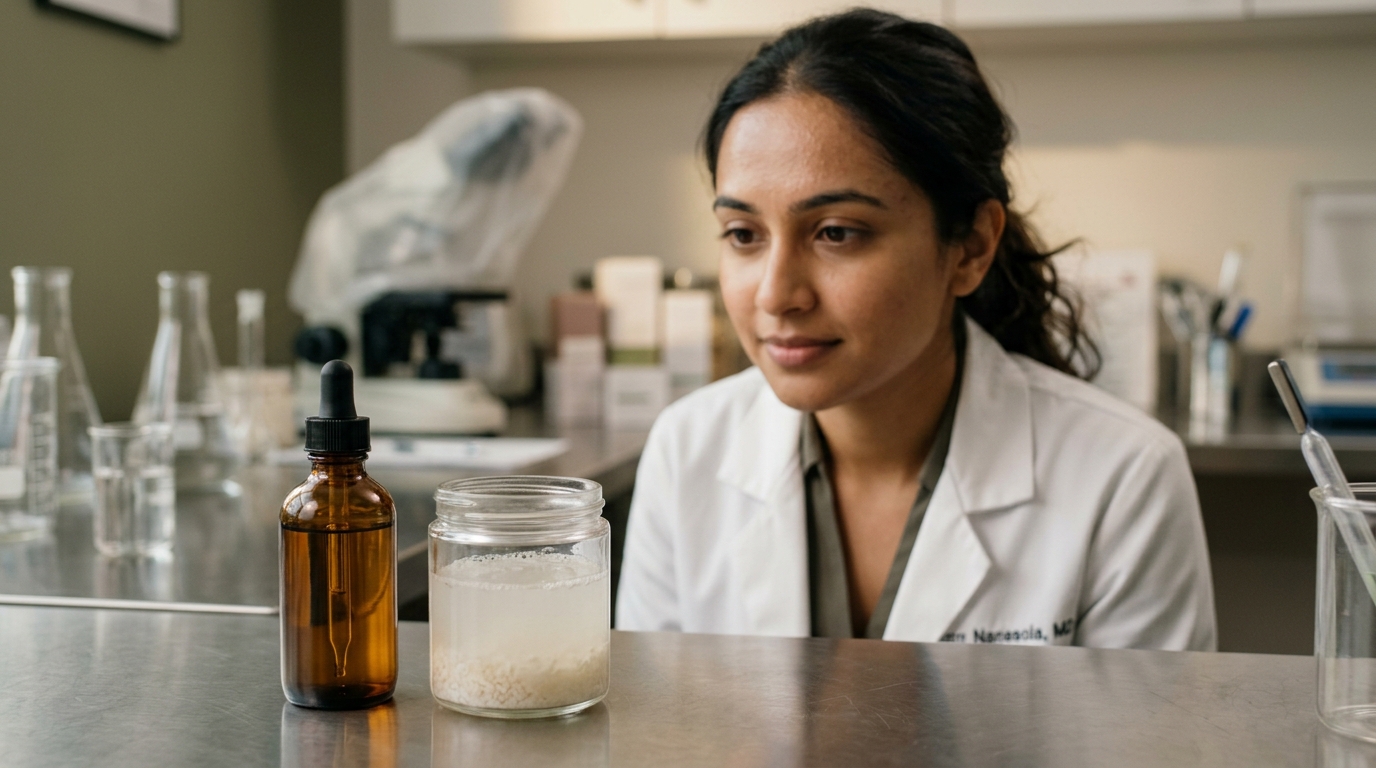
The Clinical Verdict: Does Rice Water Cause Fungal Acne?
Yes, homemade DIY rice water is one of the most common cosmetic triggers for Malassezia folliculitis (fungal acne) and sudden inflammatory breakouts in India. However, the culprit is almost never the rice molecule itself—it is the raw, unhydrolyzed starch residue and unsterile kitchen fermentation.
When you boil or soak white rice on your kitchen counter in Mumbai, Delhi, Chennai, or Bengaluru, you extract massive starch polymers (amylose and amylopectin) alongside proteins and minerals without any micro-filtration or broad-spectrum antimicrobial preservatives. When applied to human skin in warm, humid weather, this creates an occlusive biological layer that suffocates pores and alters your natural microbiome.
The Starch Substrate Trap: What Actually Happens in Indian Heat
To understand why rice water provokes such aggressive breakouts on Indian skin, we must look at follicular microbiology under tropical ambient conditions.
1. The Amylose & Amylopectin Biofilm
Raw rice grains are composed of roughly 75% to 80% complex starch. When soaked in water, raw starch granules swell and disperse into a cloudy suspension. When splashed onto the face and allowed to dry, the water evaporates, leaving behind a microscopic, cellophane-like polymeric film over the stratum corneum.
This starch film is physically occlusive. For oily and acne-prone skin types with active sebaceous glands, this film acts like a cap over the follicular infundibulum (pore opening), trapping sebum, sweat, and sloughed keratinocytes underneath.
2. Why Malassezia Thrives Under Starch Occlusion
Malassezia (formerly known as Pityrosporum) is a lipophilic yeast that naturally inhabits human skin, feeding on free fatty acids in sebum with carbon chain lengths between C12 and C24. While Malassezia does not eat starch directly, the occlusive starch film supercharges its environment in three lethal ways:
- Anaerobic Microclimate: Trapping sebum elevates local follicular temperature and humidity, creating a tropical greenhouse inside the hair follicle.
- Hydrolytic Digestion by Secondary Bacteria: Commensal skin bacteria secrete amylases that break raw starches down into simple sugars, which opportunistic yeasts and bacteria consume voraciously.
- Enzymatic Lipase Cascade: Malassezia pumps out lipases to cleave trapped sebum into irritating free fatty acids, triggering massive follicular inflammation, itching, and monomorphic pustules.
Diagnostic Checklist: Did Rice Water Trigger Fungal Acne or a Regular Breakout?
Treating fungal acne with traditional acne medications (like Benzoyl Peroxide or Salicylic acid alone) often worsens the condition by stripping your barrier. Use this dermatological diagnostic matrix to identify your exact reaction:
| Diagnostic Feature | Malassezia (Fungal Acne) | Acne Vulgaris (Bacterial) | Contact Dermatitis (Spoilage) |
|---|---|---|---|
| Causative Microbe | Malassezia restricta / globosa (Yeast) | Cutibacterium acnes (Bacteria) | Non-microbial chemical irritation or toxin |
| Lesion Appearance | Monomorphic (1–2mm uniform red bumps/white pustules) | Polymorphic (mixture of blackheads, cysts, whiteheads) | Diffuse redness, micro-vesicles, rough texture |
| Presence of Itching | Intense / Pruritic (worse with sweat) | Rarely Itchy (tender/throbbing) | Stinging & Burning |
| Primary Location | Forehead, hairline, temples, chest, upper back | Cheeks, jawline, chin, nose | Exact area where rice water was applied |
| Blackheads Present? | No open or closed comedones | Yes, abundant comedones | No |
| Response to Anti-Acne Actives | Resistant or made worse by heavy acne creams | Responds to BHA, Retinoids, Benzoyl Peroxide | Violently burns and worsens with actives |
| Response to Antifungals | Clears in 48–72 hrs (Ketoconazole) | Zero clinical response | No improvement |
If you're unsure which type of breakout you are dealing with, take a 30-second free photo analysis using our AI Scanner before applying harsh medicated washes.
The "Hairline & Forehead Cluster": Why Rice Water Hits the T-Zone First
Over 80% of individuals who experience rice-water-induced fungal folliculitis report that the bumps concentrated along their forehead, temples, and upper hairline. There are three physiological reasons for this localization:
1. Extreme Sebaceous Gland Density
The human forehead contains between 400 and 900 sebaceous glands per square centimeter—nearly four times higher than the cheeks or neck. Because Malassezia relies exclusively on human sebum for survival, the oily T-zone represents its primary habitat on the human face.
2. The Hair Rinse Runoff Phenomenon
Many people in India prepare DIY rice water primarily for hair growth and scalp conditioning. When rinsing rice water out of the hair in the shower, the cloudy starch liquid runs directly down the forehead, temples, and nape of the neck. Unless washed off immediately with a gentle surfactant, the starch settles deep into the frontal hair follicles, seeding an acute breakout.
3. Scalp Seborrheic Cross-Contamination
If you have even mild dandruff (pityriasis capitis), your scalp is already colonized with high concentrations of Malassezia furfur. Pouring nutrient-dense rice water over your scalp and hairline causes the yeast population to multiply exponentially and migrate down the forehead.
The 72-Hour Dermatological Emergency Relief Protocol
If DIY rice water has triggered itchy red bumps across your face, follow this clinical 4-step emergency recovery protocol developed for Indian skin:
Total DIY Cessation & Barrier Reset
Immediately discard all homemade rice water, toners, and kitchen pastes. Stop all chemical exfoliants (AHA/BHA), retinoids, pure oils (coconut, castor, almond), and heavy moisturizing creams containing fatty acids or esters (such as Isopropyl Myristate, Polysorbates, or Glyceryl Stearate) which feed fungal yeast.
Ketoconazole 2% Anti-Yeast Cleansing Mask
Purchase a standard OTC Ketoconazole 2% wash (such as Nizral 2%, Scalpe+, or Danfree) from any Indian pharmacy. Wet your face with lukewarm water, gently lather a coin-sized amount over the affected bumps, and leave it on for exactly 3 to 5 minutes before rinsing thoroughly. Repeat once daily for 3 consecutive days, then reduce to 2 times weekly.
Clinical note: The 5-minute contact time is essential to allow the imidazole molecule to disrupt the fungal ergosterol cell membrane.
Apply Pure Oil-Free Barrier Gels
Skin treated with antifungal washes can become tight and dehydrated. Protect your acid mantle using strictly 100% Malassezia-safe hydrators. The gold standards available in India are:
- Sebamed Clear Face Care Gel: Contains Hyaluronic Acid, Aloe, and Allantoin with zero lipids, oils, or emulsifiers.
- Minimalist Oat Extract 6% Gentle Cleanser: For gentle non-stripping morning washes.
- Benton Aloe Propolis Soothing Gel: Naturally antimicrobial and completely yeast-safe.
Incorporate Zinc PCA or Zinc Pyrithione
Once active itching subsides, add a 1% Zinc PCA serum to inhibit excess sebum production and suppress yeast recurrence without disrupting your moisture barrier. Learn how in our Zinc PCA vs Niacinamide Guide.
Lab-Fermented Rice Toners vs Raw DIY: Can You Ever Use Rice on Fungal-Acne Skin?
A common question from patients is: "If DIY rice water broke me out, does that mean I can never use Korean or Indian rice water toners?"
The answer is that lab-formulated rice toners are fundamentally different cosmetic preparations. When reputable laboratories formulate rice skincare, the rice undergoes industrial microbial bio-fermentation using isolated strains (such as Saccharomyces or Aspergillus oryzae), followed by:
- Micro-Filtration & Centrifugation: Large starch molecules (amylose/amylopectin) that form heavy occlusive films are completely filtered out, leaving behind only low-molecular-weight amino acids, vitamins, and ferulic acid.
- Broad-Spectrum Preservation: Stabilized with phenoxyethanol, ethylhexylglycerin, or 1,2-hexanediol to prevent any bacterial or fungal growth inside the bottle.
- Controlled Acid Mantle Buffering: Buffered precisely to pH 5.0–5.5 to support healthy barrier enzymes.
| Popular Rice Product in India | Texture & Vehicle | Malassezia / Fungal Acne Safety | Verdict for Prone Skin |
|---|---|---|---|
| Beauty of Joseon Glow Deep Serum (Rice Bran 68% + Arbutin 2%) | Watery, lightweight serum | Fungal-Acne Safe (No trigger lipids) | Ideal for PIH and dark spots |
| Plum 3% Niacinamide & Rice Water Toner | Watery toner | Safe (Oil-free, alcohol-free) | Great for oily Indian T-zone |
| Anua Rice 70 Glow Milky Toner | Milky essence | Use Caution (Contains Ceramides & Emulsifiers) | Best for dry/dehydrated non-fungal skin |
| The Face Shop Rice & Ceramide Emulsion | Heavy creamy emulsion | Triggers Fungal Acne (High ester & lipid load) | Avoid if prone to tiny bumps |
| Raw Homemade Kitchen Rice Water | Cloudy unpreserved starch suspension | Extremely Unsafe (100% Biofilm Risk) | Do not apply to acne-prone face |
For a complete breakdown of commercial rice products, read our comprehensive companion guide: Rice Water for Acne-Prone Skin: The Complete Indian Guide.
Frequently Asked Questions
No. While boiling sterilizes tap water and kills heat-sensitive microbes initially, cooking rice gelatinizes the starches, turning them into an even thicker, stickier amylopectin gel. When cooled and applied to the face, this dense starch layer forms an impermeable film over pores that feeds opportunistic bacteria and traps natural sebum within hours.
With immediate cessation of DIY rice water and the introduction of a Ketoconazole 2% contact wash (used for 3 to 5 minutes daily), most patients see significant flattening of bumps and complete relief from itching within 48 to 72 hours. Complete resolution of remaining erythema usually takes 7 to 10 days.
No. True purging only occurs with ingredients that accelerate cellular turnover, such as Retinoids (Adapalene, Tretinoin), Salicylic Acid, or Glycolic Acid. Rice water possesses zero keratolytic properties. Any breakout, rash, or bump eruption after using rice water is an adverse reaction (contact irritation, follicular clogging, or fungal infection)—never purging.
Traditional East Asian rituals historically utilized rice washings primarily for hair, body, or hands, or used specific sake-brewing byproducts under temperate, dry climatic conditions. Modern K-Beauty and J-Beauty formulations utilize lab-purified ferments (such as Pitera or Galactomyces) where all raw starches have been enzymatically filtered out. Furthermore, India's high tropical humidity and heat significantly accelerate microbial spoilage compared to temperate East Asian climates.
You should exercise caution. If the bumps are Malassezia folliculitis, Salicylic acid has mild antifungal properties, but high-strength leave-on BHA serums can severely irritate an already compromised skin barrier. The first-line medical intervention is an antifungal wash (Ketoconazole 2%), not aggressive acids. Once bumps subside, gentle 1%–2% BHA can be reintroduced to unclog residual sebum.
Refrigeration slows down bacterial multiplication, but it does not stop psychrotrophic microbes or remove raw starch polymers. Even cold rice water will form an occlusive starch film when applied to warm facial skin. In clinical dermatology, DIY kitchen concoctions are never recommended for active acne-prone skin.
