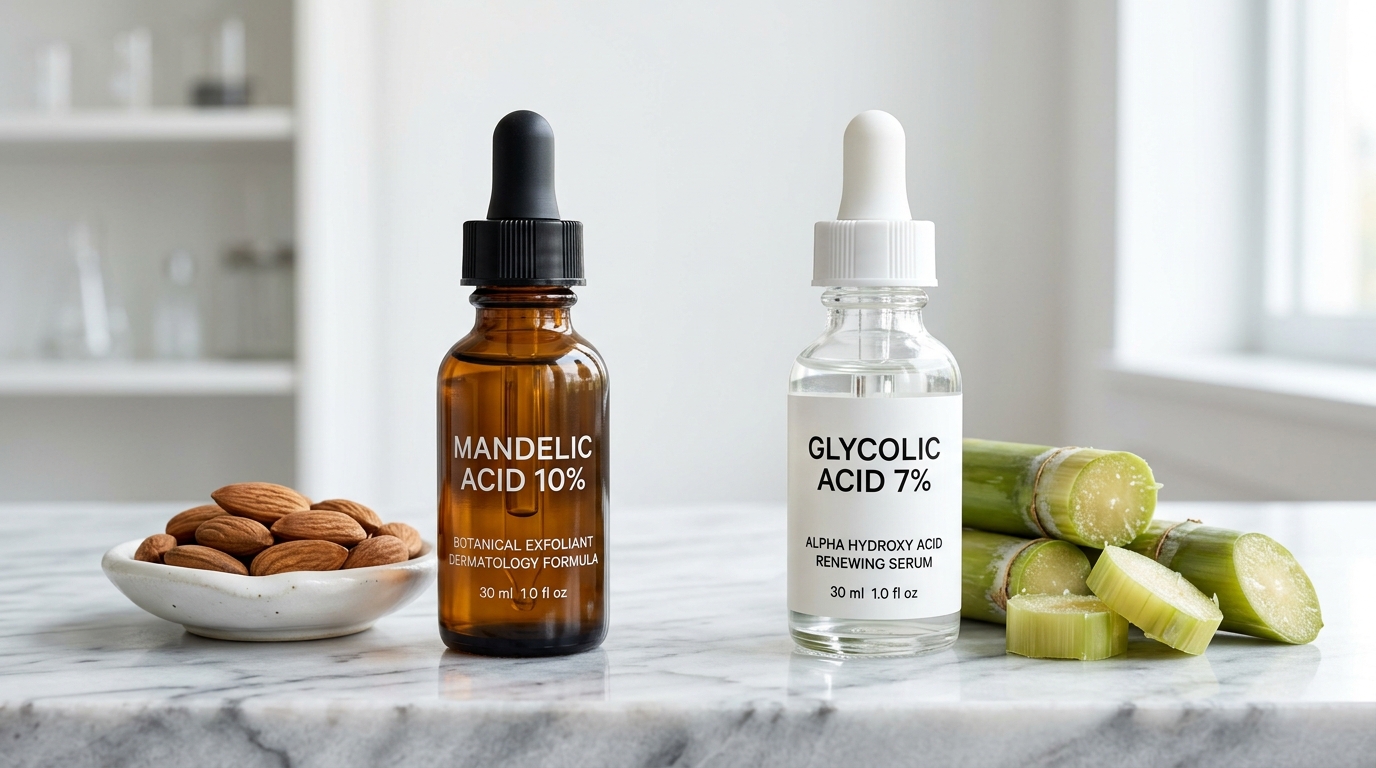
The Molecular Size Difference: 76.05 Da vs 152.15 Da
In dermatological pharmacology, the effectiveness and irritation potential of an alpha hydroxy acid (AHA) are not determined solely by its concentration (e.g., 7% vs 10%). Instead, the clinical behavior is dictated by its molecular weight (Daltons) and diffusion velocity across the stratum corneum.
When you apply an acid to your skin, it must pass through intercellular lipid bilayers. How fast it travels determines whether your epidermal cells gently desquamate or enter an inflammatory panic.
Glycolic Acid (The High-Speed Sprinter)
The simplest and smallest of all alpha hydroxy acids (C2H4O3). Because it lacks bulky chemical side chains, it possesses exceptionally high flux kinetics, penetrating deeply and rapidly into the viable epidermis in intense, concentrated bursts.
- ⚡ Flux Rate: Rapid, sharp penetration spikes.
- 💧 Solubility: Strictly water-soluble; cannot dissolve sebum.
- 🔥 Sensory Reaction: Immediate stinging, erythema, and heat.
Mandelic Acid (The Slow-Motion Speed-Bump)
Derived from the hydrolysis of bitter almond amygdalin (C8H8O3). Its bulky aromatic benzene ring provides steric hindrance, forcing the molecule to diffuse at approximately half the velocity of Glycolic Acid across human skin.
- 🛡️ Flux Rate: Slow, uniform, sustained desquamation.
- 🧴 Solubility: Dual hydrophilic + partial lipophilic affinity.
- 🌿 Sensory Reaction: Virtually zero tingling; zero cutaneous heat.
⚠️ Why Concentration Misleads Consumers: A 7% Glycolic Acid toner penetrates far faster and triggers significantly more inflammation than a 10% Mandelic Acid serum. Never assume a 10% acid is "stronger" than a 7% acid without factoring in molecular mass!
The Fitzpatrick Melanocyte Paradox: Why Glycolic Burns Cause Dark Marks
Indian skin predominantly spans Fitzpatrick phototypes III, IV, and V. While Caucasian skin (Fitzpatrick I and II) has smaller, less reactive melanosomes that usually react to acid overuse with temporary redness, Indian skin possesses large, eumelanin-dense melanosomes that are evolutionarily primed to react defensively to chemical trauma.
This biological reality creates what dermatologists call the Melanocyte Activation Threshold:
Head-to-Head Comparison Matrix: Mandelic vs Glycolic
This 8-point clinical evaluation illustrates the distinct pharmacological profile of both alpha hydroxy acids when applied to Indian skin:
| Evaluation Parameter | Glycolic Acid | Mandelic Acid | Clinical Verdict for Indian Skin |
|---|---|---|---|
| Molecular Weight | 76.05 g/mol (Smallest AHA) | 152.15 g/mol (Bulky Aromatic Ring) | Mandelic is 2x Larger |
| Penetration Velocity | High-velocity spike; rapid absorption | Gradual, uniform, slow-release diffusion | Mandelic prevents shock |
| PIH & Burn Risk | High on Fitzpatrick III–VI | Extremely Low / Safe | Mandelic is the gold-standard for brown skin |
| Sebum & Pore Affinity | Strictly water-soluble; bounces off oil | Partial lipophilic (oil-attracting) affinity | Mandelic penetrates clogged pores |
| Innate Antibacterial Power | Minimal direct antimicrobial action | Clinically bactericidal vs C. acnes | Mandelic actively targets acne bacteria |
| Fungal Acne (Malassezia) | Can trigger flare-ups via barrier disruption | Decomposes into antifungal benzaldehydes | Mandelic is safe for forehead bumps |
| Ideal Anatomical Zone | Thick body skin (knees, elbows, heels) | Delicate facial skin, neck, and chest | Face = Mandelic • Body = Glycolic |
| Typical Indian Pricing | ₹200 (Glyco 6) to ₹950 (The Ordinary) | ₹599 (Minimalist) to ₹750 (The Ordinary) | Both widely accessible across India |
The "Face vs Body" Anatomical Framework
Dermatologists do not believe Glycolic Acid is inherently "bad"—it is simply misused on delicate facial skin. To maximize both actives safely, follow our clinical anatomical zoning framework:
The 14-Day Recovery Bridge: Switching from Glycolic to Mandelic
If you currently have a compromised skin barrier, stinging, or newly darkened patches from overusing Glycolic Acid, do not switch to Mandelic Acid immediately. Follow this 3-phase rehabilitation protocol:
The Complete Actives Freeze
Stop all exfoliating acids, retinoids, benzoyl peroxide, and physical scrubs immediately. Wash only with lukewarm water or a soap-free, non-foaming lotion cleanser (Cetaphil Gentle or Episoft). Apply a generous layer of a ceramide-rich barrier repair cream twice daily. Never skip daytime SPF 50 sunscreen.
Acid Mantle Stabilization
Introduce soothing humectants (Hyaluronic Acid, Panthenol, or Centella Asiatica) into your routine. Ensure that splashing plain water on your face no longer produces stinging or tight pulling sensations. If your barrier is resilient and calm, prepare for gentle active reintroduction.
The Safe Mandelic Onboarding
Introduce 10% Mandelic Acid serum at a strict cadence of 2 nights per week (e.g., Monday and Thursday). Apply 3 drops to completely dry skin, wait 10 minutes, and seal with your barrier moisturizer. Gradually scale to 3 nights weekly after 4 weeks of zero irritation.
Leading Indian Formulations Compared (2026)
Here is how top-selling Indian market formulations stack up against each other:
Frequently Asked Questions
Glycolic acid's tiny 76-Da molecular size penetrates rapidly, triggering acute cutaneous inflammation in Fitzpatrick III–VI skin. This inflammation stimulates melanocytes to produce excess melanin via tyrosinase upregulation, causing rebound Post-Inflammatory Hyperpigmentation (PIH). Instead of shedding pigment, the skin defends itself by darkening.
You should not alternate both on your face. Using two different AHAs concurrently increases the risk of barrier degradation and chemical sensitization. However, you can use Mandelic Acid on your face and Glycolic Acid on your body (arms, elbows, legs) within the same week.
Yes. Clinical trials demonstrate that 10% Mandelic Acid stimulates dermal collagen production and cellular turnover at rates comparable to Glycolic Acid over a 12 to 16 week period. The key difference is that Mandelic achieves these anti-aging benefits without the erythema, micro-peeling, and photosensitivity typical of Glycolic.
Mandelic Acid is substantially better for active acne. Unlike Glycolic Acid which is strictly water-soluble and cannot penetrate through sebum, Mandelic Acid possesses partial lipophilic properties that allow it to enter oily pores and dissolve comedonal plugs while exerting direct antibacterial action against C. acnes.
Superficial redness and barrier stinging usually resolve within 7 to 14 days of dedicated barrier repair (ceramides, panthenol, pausing all actives). However, if the chemical burn triggered post-inflammatory hyperpigmentation (dark brown patches), fading the pigment can take 8 to 16 weeks of gentle melanin-inhibiting care and daily SPF 50 sunscreen.
