The 152-Dalton Molecular Speed-Bump: Why Size Dictates Safety
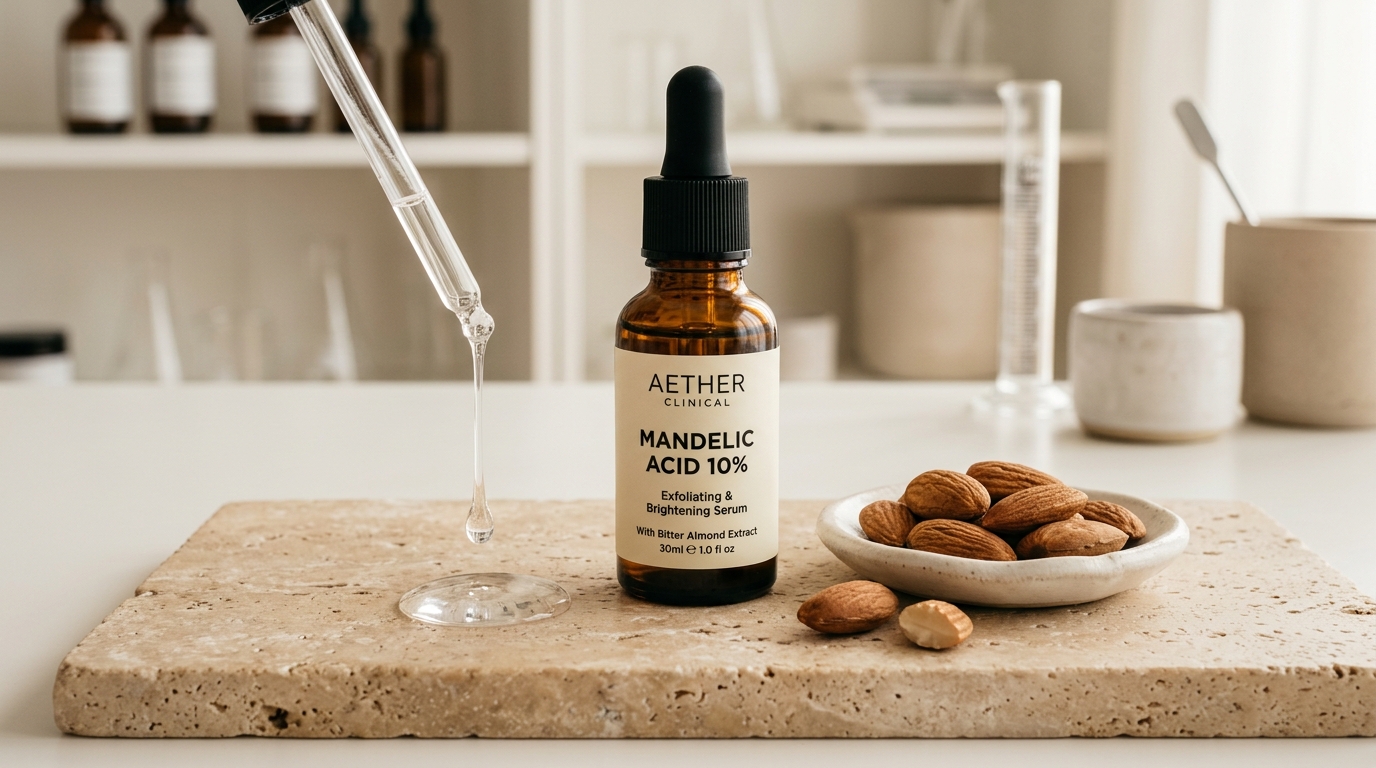
Mandelic Acid is an alpha hydroxy acid (AHA) naturally synthesized through the hydrolysis of amygdalin found in bitter almonds (Prunus dulcis var. amara). While Western marketing frequently pushes Glycolic Acid as the universal holy-grail exfoliant, Indian dermatologists have long recognized that Glycolic Acid is often too aggressive for melanin-rich skin.
The entire dermatological difference between acid comfort and severe chemical irritation boils down to a single physical parameter: molecular weight.
💡 The Clinical Kinetic Advantage: Because Mandelic Acid diffuses at half the velocity of Glycolic Acid, it breaks down the intercellular desmosomes holding dead corneocytes together uniformly without damaging the underlying viable keratinocytes. You achieve clinical-grade desquamation without peeling, erythema, or acid burns. Read our full clinical face-off: Mandelic Acid vs Glycolic Acid for Indian Skin (2026 Guide) →
The Fitzpatrick III–VI PIH Shield: Preventing Post-Acne Dark Spots
On Indian skin (Fitzpatrick phototypes III through VI), the primary danger of chemical exfoliation is not temporary redness—it is Post-Inflammatory Hyperpigmentation (PIH). Indian melanocytes are biologically wired with larger, more pigment-dense melanosomes that react defensively to inflammation.
When an aggressive acid damages the barrier:
- Epidermal keratinocytes release inflammatory cytokines (interleukin-1α, tumor necrosis factor-α).
- These cytokines stimulate nearby melanocytes, drastically upregulating the tyrosinase enzyme.
- Melanocytes over-synthesize eumelanin, depositing stubborn, deep brown or black pigmentation patches into the dermis that take 6 to 12 months to fade.
🌟 Why Mandelic Acid Breaks the PIH Cycle: Mandelic acid not only avoids triggering this inflammatory cytokine storm due to its slow diffusion, but clinical studies also show that Mandelic acid actively inhibits tyrosinase activity. It clears existing post-acne dark marks while simultaneously preventing new ones from forming during active breakouts.
The 4-Way Exfoliant Matrix: Mandelic vs Glycolic vs BHA vs Azelaic
To understand where Mandelic Acid fits in your skincare routine, compare its clinical characteristics against India's most common acne-fighting acids:
| Active Ingredient | Molecular Size | Solubility Type | PIH Risk on Indian Skin | Penetration Depth | Best Used For |
|---|---|---|---|---|---|
| Mandelic Acid | 152.15 Da (Large) | Water + Partial Lipid | Lowest Risk | Slow / Stratum Corneum | Sensitive acne, cystic PIH, fungal acne, beginner exfoliation |
| Glycolic Acid | 76.05 Da (Tiny) | Strictly Water Soluble | High Risk (Burns/PIH) | Rapid / Deep Epidermis | Thick sun-damaged skin, non-sensitive Caucasian skin, body keratosis |
| Salicylic Acid (BHA) | 138.12 Da (Medium) | Strictly Oil Soluble | Moderate (Overuse Peeling) | Pore Lining / Sebaceous Gland | Deep blackheads, severe oily T-zones, stubborn whiteheads |
| Azelaic Acid | 188.22 Da (Very Large) | Dicarboxylic Acid | Zero PIH Risk | Surface / Follicular canal | Rosacea redness, inflammatory pustules, hormonal melasma |
The "Lipophilic AHA" Paradox & Fungal Acne (Malassezia) Clearance
In classical dermatology, AHAs are water-soluble (working only on skin surface dead cells) while BHAs are oil-soluble (working inside oily pores). Mandelic Acid is the sole exception to this rule.
Because Mandelic acid contains an aromatic phenyl ring, it possesses unique partial lipophilic (oil-attracting) affinity. This dual-solubility grants it two distinct clinical advantages for Indian acne sufferers:
🍄 Dedicated Malassezia Protocol: If you struggle with stubborn forehead clusters and monsoon breakouts, read our complete guide on formulation safety, ketoconazole pairing, and fungal-safe serums: Mandelic Acid for Fungal Acne in India: The Malassezia Protocol →
The 3-Step Introduction Protocol for Indian Skin
Even though Mandelic acid is significantly gentler than Glycolic acid, incorrect application can still cause dryness. Follow this dermatologist-approved onboarding framework:
Mandatory Pre-Application Check
Apply 2 drops of Mandelic Acid serum to your inner wrist or jawline angle at night. Leave on for 24 hours. If zero swelling, itching, or hives occur, you are safe to proceed. (Note: individuals with severe nut allergies should consult an allergist before using bitter almond derivatives).
Evening Application Protocol
Cadence: Start with just 2 nights per week (e.g., Monday and Thursday) for the first 3 weeks. You may increase to 3 or 4 nights weekly only if skin shows zero tightness or flaking.
- Cleanse with a gentle, non-stripping cleanser (e.g., Episoft or Cetaphil Gentle).
- Pat face 100% dry. (Applying acids to damp skin accelerates absorption and causes mild stinging).
- Apply 3 to 4 drops of Mandelic Acid serum across face and neck. Gently press into skin.
- Wait 5 to 10 minutes for absorption.
- Follow with a lightweight, non-comedogenic gel moisturizer rich in ceramides or hyaluronic acid.
Broad-Spectrum UVA/UVB Protection
Like all AHAs, Mandelic acid thins the stratum corneum, increasing photosensitivity to Indian UV rays. You must apply a broad-spectrum SPF 50 PA++++ sunscreen every single morning to prevent sunlight from reversing your PIH clearance.
Top Mandelic Acid Serums in India Reviewed (2026)
Our clinical team evaluated the leading Mandelic acid formulations available across Indian pharmacies, Nykaa, and direct platforms:
Formulated with high-purity 10% Mandelic Acid combined with multi-molecular Hyaluronic Acid and Centella Asiatica leaf extract. It provides exceptional surface texture smoothing, dissolves closed comedones within 4 to 6 weeks, and contains zero added fragrance, essential oils, or drying alcohols.
A specialized low-concentration 5% Mandelic Acid serum buffered with Green Tea extract and Panthenol (Vitamin B5). Designed specifically for beginners who have previously experienced barrier breakdown from other acids. Highly effective for persistent redness, mild whiteheads, and sensitive skin barriers.
The iconic global benchmark formulation. Uses a propanediol-rich base that gives the serum an almost oil-like slip despite being completely oil-free. Ideal for individuals suffering from adult acne accompanied by dry, peeling patches.
Frequently Asked Questions
Mandelic acid can trigger a mild, brief purge because it accelerates cellular turnover and dissolves micro-comedones trapped beneath the stratum corneum. However, because its penetration rate is slow, the purge is typically much milder than that of Tretinoin or Glycolic acid, presenting as small, quickly resolving whiteheads rather than painful cystic flares. Purging usually subsides within 2 to 3 weeks.
Yes. In fact, Mandelic Acid (10%) and Niacinamide (2% to 5%) form a clinically synergistic duo for Indian skin. Mandelic acid loosens dead surface keratinocytes, while Niacinamide inhibits melanosome transfer, calms inflammation, and boosts ceramide synthesis. You can either use Niacinamide in the AM and Mandelic in the PM, or layer Niacinamide 10 minutes after Mandelic at night.
Most clinical trials show noticeable improvement in post-inflammatory hyperpigmentation (PIH) and skin texture within 4 to 8 weeks of consistent use (2 to 3 nights weekly). For deeper dermal post-acne marks, continuous use for 12 to 16 weeks alongside daily SPF 50 sunscreen provides optimal clearing.
Do not layer Mandelic Acid and pure Vitamin C (L-Ascorbic Acid) or Retinol on the same evening, as this can easily compromise your lipid moisture barrier. Instead, practice active cycling: use Vitamin C in the morning, Mandelic acid on Night 1, Retinol on Night 2, and take a barrier recovery night on Night 3.
Because Mandelic acid is chemically synthesized from bitter almond extracts, individuals with severe anaphylactic tree nut allergies should exercise caution. While cosmetic-grade Mandelic acid is highly purified, a dermatological patch test on the inner arm for 24 hours is mandatory prior to facial application.
