The Malassezia Yeast Dilemma in Indian Heat & Humidity
What millions of Indian teenagers and young adults call "stubborn forehead acne" is frequently not acne vulgaris at all. It is Malassezia folliculitis (formerly termed Pityrosporum folliculitis)—an opportunistic fungal infection of the hair follicle caused by lipophilic yeasts (chiefly Malassezia globosa and Malassezia restricta).
In tropical Indian climates (especially during the humid monsoon season or after sweat-heavy gym sessions), three factors combine to create the perfect incubator:
🚨 Why Traditional Acne Treatments Fail: Benzoyl Peroxide kills Cutibacterium acnes bacteria but has negligible efficacy against fungal yeast walls. Salicylic Acid dissolves pore debris, but lacks direct antimycotic cell-lysis properties. And aggressive Glycolic Acid strips your skin barrier, allowing yeast spores to burrow deeper into hair follicles and triggering severe Post-Inflammatory Hyperpigmentation (PIH). Note: If your bumps sting like pins-and-needles upon sweating rather than itching, consult our Heat Rash (Miliaria) vs Acne on Face Guide to rule out sweat duct occlusion.
The Antimycotic AHA: How Mandelic Acid Destroys Malassezia
Mandelic Acid is unique across the entire family of alpha hydroxy acids. While Glycolic and Lactic acids have zero antimycotic properties, Mandelic Acid possesses clinically validated antifungal and antibacterial efficacy.
This dual action works through two distinct biochemical mechanisms:
The 100% Malassezia-Safe Ingredient Audit: Don't Feed the Fungus
The number one reason Indian consumers fail to clear fungal acne with Mandelic Acid is not the acid itself—it is the carrier formula. Malassezia feeds on carbon fatty acid chains ranging from C11 to C24. If your Mandelic Acid serum or accompanying moisturizer contains yeast-feeding oils or esters, you are actively fertilizing the infection while trying to treat it!
❌ Banned: Yeast-Feeding Lipids
- • Polysorbates: Polysorbate 20, 40, 60, 80
- • Hydrogenated Oils: PEG-40 Hydrogenated Castor Oil
- • Fatty Acids: Lauric, Myristic, Palmitic, Stearic, Oleic
- • Esters: Isopropyl Myristate, Glyceryl Stearate
- • Natural Plant Oils: Almond, Coconut, Rosehip, Olive, Argan
✅ 100% Malassezia-Safe Actives
- • Pure Mandelic Acid 10% in water/propanediol
- • Humectants: Hyaluronic Acid, Glycerin, Panthenol (B5)
- • Safe Lipids: Pure 100% Sugarcane Squalane (C30)
- • Botanical Extracts: Centella Asiatica, Green Tea, Aloe
- • Antifungals: Ketoconazole, Zinc PCA, Ciclopirox
💡 Pro-Tip for Indian Skincare Shoppers: Always check the ingredient list of your Mandelic serum. High-purity serums like Minimalist Mandelic 10% + HA use a fungal-safe propanediol/hyaluronic matrix with zero polysorbates or plant oils, making them 100% safe for Malassezia-prone skin.
Clinical Comparison: Mandelic vs Ketoconazole vs Salicylic Acid
How does Mandelic Acid compare against India's most popular over-the-counter anti-acne and anti-dandruff solutions?
| Active Ingredient | Antifungal Potency | Follicular Unclogging | Barrier Safety on Indian Skin | PIH Mark Fading Ability | Primary Clinical Role |
|---|---|---|---|---|---|
| Mandelic Acid 10% | High (Benzaldehyde) | Excellent (AHA+Lipid) | Zero-Burn / Gentle | Inhibits Tyrosinase | Leave-on nightly clearing & mark removal |
| Ketoconazole 2% (Shampoo/Wash) | Very High (Direct Azole) | Low (No Exfoliation) | Severe Dryness / Peeling | None | Short-contact fungal knockout (2x/week) |
| Salicylic Acid 2% (BHA) | Negligible vs Yeast | High (Oil-Soluble) | Moderate Stripping | Mild | Bacterial comedones & blackheads only |
| Zinc PCA 1% | Moderate (Antiseptic) | Low | Excellent | Sebum Suppression | Daytime sebum & yeast starvation |
The 3-Step Indian Fungal Acne Clearing Protocol
To eliminate stubborn forehead bumps and fungal pustules without destroying your lipid barrier, combine short-contact antifungal therapy with leave-on Mandelic Acid:
The Ketoconazole 2% Micro-Mask
Twice weekly (e.g., Tuesday and Friday morning), apply a 2% Ketoconazole shampoo or cleanser (Scalpe Pro or Nizoral) to damp forehead, jawline, or upper chest. Lather gently and leave on for strictly 3 to 5 minutes before rinsing thoroughly with cool water. This kills surface yeast colonies without causing long-term barrier dehydration.
Leave-On Mandelic Acid 10%
On alternate evenings (e.g., Monday, Wednesday, Saturday), wash face with a fungal-safe gentle foaming cleanser. Pat completely dry. Apply 3 to 4 drops of fungal-safe 10% Mandelic Acid serum across the forehead and affected zones. Its benzaldehyde action dismantles residual yeast while its 152-Da AHA action melts the follicular plug.
100% Malassezia-Safe Barrier Hydration
Never seal your skin with heavy creams, facial oils, or moisturizers containing fatty acid esters. Instead, seal your routine with an oil-free, fungal-safe gel moisturizer such as Sebamed Clear Face Care Gel or Minimalist Oat Calming Gel.
Indian Mandelic Acid Serums Audited for Fungal Acne Safety
Our clinical dermatology team audited the ingredient listings of leading Mandelic serums sold in India against the strict Malassezia lipid exclusion standard:
Frequently Asked Questions
Fungal acne bumps are typically monomorphic (all identical in size, small 1-2mm pinpoint papules), lack a central blackhead or whitehead core, flare up dramatically in humid weather or after sweating, and frequently itch. Closed comedones vary in size, do not itch, and develop gradually from trapped dead skin and excess oil.
When paired with 100% fungal-safe skincare products and twice-weekly Ketoconazole contact therapy, most patients observe significant flattening of itchy forehead bumps within 10 to 14 days. Complete follicular clearing and dark spot resolution generally occur in 4 to 6 weeks.
Do not layer them at the same time, as double acid exfoliation will compromise your moisture barrier and invite opportunistic yeast to multiply faster. However, you can alternate them: use Salicylic Acid on your oily T-zone once a week and Mandelic Acid for fungal bump clusters twice a week.
Glycolic acid has zero antifungal activity against yeast cell walls. Furthermore, its rapid 76-Da penetration often triggers acute cutaneous inflammation, breaking down the stratum corneum barrier and allowing Malassezia colonies to penetrate deeper into the dermis while leaving behind severe dark brown marks (PIH).
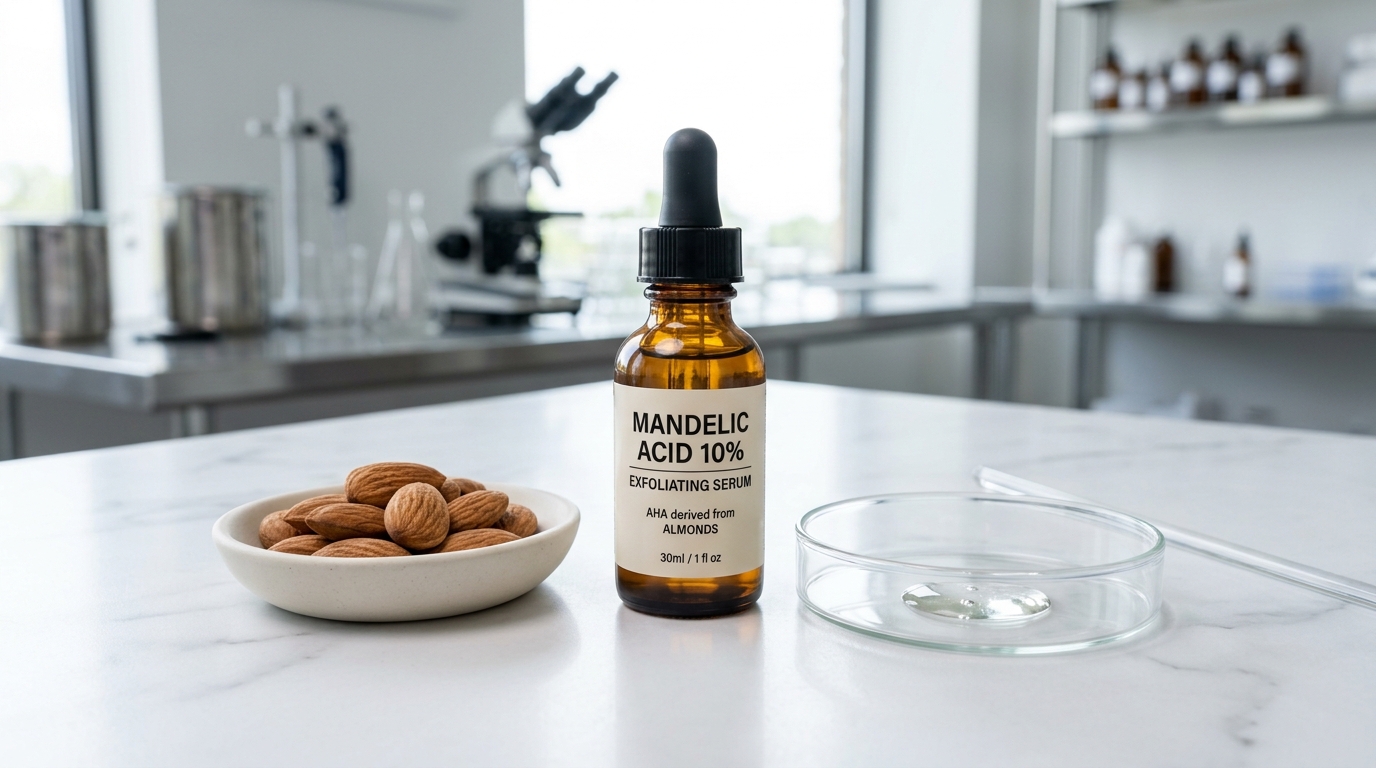
No, they are completely opposite. Sweet almond oil is an unrefined lipid rich in triglycerides that feed Malassezia yeast and trigger severe fungal breakouts. Mandelic Acid is an isolated, purified alpha hydroxy acid synthesized from bitter almond amygdalin that actively kills yeast.
