
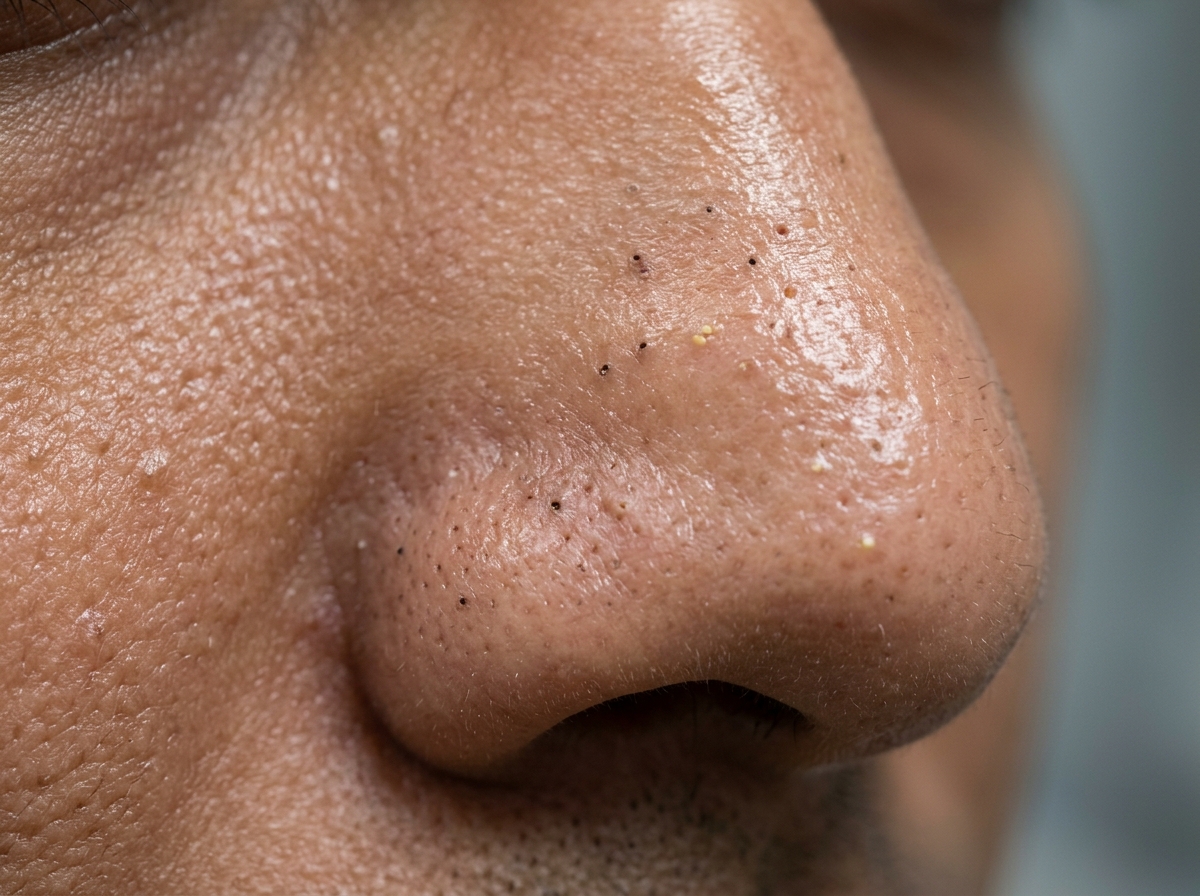
The Anatomy of Closed Comedones on Combination Skin
Closed comedones (commonly described by patients as "subclinical acne," "under-the-skin bumps," or "textured forehead sand") are non-inflammatory acne lesions. Unlike open blackheads where the pore ostium is dilated and exposed to atmospheric oxygen, a closed comedone has a microscopic keratinaceous ceiling that completely encloses the pore opening.
On bi-zonal combination skin, closed comedones do not appear randomly across the face. They cluster selectively along the Sebaceous Core (the T-Zone: forehead, glabella, nose bridge, and chin) due to three interrelated biological drivers:
1. Follicular Gland Density
The T-zone contains 400 to 900 sebaceous glands per cm², producing dense volumes of squalene, wax esters, and triglycerides. In contrast, the lateral cheeks have fewer than 100 glands/cm², creating an environment with insufficient lipid output to form comedones.
2. Retentive Hyperkeratinization
Under tropical heat and ambient Indian pollution, keratinocytes lining the follicular infundibulum fail to detach normally (dys-desquamation). Instead of sloughing off, dead cells stick together, forming an expanding micro-plug inside the narrow neck of the follicle.
3. Sebum Oxidation & Squalene Peroxides
When high-speed urban particulate matter (PM 2.5) settles onto the oily T-zone, squalene oxidizes into squalene monohydroperoxide—a highly comedogenic lipid that directly stimulates inflammatory signaling, cementing the plug into a solid flesh-colored bump.
Understanding this anatomy is critical: a closed comedone is not a bacterial infection or a "pimple" waiting to pop. It is a mechanical keratin-lipid compaction plug trapped beneath an intact layer of skin cells.
The "All-Over Treatment" Disaster: Why Treating Bumps Wrecks Your Cheeks
When patients notice dozens of tiny bumps on their forehead and chin, their instinctive reaction is to buy a strong anti-acne product—typically a 2% Salicylic Acid foaming face wash, a 5% Benzoyl Peroxide gel, or an OTC Tretinoin cream—and apply it vigorously over their entire face twice daily.
On combination skin, this uniform approach triggers an immediate dermatological crisis:
The Cheek Lipid Collapse (High TEWL & Sandpaper Flaking)
Because the lateral cheeks possess very few sebaceous glands, they rely entirely on intracellular lamellar bilayers (ceramides, cholesterol, free fatty acids) for barrier defense. Foaming surfactants and lipophilic acids dissolve these fragile lipids within days. The cheeks experience an acute surge in transepidermal water loss (TEWL), leading to stinging, erythema, and dry sandpaper skin texture.
The T-Zone Rebound Phase (More Comedones Form)
Alarmed by the burning, peeling cheeks, the patient panics and applies thick cold creams or almond oil all over the face to soothe the skin. These heavy occlusive emollients migrate directly into the distended pores of the nose and forehead, triggering an explosive rebound wave of fresh closed comedones.
🚨 The Core Dermatological Principle for Combination Comedones
Comedolytic therapy must be geographically isolated. Never treat an alipoid cheek with a lipophilic comedone active. You must apply desmolytic acids strictly to the bumpy sebaceous core while shielding the cheek perimeter with physiological barrier lipids.
Diagnostic Matrix: Closed Comedones vs. Fungal Acne vs. Milia
Before applying active treatments, verify that your forehead and chin bumps are truly closed comedones. In India's humid monsoon and summer climate, fungal folliculitis (Malassezia) and keratin milia are frequently misdiagnosed as acne:
| Diagnostic Parameter | Closed Comedones (Acne) | Fungal Acne (Malassezia Folliculitis) | Milia (Keratin Cysts) |
|---|---|---|---|
| Primary Location | Forehead, nose, glabella, chin (T-zone) | Hairline, upper forehead, temples, chest, upper back | Under eyes, upper cheeks, eyelids |
| Visual Appearance | Flesh-colored or slightly whitish bumps of varying sizes (1–3 mm) | Monomorphic (uniform in size), small pinhead-sized red or flesh bumps | Tiny, pearly-white or yellowish hard dome-shaped cysts |
| Tactile Sensation | Rough, pebbled, gritty sand-like texture | Slightly raised, itchy after sweating or workouts | Hard, discrete, smooth tiny beads under the skin |
| Pruritus (Itching) | Non-itchy (zero sensation unless picked) | Intensely itchy, especially in heat, humidity, or post-gym | Zero itching or inflammation |
| Underlying Pathology | Sebum + dead keratinocyte plug inside hair follicle | Overgrowth of opportunistic yeast (Malassezia globosa) in follicle | Keratin trapped within a benign, miniature epidermoid cyst |
| Response to Salicylic / Retinoid | Responds well (gradual dissolution over 6–8 weeks) | Little to no response (requires antifungal ketoconazole / zinc pyrithione) | No response (requires sterile needle extraction by dermatologist) |
If your bumps vary in size, lack itching, and feel like hard grains of sand under the skin of your forehead and chin, you are dealing with classic Closed Comedones.
Why You Must NEVER Squeeze or Scrub Comedones on Indian Skin
Running your fingers across a bumpy forehead triggers an overwhelming psychological urge to scrub, pick, or extract. In India, many individuals purchase metallic comedone extractor loops or use walnut face scrubs, believing they can physically "force out" the seeds.
On Fitzpatrick IV–VI skin, this physical trauma is biologically catastrophic:
Follicular Wall Rupture (Internal Extravasation)
Because closed comedones have an intact epithelial ceiling, lateral fingernail squeezing cannot force the plug upward. Instead, the intense mechanical pressure ruptures the fragile follicular wall laterally beneath the surface. The trapped sebum, bacteria, and dead keratin spill directly into the papillary dermis.
Melanocyte Dumping (The PIH Cascade)
The dermal immune system reacts to the foreign lipid spill with acute inflammation. In South Asian melanocytes, inflammatory cytokines (IL-1α, TNF-α, Prostaglandin E2) trigger hyperactive tyrosinase transcription. Melanocytes dump dense melanosomes into basal and papillary layers—turning a temporary, barely visible flesh-colored bump into a dark, stubborn brown spot that takes 6 to 12 months to fade. This is the heart of the Texture-to-Pigment Cycle.
Secondary Bacterial Infection (Pustule Formation)
Traumatized, broken skin allows surface Cutibacterium acnes to invade the ruptured follicle, converting a quiet closed comedone into an angry, painful red pustule or cystic nodule.
🚨 The Golden Rule: Chemical Desmolysis Only
Never apply physical force to closed comedones on Indian skin. The only safe way to eliminate them is through enzymatic and chemical dissolution of the intracellular desmosomes binding the keratin plug together.
The Zone-Isolated Comedolytic Protocol: BHA & Adapalene
To eliminate closed comedones on combination skin without damaging your cheeks, follow this dermatologist-designed Zone-Isolated Protocol:
Gentle Non-Stripping Cleanse
Wash face with a sulfate-free amino acid cleanser for 45 seconds on the T-zone and 10 seconds on the cheeks. Pat completely dry with a microfiber towel. Wait 5 minutes for skin surface moisture to evaporate (applying actives to wet skin increases systemic penetration and irritation).
Cheek Buffer Shield (Crucial Step)
Before applying any acne active, take a pea-sized amount of a rich ceramide cream (or 2 drops of squalane oil) and apply it strictly across your lateral cheeks and jawline. This forms an occlusive lipid shield that prevents any incidental active migration from reaching your low-sebum skin.
T-Zone Active Phase (Alternate Nights)
Night A (BHA Desmolysis): Saturate a cotton pad with 2% Salicylic Acid solution and press firmly onto your forehead, nose, and chin. Leave on for 10 minutes (short-contact) or leave on overnight if tolerated. BHA is oil-soluble and breaks down the lipid glue inside the plug.
Night B (Retinoid Keratolysis): Dispense a small pea-sized amount of Adapalene 0.1% gel (Adaferin). Dab onto your forehead, nose wings, and chin. Blend strictly within the T-zone borders, staying 1.5 cm away from the buffered cheeks. Adapalene speeds cellular turnover from below, pushing the plug upward.
Whole-Face Water Gel Finish
Finish by smoothing an oil-free hyaluronic acid or polyglutamic water gel across your entire face to ensure hydration balance without adding heavy pore-clogging waxes to the T-zone.
For a complete breakdown of daily AM and PM product sequences, refer to our detailed companion guide on Zone-Mapping Skincare Routine for Combination Skin.
Azelaic Acid 15%: The Dual Comedolytic & Anti-Pigment Powerhouse
If your combination skin is exceptionally reactive to both BHA and retinoids, or if your closed comedones frequently leave stubborn dark marks, Azelaic Acid (15% to 20% gel or cream) is the clinical gold standard in Indian dermatology:
1. Non-Irritating Comedolysis
Unlike aggressive retinoids that thin the stratum corneum and cause widespread peeling, Azelaic Acid normalizes follicular keratinocyte differentiation with minimal barrier disruption. It reduces filaggrin expression and softens hardened keratin plugs without causing cheek redness.
2. Direct Tyrosinase Inhibition
Azelaic Acid is a competitive inhibitor of tyrosinase (the key enzyme in melanin synthesis). While it dissolves the comedone plug, it selectively targets hyperactive, inflamed melanocytes, ensuring that if the bump becomes inflamed, it will not dump pigment into the dermis.
3. Safe Year-Round in Indian Climates
Unlike glycolic acid or high-strength tretinoin, Azelaic Acid does not increase cutaneous photosensitivity to tropical UV-A/UV-B radiation. It can be safely applied in the morning beneath sunscreen even during peak Indian summers.
✅ Clinical Prescription Recommendation
In Indian pharmacies, pharmaceutical-grade Azelaic Acid 15% gel (e.g., Aziderm 15% or Picspot 15%) is widely available. Apply a pea-sized amount every morning after your gentle cleanse and before your hybrid sunscreen.
The "Purge vs. Reaction" Checklist: What to Expect in Weeks 2 to 6
When you begin using Adapalene or Salicylic Acid to clear closed comedones, the cellular turnover of the follicle accelerates. Trapped microcomedones that were lurking deep beneath the skin are pushed rapidly toward the surface.
Use this clinical checklist to distinguish a therapeutic Acne Purge from an adverse Barrier Collapse:
| Diagnostic Sign | Therapeutic Acne Purge (Normal) | Barrier Collapse / Irritant Reaction (Stop) |
|---|---|---|
| Location of Bumps | Strictly on areas where you already had closed comedones (forehead, chin, nose) | Spreads to dry, unaffected areas (lateral cheeks, eye contour, neck) |
| Type of Lesions | Small whiteheads or tiny pustules that surface, pop cleanly, and resolve quickly | Red, angry, flat patches; tiny itchy hives; sandpaper micro-blisters |
| Sensory Symptoms | Mild dryness on T-zone; no intense burning or stinging with plain water | Intense stinging, burning with gentle moisturizer, constant tightness and itching |
| Duration Timeline | Peaks around week 3; steadily improves and clears completely by week 6–8 | Worsens with every application; persists beyond 8 weeks if untreated |
| Action Plan | Continue routine: Buffer dry cheeks, maintain SPF, do not pick | Emergency Barrier Reset: Stop all actives for 14 days; use ceramide cream only |
Indian Non-Comedogenic Swaps & Formulation Watchlist
Many Indian combination skin patients unknowingly fuel their closed comedones by using hair oils, traditional home remedies, and poorly formulated cosmetics containing high-comedogenicity esters.
Audit your daily vanity table against these high-risk ingredients:
| High-Risk Comedogenic Culprit | Where It Lurks | Why It Triggers T-Zone Comedones | Safe Non-Comedogenic Replacement |
|---|---|---|---|
| Coconut Oil (Nariyal Tel) | Traditional hair champi, body lotions, DIY masks | Comedogenicity Rating 4/5. Lauric acid binds with sticky sebum inside narrow pores, forming rock-hard comedone plugs within 72 hours. | 100% Plant Squalane Oil or Argan Oil (Comedogenicity 0/5) |
| Isopropyl Myristate / Palmitate | Heavy face creams, cheap chemical sunscreens | Penetration-enhancing synthetic esters that dissolve into sebum and trigger follicular hyperkeratosis. | Caprylic/Capric Triglyceride or C12-15 Alkyl Benzoate |
| Heavy Cocoa / Shea Butter | Rich night creams, body butters used on face | High melting point fats that create a suffocating occlusive barrier over oily T-zone follicles. | Physiological Ceramide NP/AP/EOP in lightweight gel-cream emulsion |
| Algal / Carrageenan Extracts | Some gel moisturizers and sheet masks | Polysaccharide thickeners rated 5/5 on comedogenicity scale; notorious for sudden forehead bumps. | Hyaluronic Acid or Polyglutamic Acid |
In-Clinic Dermatological Procedures for Stubborn Comedones
When closed comedones have formed dense, hyper-keratinized plugs that resist at-home topicals for more than 10 weeks, professional in-clinic intervention can safely clear the skin without triggering post-inflammatory hyperpigmentation on Fitzpatrick IV–VI skin:
1. Salicylic Acid 20%–30% Beta-Peels
A dermatologist applies a medical-grade 20%–30% Salicylic Acid solution strictly over the T-zone for 3 to 5 minutes. The high-strength lipophilic acid breaks down the stratum corneum desmosomes, causing the keratin ceilings of closed comedones to lift off over 3 to 5 days without peeling dry cheeks.
2. Sterile Medical Comedone Extraction
Under professional magnification and sterile conditions, a dermatologist uses an ultra-fine 30-gauge lancet to make a microscopic 0.1 mm puncture in the epithelial ceiling of the closed comedone. Light, vertical pressure is applied to pop out the solid seed cleanly without bruising the deep dermis or triggering melanocyte pigment dumping.
3. Ultrasonic Skin Scrubber / Vortex Extraction
Using low-frequency ultrasonic soundwaves (28,000 vibrations per second), fluid is vaporized into microscopic bubbles that implode against the pore ostia, dislodging oxidized squalene plugs from the nose and chin without thermal trauma or mechanical suction bruising.