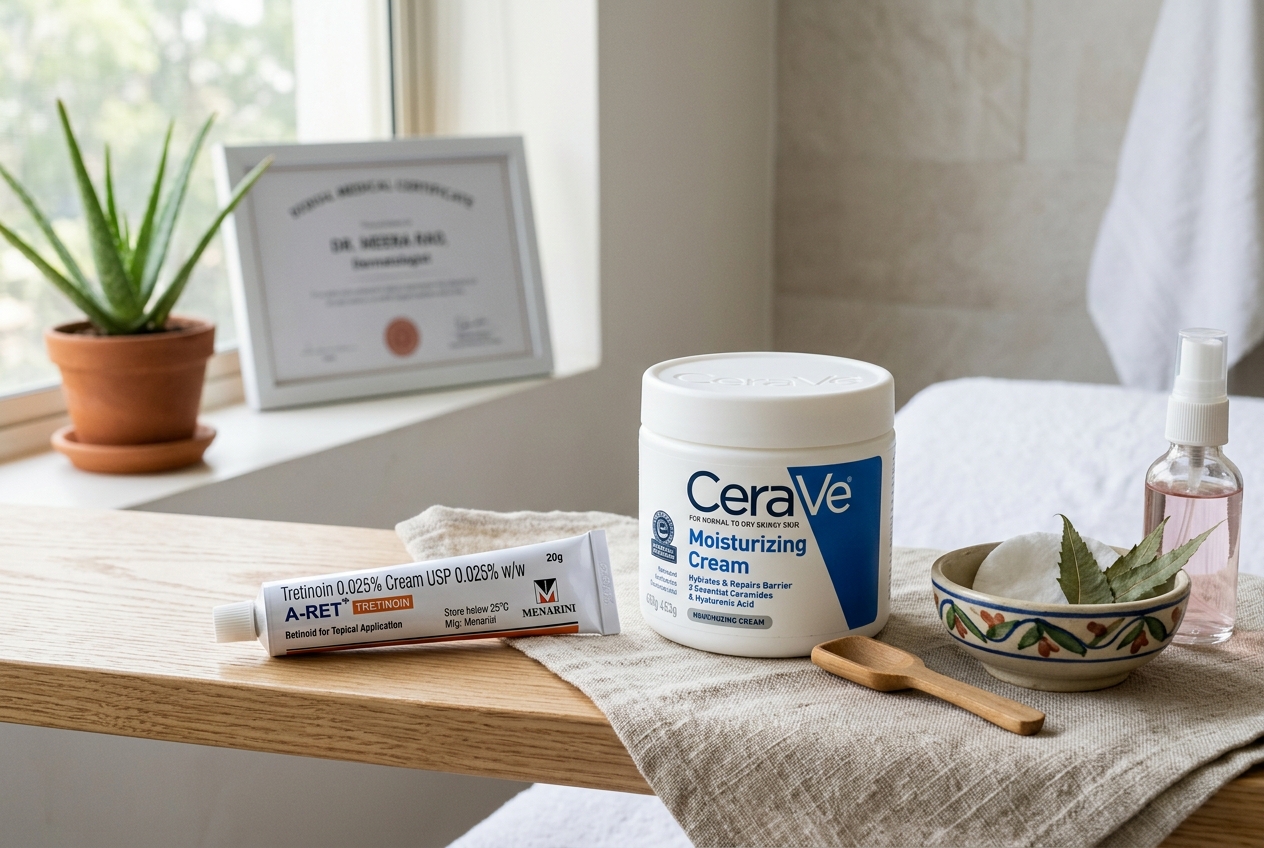
The Flaky-Greasy Paradox: Anatomy of the Perinasal Crease on Combination Skin
One of the most perplexing complaints in Indian outpatient dermatology clinics is: "Doctor, my forehead and nose are an oil factory, but the sides of my nostrils are peeling, red, and flaky. If I put cream on it, I break out in pimples; if I wash my face, it burns like acid. How can my skin be oily and dry in the exact same spot?"
To understand this condition, we must dissect the micro-anatomy of the alar crease (the sulcus where the nostril meets the cheek). The central T-zone possesses the highest density of pilosebaceous units on the entire human body—between 400 and 900 sebaceous glands per square centimeter. However, the alar crease represents a precarious transitional zone:
Sebum Density vs Moisture
Sebum is lipid mass (squalene, wax esters, triglycerides, and cholesterol). It is not moisture. Moisture is water molecules bound inside the stratum corneum by Natural Moisturizing Factor (NMF) and organized lamellar ceramides. You can have excess sebum pooling on the surface while the underlying epidermal layers are severely dehydrated.
Corneocyte Desquamation Failure
Healthy skin sheds dead cells (corneocytes) invisibly through enzymatic breakdown of corneodesmosomes. In an oily, inflamed T-zone, abnormal lipid composition inhibits enzymes like kallikrein. Instead of shedding invisibly, corneocytes clump together in sticky sheets, creating coarse, visible flakes.
Furthermore, the skin inside the alar crease experiences continuous mechanical flexion: every time you talk, chew, smile, sneeze, or blow your nose, the fold contracts and stretches. When this mechanical stress is combined with an altered lipid film, the barrier fractures, giving rise to micro-fissures, stinging upon contact with water, and stubborn flaking that resists standard moisturizers.
💡 The Fundamental Rule of Perinasal Flaking
An oily nose does not protect against barrier damage. In fact, high sebum flow with an abnormal ratio of free fatty acids actively degrades epidermal junction proteins, making the crevice around the nose far more vulnerable to peeling and dermatitis than the surrounding cheeks.
The Malassezia Factor: Why Your "Dry Nose" Is Often Seborrheic Dermatitis
When patients notice white or yellowish flakes around their nose, their immediate instinct is to diagnose themselves with "severe dry skin." In reality, clinical examinations reveal that in more than 80% of individuals with combination skin, perinasal flaking is not simple dry skin (xerosis); it is perinasal seborrheic dermatitis.
Seborrheic dermatitis is a chronic, relapsing inflammatory dermatosis driven by a complex interplay between host sebum composition and commensal lipophilic yeast of the genus Malassezia (predominantly Malassezia restricta and Malassezia globosa). Here is the four-step biological cascade that produces the flakes:
Sebum Hyper-Secretion Fuels Yeast Proliferation
The sebaceous glands of the T-zone pump out triglycerides. Malassezia yeast lacks the genes to synthesize its own fatty acids, so it relies entirely on human sebum for sustenance. It resides deep within the follicular infundibulum of the nasal creases.
Lipase Cleavage Leaves Behind Irritating Free Fatty Acids
The yeast secretes extracellular lipase enzymes that split sebum triglycerides into saturated fatty acids (which the yeast eats) and unsaturated free fatty acids (specifically oleic acid and arachidonic acid), which the yeast leaves behind on your skin.
Oleic Acid Breaches the Stratum Corneum
Oleic acid has a curved molecular configuration that disrupts the tightly packed, orderly lipid bilayers of the stratum corneum. It penetrates the living epidermis and triggers subclinical inflammation, activating Toll-like receptors and releasing inflammatory cytokines (IL-1α, IL-6, TNF-α).
Accelerated Keratinocyte Transit (Parakeratosis)
In response to cytokine-induced inflammation, the epidermal turnover cycle hyper-accelerates from the normal 28 days down to just 7 to 10 days. Keratinocytes rush to the skin surface without properly losing their cellular nuclei (a pathological state called parakeratosis). These immature cells form loose, greasy, visible crusts and flakes around the nostrils.
⚠️ The Critical Takeaway
The flakes around your nose are not lacking oil. They are the result of inflammatory accelerated shedding caused by yeast feeding on your own excess oil. Treating this condition with heavy plant oils or rich balms is essentially feeding the fuel that drives the fire.
Diagnostic Matrix: Flaky Combination Nose vs Seborrheic vs Contact vs Perioral Dermatitis
Proper clinical management requires an accurate diagnosis. Because multiple conditions can cause erythema and desquamation around the nose, dermatologists use specific clinical markers to differentiate them. Review the diagnostic matrix below:
| Clinical Feature | True Dry Skin (Xerosis) | Seborrheic Dermatitis | Allergic / Irritant Contact Dermatitis | Perioral Dermatitis |
|---|---|---|---|---|
| Flake Appearance | Fine, powdery, translucent white flakes; dry to the touch. | Yellowish, waxy, or greasy adherent flakes; clumped in folds. | Crusty, raw, peeling sheets; often with weeping or blisters. | Tiny pinpoint papules/pustules with fine surrounding dry scale. |
| Primary Sensation | Tightness, mild roughness, improved immediately by hydration. | Intermittent itching, crawling sensation, mild burn with sweat. | Intense stinging, burning, prickling upon applying any product. | Tension, burning, hypersensitivity to all occlusive moisturizers. |
| T-Zone Sebum Level | Low everywhere (cheeks and T-zone are both dry). | High (forehead, nose tip, and chin are visibly shiny/greasy). | Variable; depends on underlying baseline skin type. | Variable; frequently triggered after topical steroid or heavy cream use. |
| Anatomical Distribution | Diffuse across cheeks, temples, and perimeter of face. | Alar crease, glabella (between eyebrows), nasolabial folds, hairline. | Confined strictly to areas where offending product was applied. | Nasolabial folds, perioral region with a clear halo sparing vermilion. |
| Response to Heavy Cream | ✅ Flaking resolves rapidly within 24–48 hours. | ❌ Redness intensifies; flaking becomes greasier and itches more. | ⚠️ May temporarily soothe or worsen if cream contains allergens. | 🚨 Major flare-up; pustules multiply within 24 to 72 hours. |
| First-Line Medical Strategy | Ceramides, cholesterol, fatty acids, glycerin, hyaluronic acid. | Ketoconazole 2% wash-off, Zinc Pyrithione, pure Squalane, Ectoin. | Discontinue all suspected contactants, cold compresses, barrier reset. | Zero-therapy (stop all cosmetics), oral doxycycline or topical azelaic acid. |
If your flaking is accompanied by tiny red bumps or pustules around the mouth and nose that appeared after using a steroid cream (like Betnovate or Panderm) or thick slugging balms, you may be dealing with perioral dermatitis. For our complete clinical manual on that condition, read our Indian Dermatologist Guide to Perioral Dermatitis ➔.
The Perinasal Hyperpigmentation Trap in Fitzpatrick IV–VI Indian Skin
In Caucasian or fair skin (Fitzpatrick I–II), seborrheic dermatitis manifests primarily as pink or salmon-red erythema that fades quickly once the inflammation resolves. However, on Fitzpatrick IV, V, and VI Indian skin, inflammation follows a drastically different path.
Melanocytes in brown skin are larger, have more dendritic arborizations, and produce predominantly photo-protective, deeply pigmented eumelanin. When the epidermal barrier in the alar crease becomes inflamed, melanocytes are triggered by inflammatory mediators (prostaglandins PGE2, leukotrienes, and endothelin-1). This leads to rapid eumelanogenesis, resulting in perinasal post-inflammatory hyperpigmentation (PIH).
The Mechanical Friction Trap
When flakes accumulate around the nostrils, many people aggressively pick, rub, or scratch them off with fingernails or coarse towels. This mechanical shear fractures the basement membrane zone. Melanin pigment drops down from the basal layer into the upper papillary dermis, where it is engulfed by dermal macrophages (melanophages). Dermal pigmentation cannot be exfoliated and takes 6 to 18 months to fade.
The Chemical Burn Trap
Mistaking perinasal congestion for "stubborn blackheads" or "clogged pores," individuals frequently apply leave-on 2% Salicylic Acid, Glycolic Acid toners, or Adapalene directly into the nostril fold. Because the stratum corneum in the alar fold is already compromised, the acid causes a chemical burn, culminating in a deep brown-gray perinasal halo.
🚨 The Zero-Friction, Zero-Peeling Mandate
Never physically peel, scrub, or scrape flakes from the alar crease. Every single mechanical pull triggers subclinical melanocyte activation. The only safe way to remove perinasal flakes is through enzymatic chemical dissolution using gentle antifungal wash-offs and bio-compatible humectants.
For a detailed breakdown of how localized inflammation cascades into dermal pigment deposition across brown skin, read our clinical analysis: The Texture-to-Pigment Cycle: Why Micro-Inflammation Causes Deep Dark Marks ➔.
Why Coconut Oil, Boroline & Heavy Cold Creams Make It 10x Worse
In Indian households, the instinctive remedy for any form of skin peeling is handed down across generations: "Apply coconut oil (nariyal tel), mustard oil (sarson tel), almond oil, Boroline, or desi ghee." While these lipids are excellent for healthy, non-fungal body skin or cracked heels, applying them to an oily T-zone with perinasal flaking is a dermatological disaster.
Here is the biochemistry of why traditional Indian home treatments intensify the problem:
| Traditional Remedy | Key Chemical Components | Why It Worsens Perinasal Flaking |
|---|---|---|
| Coconut Oil (Nariyal Tel) | 50% Lauric Acid (C12:0), 18% Myristic Acid (C14:0), 8% Palmitic Acid (C16:0). | Malassezia yeast exclusively metabolizes fatty acids with carbon chain lengths between C11 and C24. Coconut oil provides a supercharged feast for the yeast, causing exponential fungal colony expansion, intense redness, and greasy yellow crusting. |
| Desi Ghee / Butter | Triglycerides of Palmitic (C16), Oleic (C18:1), and Stearic (C18) acids. | High concentration of oleic acid triggers direct epidermal barrier disruption. Ghee is deeply comedogenic for oily T-zones, causing closed comedones and pustules alongside the flaking. |
| Almond Oil / Mustard Oil | High Oleic Acid (65–70%) and Erucic Acid (C22:1). | Mustard oil contains isothiocyanates which cause irritant contact dermatitis on delicate facial folds, while almond oil directly feeds Malassezia lipases. |
| Boroline Antiseptic Cream | Boric Acid, Zinc Oxide, Anhydrous Lanolin, White Petrolatum, Heavy Perfume. | While Zinc Oxide is soothing, the thick lanolin and petrolatum base traps sweat, sebum, and yeast against the skin in tropical Indian humidity, worsening fungal folliculitis. The fragrance can also cause allergic contact dermatitis in sensitized creases. |
| Nivea Blue Creme / Cold Creams | Mineral oil, Petrolatum, Microcrystalline Wax, Lanolin Alcohol, Paraffin. | Forms an occlusive blanket over an active microbial overgrowth. It traps the yeast's acidic waste products against the skin, preventing natural evaporation and intensifying the burning sensation. |
If you have been applying coconut oil or ghee to your flaky nose, you must stop immediately. Your skin does not need more lipids of the wrong chain length; it needs targeted antifungal resetting and bio-compatible, non-fungal-feeding hydration.
The Zone-Isolated Perinasal Clearing Protocol (Step-by-Step AM & PM)
Curing a flaky alar crease while balancing an oily T-zone and dry cheeks requires a zone-isolated clinical strategy. You cannot treat your entire face with one single formulation. Follow this precise dermatologist-developed protocol:
Ketoconazole 2% or Zinc Pyrithione Short-Contact Mask
Instead of leave-on antifungal creams that can clog pores on the nose, use a pharmaceutical Ketoconazole 2% solution (e.g., Nizral, Scalpe Plus) or a Zinc Pyrithione 1% cleanser. Wet the face with lukewarm water. Lather a pea-sized drop between your fingertips and apply strictly to the alar creases, sides of the nose, and glabella. Leave it in place for 3 to 5 minutes to allow the antifungal agent to bind to the keratinocytes. Rinse thoroughly with cool water.
Sulfate-Free, Low-pH Amino Acid Cleanser
Avoid harsh bar soaps, alkaline face washes, or exfoliating scrub cleansers. Use an amphoteric or amino acid-based gentle gel cleanser with a pH between 4.5 and 5.5. Cleanse the entire face gently for 45 seconds; do not rub the alar creases with washcloths or brushes. Pat dry with a clean microfiber towel.
Niacinamide 3% + Zinc PCA + Ectoin Serum
Apply a lightweight water-based serum containing 2% to 5% Niacinamide and 1% Zinc PCA across the entire T-zone. Niacinamide accelerates ceramide synthesis to repair the leaky barrier, while Zinc PCA exerts potent antimicrobial and sebum-suppressive activity. Ectoin (1–2%) stabilizes cell membranes against osmotic and inflammatory stress.
100% Pure Plant-Derived Sugarcane Squalane
While standard plant oils feed yeast, pure Squalane is completely saturated (hydrocarbon chain with zero double bonds) and cannot be metabolized by Malassezia lipases. Apply 1 to 2 drops of 100% Sugarcane Squalane directly onto damp alar creases and over dry cheeks. It restores lipid cohesion without feeding the fungal population or clogging pores.
Hybrid Non-Comedogenic Matte Fluid SPF 50+ PA++++
UV radiation degrades nitric oxide and oxidizes squalene in your sebum, transforming it into comedogenic squalene peroxide that exacerbates both flaking and PIH. Apply a lightweight, matte-finish fluid sunscreen across your entire face every morning. Reapply every 3 hours if outdoors.
🌿 Expected Clinical Timeline
With strict adherence to this zone-isolated protocol, the tight, stinging sensation and visible flaking typically improve by 60–80% within 10 to 14 days. Full normalization of the perinasal stratum corneum requires approximately 4 to 6 weeks.
For a complete master guide on mapping different products to your T-zone versus your cheeks, consult our companion manual: Zone-Mapping Skincare Routine for Combination Skin: Indian Dermatologist AM & PM Guide ➔.
Malassezia-Safe vs Dangerous Ingredients Scorecard for Indian Regimens
When treating a flaky, peeling nose on combination skin, product labels can be deceptive. A moisturizer labeled "For Sensitive Dry Skin" may be loaded with plant oils and fatty esters that accelerate yeast growth. Use this clinical scorecard to audit your skincare products:
| Ingredient Category | 🚨 Dangerous / Yeast-Feeding (AVOID on Flaky Nose) | ✅ 100% Malassezia-Safe (RECOMMENDED) |
|---|---|---|
| Plant Oils & Butters | Coconut oil, Olive oil, Almond oil, Argan oil, Jojoba oil (wax ester, partially safe but can trigger flares), Shea butter, Cocoa butter, Mango butter, Rosehip oil. | 100% Pure Sugarcane Squalane, Mineral Oil (USP Cosmetic Grade), Pure White Petrolatum (thin film only). |
| Fatty Acids & Esters | Lauric acid, Myristic acid, Palmitic acid, Stearic acid, Oleic acid, Isopropyl Myristate, Isopropyl Palmitate, Glyceryl Stearate, Cetyl Alcohol (borderline), Polysorbate 20, 60, 80. | Caprylic/Capric Triglyceride (fractionated MCT oil with C8 and C10 chains only; cannot be metabolized by Malassezia), Squalane. |
| Humectants & Hydrators | Fermented extracts (Galactomyces, Bifida ferment—can trigger fungal sensitivity in active flares). | Glycerin, Hyaluronic Acid (multi-molecular), Panthenol (Vitamin B5), Sodium PCA, Polyglutamic Acid, Beta-Glucan, Trehalose. |
| Active Keratolytics | Leave-on Glycolic Acid >7%, high-strength L-Ascorbic Acid >15%, leave-on Tretinoin (pools in crease and burns). | Azelaic Acid 10%–15% (dual antifungal & anti-PIH), Sulfur 3%–5%, Zinc PCA 1%, Ketoconazole 2% (wash-off). |
| Soothing Agents | Essential oils (Tea tree oil >5%, Lavender oil, Citrus peel extracts, Eucalyptus). | Ectoin 1%–2%, Centella Asiatica (Madecassoside pure), Allantoin, Colloidal Oatmeal, Bisabolol. |
Notice that Azelaic Acid appears as a top-tier active for this condition. Azelaic acid is a naturally occurring dicarboxylic acid that competitively inhibits tyrosinase (preventing perinasal PIH) while exerting direct anti-inflammatory and mild antifungal effects without peeling the skin.
Seasonal Adjustments Across India: Monsoon Humidity vs North Indian Winter
India's extreme climatic variations exert a powerful influence on the perinasal barrier. Your routine must flex dynamically between the sweltering humidity of the monsoon and the bone-dry cold of North Indian winters:
Monsoon Season (June – September)
The Challenge: Ambient relative humidity exceeds 80–95% in coastal and tropical regions (Mumbai, Chennai, Kolkata, Kerala). High ambient heat drives copious sweating. The mixture of sweat electrolytes, sebum, and humidity creates a tropical incubator for Malassezia overgrowth.
Clinical Tweak: Increase Ketoconazole 2% wash-off therapy to 3 times per week. Eliminate all occlusives and facial oils entirely. Rely strictly on oil-free humectant gels (Glycerin, Panthenol, Hyaluronic Acid) followed by matte SPF.
North Indian Winter (November – February)
The Challenge: Relative humidity drops below 25–35% in Delhi NCR, Punjab, Haryana, and Rajasthan. Indoor heating and dry winds deplete stratum corneum water, while high-TDS municipal tap water disrupts the acid mantle. Micro-fissures in the alar fold crack and bleed.
Clinical Tweak: Reduce Ketoconazole wash to once weekly to prevent excessive drying. Introduce 2 drops of pure Sugarcane Squalane over your humectant serum in the nostril creases morning and night. Use thermal water or filtered water for face washing.
🏙️ Hard Water Advisory for Delhi, Bengaluru & Mumbai
Municipal and borewell tap water in major Indian metros frequently carries high levels of calcium and magnesium salts with an alkaline pH (7.8–8.5). Alkaline water neutralizes the skin's protective acid mantle (pH 4.7–5.5), inactivating the skin's antimicrobial peptide defenses and allowing Malassezia to flourish. If your nose burns every time you wash your face, rinse your perinasal area with bottled drinking water or install a shower filter.
7 Critical Mistakes Indians Make When Treating a Flaky Oily Nose
Avoid these seven common dermatological pitfalls that turn mild perinasal peeling into chronic, disfiguring hyperpigmentation:
Using Blackhead Pore Strips or Metal Extractors on the Alar Crease
Adhesive nose strips pull off the topmost layer of stratum corneum cells along with sebaceous filaments. In the delicate alar fold, this causes immediate epidermal stripping, telangiectasia (broken blood vessels), and profound post-inflammatory hyperpigmentation.
Applying Retinoids (Tretinoin/Adapalene) Directly into the Nostril Sulcus
Retinoids naturally migrate into skin crevices due to surface tension (the "crevice pooling effect"). Applying tretinoin close to the nostril fold results in concentrated accumulation, intense burning, severe peeling, and retinoid dermatitis. Always apply a thin barrier of pure squalane or petrolatum to the alar fold before applying retinoids to the face.
Applying Steroid / Fairness Creams (Betnovate, Panderm, Dermovate)
Over-the-counter topical corticosteroids provide rapid temporary relief from redness because they suppress local immune responses. However, within weeks, they induce severe steroid-induced rosacea, perioral dermatitis, and permanent skin thinning. Never apply steroid creams to the face for flaky skin.
Scrubbing with Physical Walnut, Apricot, or Besan (Gram Flour) Pastes
Coarse abrasive particles create jagged micro-tears in the stratum corneum. While the nose may feel smooth for a few hours, the ruptured barrier responds by producing more defensive sebum and releasing inflammatory prostaglandins that worsen the flaking within 48 hours.
Washing Face with Steaming Hot Water During Winter Baths
Hot geyser water strips the few remaining structural ceramides and natural moisturizing factors from the skin surface, instantly causing erythema and cracking in the perinasal fold. Always wash your face with lukewarm or cool water.
Applying Heavy Hair Oils (Champi) That Migrate Down the Forehead
Applying mustard, coconut, or amla oil to the scalp and leaving it overnight causes the oil to migrate down the forehead, glabella, and sides of the nose during sleep. This delivers a continuous infusion of fungal food to your T-zone. Wash off hair oils within 45 minutes of application.
Skipping Sunscreen Because the Nose Feels "Too Oily"
Skipping sunscreen allows ultraviolet A (UVA) and high-energy visible (HEV) blue light to penetrate the inflamed, peeling alar crease. Unshielded melanocytes respond by producing dense clusters of eumelanin, transforming temporary post-inflammatory erythema into persistent dark brown perinasal shadows.
Frequently Asked Questions (Dermatologist FAQ)
In over 80% of individuals with an oily T-zone, flaking in the alar crease (nostril fold) is not simple dry skin (xerosis); it is mild seborrheic dermatitis driven by Malassezia yeast. Malassezia feeds on sebum triglycerides, releasing irritating free fatty acids that trigger inflammation and accelerate skin shedding. True dry skin flakes are flat, white, and relieved by rich moisturizers, whereas Malassezia flakes are yellowish or greasy and flare when treated with heavy oils.
Perinasal hyperpigmentation occurs because Indian skin (Fitzpatrick IV–VI) contains highly hyper-reactive melanocytes. Chronic low-grade inflammation from seborrheic dermatitis, repeated tissue trauma from blowing the nose, or chemical irritation from acne acids triggers melanocytes to produce excess eumelanin, which is deposited into the basal layer or dermal macrophages, creating stubborn brown-gray shadows.
No. Coconut oil is rich in lauric (C12) and myristic (C14) fatty acids, which provide the exact lipid chain lengths that Malassezia yeast metabolizes. Applying coconut oil, almond oil, or ghee fuels fungal proliferation and intensifies redness. Boroline contains heavy petrolatum, lanolin, and fragrance that trap humidity and yeast in warm Indian climates, worsening folliculitis.
Never apply leave-on Salicylic Acid (BHA), Glycolic Acid (AHA), or topical retinoids (Adapalene/Tretinoin) directly into the alar crease when it is actively flaking. The epidermal barrier in the nasal fold is exceptionally thin; potent keratolytics pool in the crevice, causing severe chemical contact dermatitis, stinging, and dark hyperpigmented marks.
Use Ketoconazole 2% shampoo as a short-contact wash-off therapy 2 to 3 times weekly. Wet your face with lukewarm water, lather a pea-sized amount specifically between your fingers, apply gently to the alar creases and glabella, leave on for 3 to 5 minutes to allow the antifungal agent to penetrate the follicular infundibulum, and rinse thoroughly. Always follow with a Malassezia-safe moisturizer.
The ideal moisturizer contains humectants (Glycerin, Hyaluronic Acid, Panthenol B5) and strictly Malassezia-safe barrier lipids such as 100% Sugarcane Squalane or Caprylic/Capric Triglyceride (fractionated MCT oil). Avoid products containing shea butter, natural plant oils, isopropyl myristate, or polysorbates.
This occurs because sebum production and stratum corneum hydration are governed by entirely separate biological mechanisms. Your sebaceous glands are overactive due to genetics or androgens, but your epidermal barrier is depleted of water and structural ceramides. Dehydrated skin cannot shed dead cells smoothly, creating flakes while sebum continues to pool over them.
High monsoon humidity (75–95%) encourages rapid Malassezia yeast growth, leading to greasy yellow crusts. Conversely, North Indian winters (Delhi, Punjab) drop ambient humidity to <30%, stripping water and creating painful micro-fissures. Furthermore, hard municipal tap water (pH 7.8–8.5) disrupts the skin's acidic mantle (pH 4.7–5.5), impairing skin barrier defenses.
In-clinic chemical peels (such as Mandelic acid or low-concentration Salicylic acid) can be performed on the oily T-zone, but the dermatologist must pre-coat the alar creases with medical-grade petrolatum (Vaseline) as a barrier shield to prevent the acid solution from pooling and causing chemical burns in the fold.
With a consistent zone-isolated antifungal reset and Malassezia-safe hydration, visible flaking and itching typically subside within 10 to 14 days. However, restoring full stratum corneum barrier resilience takes 4 to 6 weeks, and fading any resulting perinasal post-inflammatory hyperpigmentation (PIH) requires 8 to 16 weeks of sun protection and tyrosinase inhibitors.
