
1. The Topical Ceiling: When At-Home Skincare Cannot Fix Uneven Face Skin
It is one of the most disheartening experiences in modern skincare: you have religiously applied 10% Niacinamide, rotated 2% Salicylic Acid, introduced prescription Adapalene or Tretinoin, and applied SPF 50+ every two hours for six straight months. Yet, under angled bathroom lighting or midday sunlight, your facial skin remains visibly uneven—displaying persistent pebbled roughness, pitted rolling indentations, dilated "orange-peel" pores, and stubborn muddy shadows across your cheeks.
You have not failed your skincare routine; your skincare routine has simply hit the biological topical ceiling. To understand why, one must examine the micro-anatomy of human facial skin:
Over-the-counter actives (Mandelic, Glycolic, Salicylic, Retinol) act almost exclusively on the stratum corneum (the upper 15–20 layers of dead keratinocytes) and superficial stratum spinosum. They loosen surface intercellular desmosomes and accelerate epidermal turnover.
Clinical lasers, RF needles, and medium-depth peels deliver photothermal, acoustic, or mechanical energy deep into the papillary and reticular dermis (0.5mm to 2.5mm deep), where structural collagen bundles, elastin fibers, and deep melanophages reside.
When uneven facial skin is caused by architectural dermal deficits—such as fibrous acne scar tethering, collagen degradation around follicular ostia (enlarged pores), or melanin pigment that has dropped into dermal macrophages (melanophages)—no serum on Earth can dissolve or reconstruct it. At that juncture, professional dermatological procedures become not just optional, but the only clinically viable pathway.
2. The Core 5 Clinic Procedures for Uneven Skin (Comparison Matrix)
In modern Indian aesthetic dermatology, five primary treatment modalities address uneven facial skin texture and tone. Each operates on a distinct biophysical mechanism and carries specific risks for melanin-rich Indian skin (Fitzpatrick Phototypes IV, V, and VI):
| Procedure | Primary Target | Depth of Action | Downtime | Fitzpatrick IV–VI Risk | Average Indian Cost |
|---|---|---|---|---|---|
| Medical Chemical Peels (Yellow, TCA Cross, Glycolic) | Epidermal tone, minor texture, post-acne dark marks | Stratum Corneum to Upper Papillary Dermis | 2 to 5 Days (Flaking) | Low to Moderate | ₹2,500 – ₹6,000 / session |
| Q-Switched Nd:YAG Laser (1064nm Laser Toning) | Dermal melasma, deep pigmentation, skin glow | Deep Dermis (Selective Photothermolysis) | 0 to 24 Hours (Mild Pinkness) | Very Low (Safest Laser) | ₹4,500 – ₹9,000 / session |
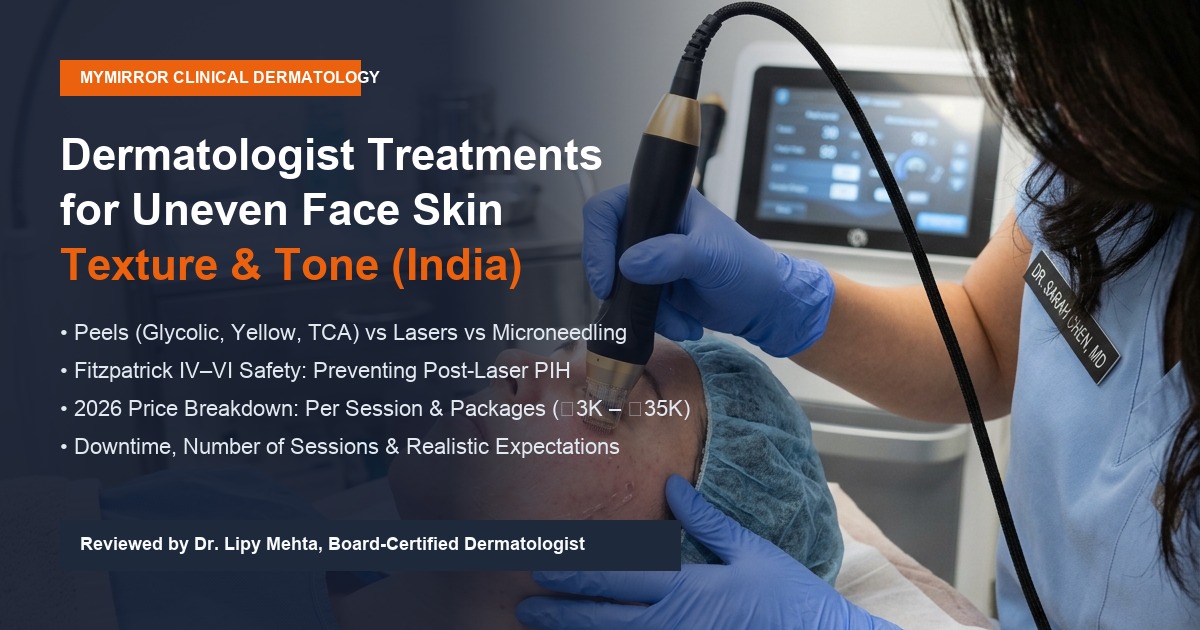
| Radiofrequency Microneedling (MNRF / Morpheus8 / Secret RF) | Pitted scars, enlarged pores, severe textural unevenness | 0.5mm to 3.5mm Reticular Dermis | 2 to 4 Days (Grid Marks) | Very Low (Sub-Epidermal) | ₹9,000 – ₹20,000 / session |
| Fractional Resurfacing (Erbium:YAG vs Fractional CO2) | Deep rolling scars, coarse leathery texture, sun damage | Dermal Microthermal Zones (MTZs) | 5 to 9 Days (Bronzing/Crusting) | Moderate to High (PIH Risk) | ₹8,000 – ₹18,000 / session |
| Medical Medifacials / Hydrafacial (Vortex Infusion) | Keratin debris, congested pores, instant dullness relief | Superficial Stratum Corneum | Zero Downtime | Completely Safe | ₹4,000 – ₹9,500 / session |
Selecting the ideal procedure depends on whether your primary concern is textural (tactile roughness, indentations, pore architecture) or chromatic (melasma, PIH, sun darkening). As detailed in our master analysis of the Texture-to-Pigment Cycle, these two issues frequently feed into one another on Indian skin.
3. Medical Chemical Peels: Glycolic, Salicylic, Yellow Peel & TCA Cross
Unlike a 10-minute "exfoliating facial" offered at a beauty salon, medical chemical peels administered by a dermatologist utilize precise, unbuffered acid solutions formulated at low pH levels (pH 1.5 to 2.8) to induce controlled chemo-exfoliation.
The 4 Clinically Proven Peels for Indian Skin
Best For: Mixed Melasma, Sun Tan & Superficial Post-Acne PIH
The Yellow Peel is currently considered the gold-standard chemical peel for Indian skin. Unlike aggressive acids that strip the skin instantly, the Yellow Peel is a leave-on formulation containing encapsulated retinoic acid derivatives, tranexamic acid, phytic acid, and azelaic acid. It remains on the face for 4 to 8 hours before being washed off at home. It causes gentle micro-sheeting (flaking) over days 3 to 6 without burning or crusting, delivering extraordinary clarity and tone uniformity.
Best For: Ice-Pick Acne Scars & Fibrotic Enlarged Pores
TCA Cross (Chemical Reconstruction of Skin Scars) does NOT cover the whole face. A dermatologist dips a fine wooden toothpick or 30G needle into 70% to 100% trichloroacetic acid and focally touches only the base of deep pitted scars or severely dilated pores. This causes immediate white protein denaturation ("frosting"), triggering local necrosis followed by intense neocollagenesis that lifts the scar crater from the bottom up. In Indian skin, strict sun avoidance post-procedure is paramount to prevent dark spots in the treated pits.
Best For: Oily T-Zone, Closed Comedones & "Sandpaper" Roughness
Combining 20% Salicylic Acid with 20% Mandelic Acid harnesses the lipophilic pore-clearing capacity of BHA with the large-molecule, slow-penetrating gentleness of Mandelic Acid. It dissolves sebaceous plugs within 5 minutes while polishing tactile roughness on the cheeks, making it ideal for patients suffering from combination skin texture.
Best For: Generalized Dullness & Surface Keratin Buildup
While high-concentration glycolic acid (50%–70%) is hazardous on brown skin due to rapid, erratic penetration that induces chemical burns, serial low-strength sessions (20%–30% with strict neutralization timing under 3 minutes) offer safe epidermal desquamation. For a complete comparison of at-home vs clinic acid safety, review our guide to Chemical Exfoliation for Uneven Skin.
4. Laser Toning & Resurfacing: Q-Switch Nd:YAG vs Fractional Lasers
Laser technology represents the cutting edge of aesthetic dermatology, but for patients with Indian skin (Fitzpatrick IV–VI), it carries the highest risk of iatrogenic (treatment-induced) damage if the wavelength or fluence is chosen poorly.
The Biophysical Principle: Melanin as a Competing Chromophore
Lasers work via Selective Photothermolysis: emitting a specific wavelength of light that is absorbed by a specific target (chromophore), converting light into heat. On brown skin, the epidermis contains a dense layer of eumelanin. If a laser uses a wavelength heavily absorbed by melanin (such as 532nm KTP or 755nm Alexandrite lasers), the beam will superheat the epidermal surface before ever reaching the dermis, causing severe blister formation, burns, and permanent hypopigmentation (loss of pigment).
The Safest Laser for Indian Skin: Operating at a deep 1064 nanometer wavelength, it largely bypasses epidermal melanin. Operating in nanosecond pulses, it shatters deep pigment particles mechanically (photo-acoustic effect) without overheating surrounding skin cells.
- Primary use: Dermal melasma, PIH, skin tone uniformity
- Zero downtime: Patient can return to work immediately
- Includes the "Carbon Laser Peel" for pore tightening
Deep Textural Reconstruction: Instead of burning the entire skin surface, fractional lasers create thousands of microscopic columns of thermal injury (Microthermal Treatment Zones, or MTZs), leaving healthy bridging skin between columns to accelerate rapid healing.
- Primary use: Pitted acne scars, rough leathery photodamage
- Erbium:YAG (2940nm) is significantly safer for Indian skin than CO2
- Requires 5 to 7 days of social downtime for peeling and bronzing
What is the "Hollywood Carbon Laser Peel"?
Popular across dermatology clinics in Delhi, Mumbai, and Bengaluru, the Carbon Laser Peel involves applying a medical-grade liquid carbon lotion across the face. The carbon penetrates deeply into dilated pores and sebum crevices. The dermatologist then passes a 1064nm Q-Switched Nd:YAG laser over the skin. The laser light is instantly absorbed by the black carbon particles, causing them to vaporize along with dead stratum corneum cells, clearing clogged follicles and instantly refining the appearance of orange-peel skin texture and enlarged pores.
5. Radiofrequency Microneedling (MNRF): The Texture Miracle for Brown Skin
If you have stubborn tactile roughness, depressed boxcar/rolling acne scars, or loose, enlarged pores on your cheeks, Radiofrequency Microneedling (MNRF) (using devices such as Secret RF, Morpheus8, or Endymed) is widely recognized by dermatologists as the most effective and safest resurfacing modality for Indian skin.
MNRF Protocol: What Actually Happens During a Session
- Topical Anesthetic Application: A thick layer of compounded 7% Lidocaine / Prilocaine cream is applied for 45 to 60 minutes until your facial skin is completely numb.
- Antiseptic Prep: The face is cleansed with chlorhexidine to sterilize the skin surface and eliminate bacterial contamination.
- Double-Pass Microneedling: The dermatologist stamps the motorized handpiece across the face. The first pass is typically delivered at 1.8mm to 2.2mm depth for deep collagen tightening; the second pass is performed at 0.8mm to 1.2mm depth to smooth superficial pore walls.
- Soothing Peptide/Exosome Infusion: Sterile hyaluronic acid, recombinant growth factors, or cold saline compresses are applied immediately to soothe erythema.
Over the next 6 to 12 weeks, the thermal coagulative zones trigger your fibroblasts to synthesize Type I and Type III collagen, gradually tightening enlarged pore walls and lifting indented textured depressions.
6. The Dark Side: Laser-Induced PIH & Hypopigmentation on Indian Skin
While clinic treatments offer transformative results, undergoing laser or peel procedures on Indian skin without strict precautions can lead to a dermatological disaster: Laser-Induced Post-Inflammatory Hyperpigmentation (PIH) or Mottled Hypopigmentation.
The Mandatory "Pre-Priming" Protocol (4 Weeks Before Any Procedure)
A reputable dermatologist will NEVER perform an aggressive laser resurfacing session on an Indian patient on the first day of consultation. Your skin melanocytes must be "primed" (calmed down) for 3 to 4 weeks prior using topical tyrosinase inhibitors:
- Azelaic Acid 10%–15%: Inhibits hyperactive melanocytes and suppresses inflammatory prostaglandins.
- Tranexamic Acid 3%–5%: Blocks plasminogen-induced melanogenesis triggered by heat or UV exposure.
- Alpha Arbutin 2%: Competitively inhibits tyrosinase enzymes to stabilize pigment output.
- Strict Broad-Spectrum Sunscreen (SPF 50+ PA++++): Ensures that baseline epidermal pigmentation is at its lowest possible baseline before energy is introduced.
7. Cost Breakdown in India: What You Will Actually Pay (2026 Price Guide)
Dermatology clinic pricing in India varies significantly based on city tier, clinic accreditation, doctor seniority, and whether US-FDA-approved equipment is utilized. Below is the realistic 2026 market price guide across India:
| Procedure | Tier-1 Metros (Delhi NCR, Mumbai, Bengaluru) | Tier-2 Cities (Pune, Chandigarh, Ahmedabad, Jaipur) | Recommended Package (Sessions) |
|---|---|---|---|
| Yellow Peel / Melasma Peel | ₹3,500 – ₹6,500 / session | ₹2,500 – ₹4,500 / session | 3 to 4 Sessions (₹10,000 – ₹18,000) |
| TCA Cross (Acne Scars/Pores) | ₹2,500 – ₹5,000 / session | ₹1,800 – ₹3,500 / session | 3 to 5 Sessions (₹8,000 – ₹15,000) |
| Q-Switch Nd:YAG Laser Toning | ₹5,000 – ₹9,500 / session | ₹3,500 – ₹6,500 / session | 5 to 6 Sessions (₹22,000 – ₹45,000) |
| Carbon Laser Peel | ₹4,500 – ₹8,000 / session | ₹3,000 – ₹5,500 / session | 3 to 4 Sessions (₹12,000 – ₹24,000) |
| Radiofrequency Microneedling (MNRF) | ₹12,000 – ₹22,000 / session | ₹8,000 – ₹15,000 / session | 3 to 4 Sessions (₹30,000 – ₹60,000) |
| Fractional Erbium / CO2 Laser | ₹9,000 – ₹18,000 / session | ₹6,500 – ₹12,000 / session | 4 to 5 Sessions (₹32,000 – ₹65,000) |
| Medical Hydrafacial MD | ₹5,500 – ₹10,500 / session | ₹3,800 – ₹7,000 / session | Maintenance (Monthly / Bi-Monthly) |
8. Downtime, Healing Timelines & Post-Procedure Barrier Care
The clinical success of any laser or peel procedure is 50% what happens in the doctor's clinic and 50% how strictly you care for your healing skin barrier during the subsequent 14 days.
Day-by-Day Recovery Timeline (After Laser / MNRF)
Skin feels sunburned, tight, and warm to the touch. Tiny pinpoint bleeding spots or needle grid marks may be visible. Apply sterile cold thermal water sprays and cool ice packs wrapped in clean cotton towels. Do not wash your face with hot tap water.
Treated areas develop tiny brown microscopic epidermal necrotic debris (MENDs), giving the face a coarse, bronzed "sandpaper" texture. CRITICAL: Do NOT pick, scrub, or scratch these crusts! Prematurely peeling these micro-crusts will pull away unhealed epidermis, creating permanent pitted scars or dark spots. Let them slough off naturally during gentle cleansing.
The micro-crusts completely detach, revealing smooth, refined, fresh skin underneath. The stratum corneum barrier remains vulnerable. Continue rich ceramide moisturizers and strict sun defense.
Fibroblasts in the dermis actively remodel collagen and elastin. Pore shrinkage, scar elevation, and pigment clearance continue steadily over months 2 through 4 post-treatment.
The "Active Blackout" Protocol
For a minimum of 7 to 14 days following any medical peel, laser toning, or microneedling session, enforce a complete active blackout:
- ❌ Zero Retinoids: Discontinue Tretinoin, Adapalene, and OTC retinol completely.
- ❌ Zero Direct Acids: No Salicylic, Glycolic, Lactic Acid, or Vitamin C serums.
- ❌ Zero Physical Friction: No face scrubs, loofahs, salon facial massages, threading, or waxing for 3 weeks.
- ✅ Ceramide + Panthenol Therapy: Use pure physiological barrier creams containing Ceramides 1, 3, 6-II, Panthenol (Vitamin B5), and Squalane.
- ✅ Physical Mineral Sunscreen: Tinted Zinc Oxide/Titanium Dioxide sunscreen prevents UV-induced pigment flares while physically soothing heat.
9. How to Choose a Reputable Clinic vs Avoiding Unsafe "Skin Spas"
Before committing thousands of rupees to clinical skin procedures, conduct thorough due diligence. Ensure the facility is an accredited medical dermatology clinic rather than an aesthetic spa:
- Consultation performed in-person by an MD or DNB in Dermatology (IADVL registered).
- Operates US-FDA approved machinery (Lutronic, Cynosure, Candela, Alma).
- Insists on 3–4 weeks of pre-procedure priming for brown skin.
- Offers written consent forms detailing risks of PIH and downtime.
- Provides 24/7 post-procedure medical emergency support.
- Doctor is absent; procedures performed by "cosmetologists" or technicians.
- Promises "100% permanent glass skin in just 1 session."
- Pressures you into signing expensive annual packages immediately.
- Offers aggressive chemical peels or fractional lasers without pre-priming.
- Uses unbranded desktop laser machines with no visible serial numbers.
10. Frequently Asked Questions (Clinical Dermatology)
Can laser treatments permanently cure uneven skin texture and enlarged pores?
Is a chemical peel or a laser better for uneven Indian skin tone?
How painful are microneedling and fractional lasers? Is numbing cream necessary?
Can laser resurfacing cause permanent dark patches or white spots on Indian skin?
How many sessions of Q-Switch laser will I need to see visible improvements?
Can I combine a chemical peel with microneedling or laser in the same clinic visit?
When can I wear makeup after a clinical laser or microneedling session?
Is a Medical Hydrafacial worth the money for textured skin or is it only temporary?

Medically Reviewed by Dr. Lipy Mehta
Dr. Lipy Mehta is a board-certified dermatologist specializing in laser resurfacing, chemical peels, and ethnic skin disorders. She serves on the MyMirror Dermatology Advisory Board, ensuring all clinical protocols adhere to the highest standards of safety for Fitzpatrick Phototypes IV–VI.