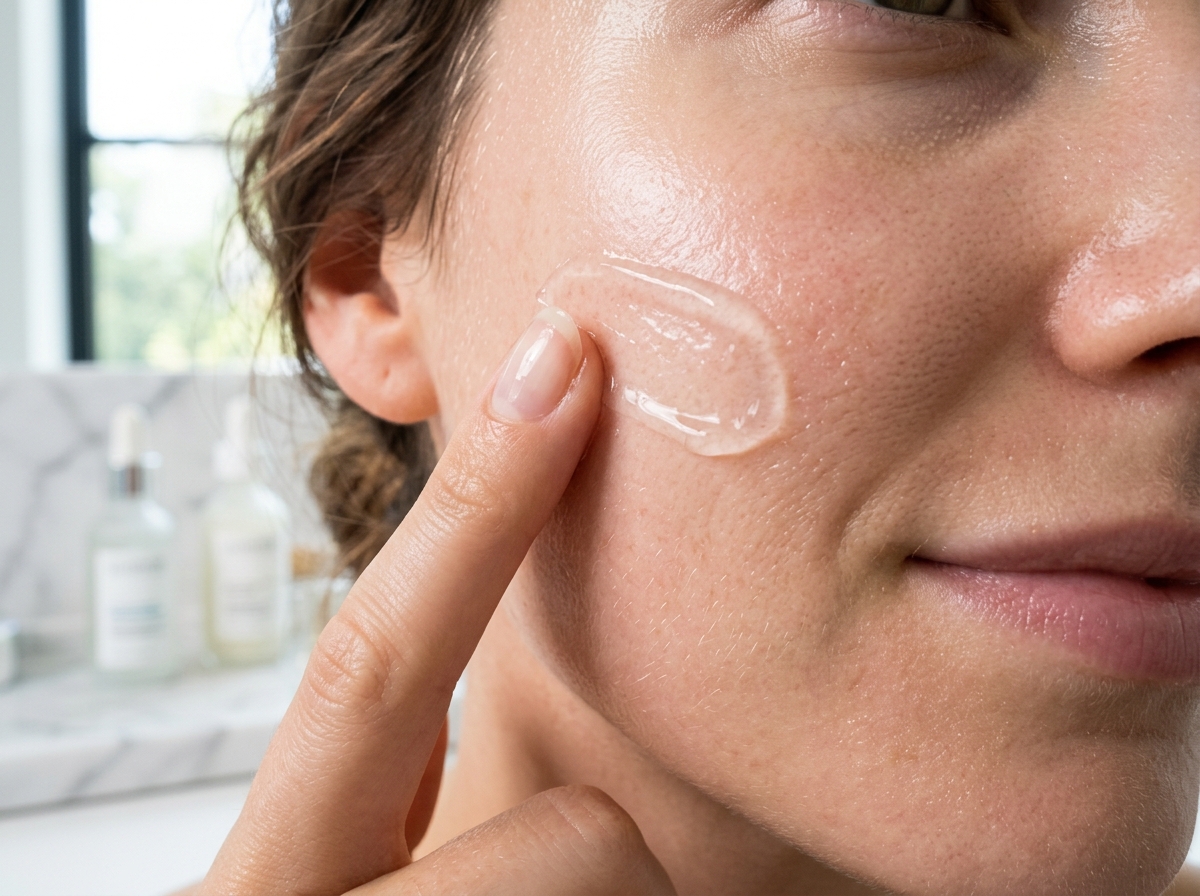
The "One Moisturizer Myth" (Why Single Creams Fail on Combination Skin)
For decades, the commercial skincare industry has promoted a seductive falsehood: that a single tube or jar of moisturizer can simultaneously balance an oily, congested T-zone while repairing parched, flaking cheeks. If you have combination skin in India, your personal experience has undoubtedly proven otherwise.
The failure of single-moisturizer routines is rooted in human histology. Your facial skin is not a homogenous canvas; it is an asymmetrical mosaic governed by vastly different sebaceous gland densities:
The Oily T-Zone (Forehead, Nose, Chin)
Houses between 400 and 900 sebaceous glands per cm². Under the influence of circulating dihydrotestosterone (DHT) and cortisol, these glands continuously pump out natural lipid mass (squalene, wax esters, triglycerides). The T-zone already produces abundant natural occlusives; what it lacks is aqueous water binding.
The Dry U-Zone (Lateral Cheeks, Jawline)
Contains fewer than 100 sebaceous glands per cm². The stratum corneum in this zone has a drastically thinner natural lipid bilayer, lower concentrations of ceramides 1, 3, and 6-II, and an elevated baseline Transepidermal Water Loss (TEWL). Without external physiological lipids, moisture evaporates rapidly into the air.
When you attempt to treat both zones with one product, you trigger an inevitable compromise failure:
Water-Gel All Over = Sandpaper Cheeks
You pick a light, oil-free hyaluronic acid or aloe water-gel to keep your forehead matte. Your T-zone feels great, but your cheeks begin to tighten within 45 minutes. By midday, especially in air-conditioned offices or dry Indian winters, water evaporates from the lateral cheeks. Fine micro-cracks form, makeup cakes and flakes, and the cheek texture feels like fine-grit sandpaper.
Barrier Cream All Over = Comedone Catastrophe
Frustrated by peeling cheeks, you switch to a rich ceramide cream or cold cream. Your cheeks feel nourished and smooth, but within 48 hours, your nose and forehead become greasy and suffocated. Heavy occlusive emollients mix with your sebum, creating oxidized plugs that erupt into bumpy closed comedones, sebaceous filaments, and pustules across the T-zone.
⚠️ The Clinical Truth
Expecting one moisturizer to successfully treat both an oily T-zone and dry cheeks is the dermatological equivalent of wearing a heavy wool sweater and shorts in the rain. To achieve a smooth, even, and radiant complexion, you must discard the one-moisturizer myth and embrace zone-targeted multi-moisturizing.
The Biology of Multi-Moisturizing: Hydration Vectors vs Lipid Barriers
To master the dual-moisturizer method, you must understand that "moisturizing" is not a single biological action. It is composed of two distinct pharmacological vectors:
| Moisture Vector | Biological Mechanism | Key Active Ingredients | Target Facial Zone |
|---|---|---|---|
| Vector 1: Aqueous Hydration (Water Binding) | Delivers water molecules into the stratum corneum and binds them to the intracellular matrix via hydrogen bonding. Plumps dehydrated corneocytes without adding lipid mass. | Glycerin, Polyglutamic Acid, Sodium Hyaluronate, Panthenol (Vitamin B5), Sodium PCA, Beta-Glucan, Trehalose. | Universal Base: Essential for the entire face, especially the oily T-zone where lipids are already excessive. |
| Vector 2: Lamellar Lipid Occlusion (Barrier Sealing) | Replenishes missing intercellular lipid bilayers (the "mortar" between skin cells). Forms a semi-permeable physiological film that reduces Transepidermal Water Loss (TEWL). | Ceramide NP, Ceramide AP, Ceramide EOP, Phytosphingosine, Cholesterol, 100% Sugarcane Squalane, Free Fatty Acids. | Targeted Zone: Restricted strictly to the dry lateral cheeks, zygomatic arch, jawline, and periorbital area. |
Because the T-zone already manufactures its own natural lipid film (squalene, wax esters), it requires 100% Vector 1 (Water Binding) and 0% Vector 2 (Heavy Occlusion). Conversely, the dry lateral cheeks have a severely depleted lipid matrix; they require 100% Vector 1 followed by 100% Vector 2. Multi-moisturizing is simply the clinical application of this exact biological reality.
Formulation Architecture: Gel Matrix vs Emulsion vs Balm
Not all moisturizers are created equal. Understanding how ingredients are formulated into vehicles determines whether they will sink in weightlessly or trap heat and sebum:
1. Oil-Free Aqueous Water-Gels (T-Zone)
Constructed from cross-linked acrylate polymers (carbomer, acrylates copolymer) holding high concentrations of water, glycerin, and humectants. Zero fatty esters or occlusive waxes. Upon skin contact, skin warmth and salt electrolytes break the polymer network, releasing pure water that absorbs within seconds, leaving a matte, velvet, non-tacky finish.
2. Lamellar Emulsions / Barrier Lotions (Cheeks)
Formulated with liquid crystal lamellar structures that mimic the natural 3:1:1 molar ratio of the human stratum corneum (ceramides, cholesterol, fatty acids). They integrate seamlessly into the skin's fractured intercellular spaces, restoring barrier resilience without leaving a heavy grease film.
3. Heavy Anhydrous Balms & Salves (Emergency Spot-Use)
Formulated with white petrolatum, microcrystalline wax, lanolin, or heavy plant butters (shea, cocoa). These provide nearly 100% occlusivity. While excellent for chapped lips or localized eczema patches on the jawline during harsh winter, they must never touch the T-zone.
4. 100% Pure Sugarcane Squalane (The Booster)
A single-molecule saturated hydrocarbon oil identical to natural human squalene, but without the double bonds that oxidize into comedogenic peroxides. Non-comedogenic and fungal-acne safe. 1 to 2 drops mixed into a light lotion provides instant custom lipid richness for dry cheeks.
The Zygomatic Transition Zone: How to Blend Without Overlapping
The most common tactical error when practicing multi-moisturizing is sloppy application at the transitional borders. If you carelessly overlap thick ceramide cream onto the inner cheek area adjacent to the nose, you will develop a cluster of closed comedones right along the nasolabial fold.
Dermatologists teach the Zygomatic Boundary Technique to ensure flawless application:
Locate the Anatomical Landmark (Zygomatic Arch)
Place your fingers along your cheekbones. The ridge of the bone marks the zygomatic arch. The skin directly over the lateral cheekbone and extending outward to the hairline and downward along the jawline represents the Dry Zone (Zone 2). The inner cheek area medial to the mid-pupillary line represents the Sebaceous Zone (Zone 1).
Outward-Only Feathering
When applying your rich ceramide cream to the cheeks, place the product at the center of the outer cheek and smooth strictly outward toward the ears and hairline. Never swipe inward toward the nose or upward onto the temples. As your fingers reach the inner cheekbone boundary, lift them off the skin completely to avoid product transfer.
Maintain a 1-Centimeter Safety Margin Around Nostrils
Keep rich creams at least 1 cm away from the alar creases (the nostril folds). The alar crease is exceptionally prone to Malassezia yeast overgrowth. Applying heavy creams to the nostril fold fuels seborrheic dermatitis, leading to red, itchy, peeling creases.
If you already have peeling nostril creases alongside an oily T-zone, read our clinical diagnostic manual: Flaky Skin Around Nose with an Oily T-Zone: Indian Dermatologist Guide ➔.
Step-by-Step Dual-Moisturizer Application Protocol (AM & PM)
Follow this clinically validated, 60-second protocol every morning and night to achieve balanced hydration across all zones of your face:
Cleanse & Leave Skin Slightly Damp
Wash your face with a gentle, low-pH amino acid cleanser. After rinsing, do not rub your skin dry with a towel. Pat lightly so the stratum corneum remains damp. Humectants require ambient water molecules to bind effectively; applying water-gel to bone-dry skin severely reduces its plumping efficiency.
Apply Oil-Free Water-Gel (Face-Wide or T-Zone Focused)
Dispense a nickel-sized amount of your water-gel (formulated with Glycerin, Panthenol B5, and 2% Niacinamide). Smooth it across your forehead, down the bridge of your nose, over the chin, and lightly across the cheeks. Pat gently until absorbed. This supplies 100% of your T-zone's moisture requirements.
Allow Polymer Settlement
Wait 45 to 60 seconds. The water phase absorbs into the stratum corneum, leaving a soft, non-tacky humectant film on the skin surface.
Apply Ceramide Cream (Lateral Cheeks Only)
Dispense a small pea-sized amount of your lamellar ceramide cream (or 1 to 2 drops of pure Sugarcane Squalane). Warm it between your fingertips and press it strictly onto your lateral cheeks, jawline, and orbital eye area. Do not touch your forehead or nose.
Sunscreen (AM) or Active Repair (PM)
In the Morning: Follow with a lightweight hybrid fluid sunscreen (see our Sunscreen Guide).
At Night: Your skin barrier enters its circadian recovery cycle, repairing lipid bilayers while your T-zone breathes without pore congestion.
Active Ingredient Layering: Retinoids, BHA, and Azelaic Acid Integration
Managing potent active treatments (retinoids, chemical exfoliants, tyrosinase inhibitors) on combination skin is notoriously difficult. If you apply actives all over, your cheeks peel into sandpaper; if you skip them, your T-zone breaks out. Here is how to integrate actives into your dual-moisturizer routine:
The "Targeted Sandwich Technique"
1. Apply your water-gel all over damp skin.
2. Apply your ceramide cream to your dry cheeks and orbital area (creating a protective buffer).
3. Apply a pea-sized amount of Adapalene 0.1% or Tretinoin 0.025% directly onto the forehead, nose, and chin, feathering only slightly over cheek marks.
4. Top the cheeks with a second light dab of ceramide cream. The cheeks are fully shielded against retinoid dermatitis, while the T-zone receives direct comedolytic action.
Zone-Isolated Desmolysis
1. Cleanse and pat skin 100% dry.
2. Apply 2% BHA leave-on serum strictly to the congested T-zone. Never apply BHA to the dry lateral cheeks; BHA dissolves the few remaining intercellular lipids, causing barrier collapse.
3. Apply your ceramide cream directly to your cheeks.
4. After 10 minutes, apply your oil-free water-gel over the T-zone to hydrate without neutralizing the BHA.
The "Great Unifier" Protocol
Azelaic acid is the single most versatile molecule for Indian combination skin. It competitively inhibits tyrosinase (fading post-acne dark marks and melasma) while normalizing follicular keratinization on the T-zone without stripping moisture from the cheeks. Apply Azelaic acid across the entire face, then follow with water-gel on the T-zone and ceramide cream on the cheeks.
To learn more about clearing bumpy microcomedones on the T-zone without flaking the cheeks, read our clinical guide: Closed Comedones on Combination Skin: How to Clear Bumps Without Peeling ➔.
Product Formulation Matrix for the Indian Market
Building a dual-moisturizer routine does not require spending thousands of rupees on luxury imports. Excellent, dermatologist-tested formulations are widely available in Indian pharmacies and clinical brands:
| Category | Product Example (Indian Market) | Key Ingredients | Best For |
|---|---|---|---|
| T-Zone Water-Gel | Minimalist Vitamin B5 10% Moisturizer / Sebamed Clear Face Care Gel. | 10% Panthenol, Glycerin, Hyaluronic Acid, Allantoin (Zero Oil). | Extremely oily foreheads, sebaceous noses, active comedones. |
| T-Zone Balancing Gel | Dot & Key Cica Calming Gel / Cipla Excela Moisturizer. | Centella Asiatica, Niacinamide, Zinc PCA, Enantia Chlorantha Extract. | Oily T-zones prone to redness, enlarged pores, and midday shine. |
| Cheek Barrier Lotion | Minimalist Multi-Ceramides 0.3% / Physiogel Daily Moisture Therapy. | Ceramides NP/AP/EOP, Phytosphingosine, Squalane, Hydrogenated Lecithin. | Dehydrated, tight cheeks in mild to moderately dry weather. |
| Cheek Intensive Cream | CeraVe Moisturizing Cream / Bioderma Atoderm Creme Ultra. | 3 Essential Ceramides, Cholesterol, MVE Delivery Technology, Niacinamide. | Severe cheek flaking, peeling from retinoids, North Indian winter. |
| Custom Lipid Booster | Minimalist 100% Sugarcane Squalane Oil (1–2 drops). | 100% Pure Squalane (Ecocert-approved single-ingredient hydrocarbon). | Instant customization: mix with any lotion for customized cheek nourishment. |
Seasonal Adaptations Across India: Monsoon vs North Indian Dry Winter
India's dynamic climate demands that your dual-moisturizer routine flex throughout the year. What works in an air-conditioned bedroom during July will fail during a dry January:
Monsoon Season (June – September)
The Environment: Relative humidity exceeds 85–95% in coastal regions (Mumbai, Chennai, Kolkata, Kerala). High ambient moisture reduces cutaneous evaporation, while sweating increases.
Dual-Moisturizer Tweak: Lighten both vectors. Rely strictly on an oil-free water-gel for the T-zone. On the cheeks, switch from a heavy cream to a featherweight ceramide lotion. In daytime, a modern fluid sunscreen often provides all the moisture your T-zone needs.
North Indian Winter (November – February)
The Environment: Freezing dry winds in Delhi NCR, Punjab, and Uttar Pradesh drop ambient relative humidity below 25%. Central heating and room blowers strip water from the skin.
Dual-Moisturizer Tweak: Upgrade your cheek lipid vector to a rich, dense ceramide-cholesterol cream, or add 2 drops of squalane oil over your cheeks morning and night. On the T-zone, transition from an ultra-light gel to a light hydrating lotion to prevent rebound dehydration oiliness.
7 Critical Mistakes Indians Make When Moisturizing Combination Skin
Avoid these seven common moisturizing pitfalls that sabotage your skin barrier and trigger recurring breakouts:
Slugging the Entire Face with Vaseline, Boroline, or Coconut Oil
Slugging (coating the face in pure petrolatum or heavy ointment overnight) is a fantastic trend for severe dry skin, but doing it on a combination face is disastrous. Thick occlusives trap sebum, dead corneocytes, and anaerobic bacteria inside the T-zone follicles, causing acute outbreaks of pustules and closed comedones. Restrict slugging strictly to the lateral cheeks if they are peeling.
Skipping Moisturizer Entirely Because the Forehead Looks Shiny
When you dehydrate an oily T-zone by withholding moisturizer, the skin senses barrier impairment. The sebaceous glands respond by pumping out more compensatory sebum (rebound oiliness) within 2 hours. Hydrating with an oil-free water-gel signals the skin that its moisture needs are met, reducing compensatory sebum output.
Applying Hyaluronic Acid on Bone-Dry Skin in Air-Conditioned Rooms
Hyaluronic acid acts as a molecular sponge. In humid environments, it draws water from the air into the skin. But in dry, air-conditioned rooms or winter weather (ambient humidity <40%), HA cannot find water in the air, so it pulls moisture out of the deeper dermis into the stratum corneum, where it evaporates into the room. Always apply HA onto damp skin and immediately seal it.
Applying Heavy Creams Directly into the Nostril Sulcus (Alar Crease)
Tucking rich cold creams into the crease around the nose feeds Malassezia yeast, triggering perinasal seborrheic dermatitis. Keep rich creams at least 1 cm away from the nostrils.
Using Fragranced Ayurvedic Cold Creams with Heavy Mineral Waxes
Traditional Indian cold creams contain heavy beeswax, microcrystalline paraffin, and strong synthetic perfumes. They clog T-zone pores and trigger allergic contact dermatitis on sensitized cheeks. Stick to fragrance-free clinical formulations.
Over-Cleansing with Harsh Foaming Soaps to "Control T-Zone Oil"
Washing with high-pH bar soaps or aggressive foaming cleansers strips the natural ceramides from your lateral cheeks. This forces you to apply heavier creams, creating an endless cycle of barrier stripping and pore clogging. Use a gentle, low-pH amino acid cleanser.
Rubbing Moisturizer Vigorously Instead of Patting and Smoothing
Aggressively rubbing products into the skin generates friction, damaging the fragile dermo-epidermal junction on melanin-rich Fitzpatrick IV–VI skin. Always smooth moisturizers gently in one direction or pat them into the skin.
Frequently Asked Questions (Dermatologist FAQ)
Yes, for the vast majority of individuals with marked combination skin in India. Your T-zone has 400 to 900 sebaceous glands per cm² and produces ample occlusive lipids, requiring only water-based humectants (Glycerin, Hyaluronic acid, Panthenol). Your lateral cheeks have fewer than 100 glands per cm² with high transepidermal water loss, requiring physiological ceramides, cholesterol, and fatty acids. A single product is either too light for your cheeks (causing sandpaper flaking) or too heavy for your T-zone (causing closed comedones).
Pure aloe vera gel can provide temporary soothing hydration, but on its own, it lacks sufficient film-forming humectants (like Glycerin or Polyglutamic Acid) to hold water inside the stratum corneum in dry air. For the T-zone, dermatologists recommend an oil-free water-gel formulated with Glycerin, Panthenol (Vitamin B5), and Niacinamide (2–3%), which hydrates while actively regulating sebum excretion.
The fastest clinical technique is the 'Base & Target' method: Dispense a dime-sized amount of lightweight water-gel and smooth it quickly across your entire face (both T-zone and cheeks). Then, immediately dab a small pea-sized amount of rich ceramide cream or 1 drop of pure squalane exclusively onto your dry cheeks and jawline. The entire process takes less than 30 seconds.
Always apply the lighter, water-based product first. If you choose to layer over the cheeks, apply your hydrating water-gel across the face first to infuse the stratum corneum with water molecules, and then follow with the lipid-rich ceramide cream on the cheeks to seal in the hydration. Never apply a light water gel over a thick occlusive cream, as water cannot penetrate an oil/lipid barrier.
If heavy occlusives or comedogenic plant oils (like shea butter or coconut fractions) migrate onto the nose and alar crease, they mix with natural sebum triglycerides to form micro-plugs within 48 to 72 hours, triggering closed comedones or feeding Malassezia yeast. To avoid this, keep rich creams at least 1 cm away from the nasolabial fold and alar crease.
The dual-moisturizer method actually prevents fungal acne when executed correctly. Fungal acne flares when heavy oils and fatty esters are applied to the sebaceous T-zone. By keeping your T-zone strictly on oil-free, fungal-safe water gels and confining lipid-rich creams to the non-sebaceous lateral cheeks, you starve Malassezia yeast while repairing barrier defenses.
No. Hyaluronic acid is a pure humectant—it pulls water into the upper epidermis, but it cannot prevent that water from evaporating into dry air. In air-conditioned offices or North Indian winters (RH <30%), applying pure hyaluronic acid without an emollient seal pulls water from deeper dermal layers, worsening cheek dryness. It must always be followed by a lipid seal on the cheeks.
During the humid monsoon (80–95% RH), ambient air is saturated with moisture. You can lighten both vectors: Use an ultra-light oil-free water-gel on the T-zone, and switch the cheeks from a heavy cream to a light, non-comedogenic ceramide lotion. In coastal cities like Mumbai and Chennai, many combination skin patients find that a modern hybrid sunscreen provides sufficient moisture for the T-zone during the day.
Face oils can be safely used if restricted strictly to the dry cheeks at night. High-linoleic oils (like Rosehip) or 100% Sugarcane Squalane are well-tolerated on Fitzpatrick IV–VI skin. However, never apply face oils to the forehead, nose, or chin, as they accelerate sebum oxidation and follicular plugging.
With consistent zone-targeted ceramide lipid replenishment, tight stinging and visible micro-flaking improve significantly within 5 to 7 days. Full restoration of the lipid bilayer lamellar architecture, Natural Moisturizing Factor (NMF) synthesis, and invisible enzymatic desquamation typically takes 3 to 4 weeks (one complete epidermal turnover cycle).
