The Sunscreen Dilemma for Combination Skin in India (The Bi-Zonal Paradox)
Ask any Indian skincare enthusiast with combination skin what their most difficult product to find is, and the answer is almost always sunscreen. The reason lies in the physiological contradiction of combination skin: your face behaves like two entirely different biological ecosystems existing mere inches apart.
Your central T-zone (forehead, nose, and chin) houses up to 900 sebaceous glands per cm², generating copious lipid flow. Meanwhile, your lateral cheeks have fewer than 100 glands/cm² with a thin lipid barrier prone to high transepidermal water loss (TEWL) and xerosis (dryness). When you apply standard sunscreens sold in the Indian market, this bi-zonal conflict leads to immediate formulation failure:
The Matte Sunscreen Trap (Dry Cheeks)
Silicone-heavy "dry touch" or "matte finish" sunscreens contain high percentages of volatile silicones (cyclopentasiloxane) and cross-linked dimethicone. While they temporarily mattify an oily forehead, they suck moisture from dehydrated cheeks within 90 minutes. They cling to microscopic dead skin flakes, accentuate uneven texture, and cause makeup to crack like dried mud.
The Dewy Sunscreen Trap (Greasy T-Zone)
"Hydrating", "glowy", or "water-gel" sunscreens formulated for dry skin rely on rich emollient esters and heavy fatty alcohols. On an Indian combination T-zone in 34°C humidity, these sunscreens emulsify with your natural sebum within 30 minutes. The resulting oil slick slides into the eyes causing painful burning, clogs follicular pores, and triggers outbreaks of closed comedones.
Yet, skipping sunscreen is the single worst mistake an Indian individual with combination skin can make. On Fitzpatrick IV–VI skin, ultraviolet A (UVA) and high-energy visible (HEV) blue light hyper-stimulate melanocytes. Every single breakout or inflamed patch on the T-zone transforms into stubborn, dark brown post-inflammatory hyperpigmentation (PIH) that lasts 6 to 18 months. Solving the sunscreen paradox is not a luxury—it is the non-negotiable foundation of clear, even skin.
⚠️ The Two-Tone Indian Tanning Hazard
Because the forehead and nose protrude geometrically from the facial plane, they receive up to 35% more direct solar radiation than the lateral cheeks. When combination skin users skip SPF or apply it inconsistently due to greasiness, the forehead turns 2 to 3 shades darker than the cheeks, worsening the appearance of uneven skin tone.
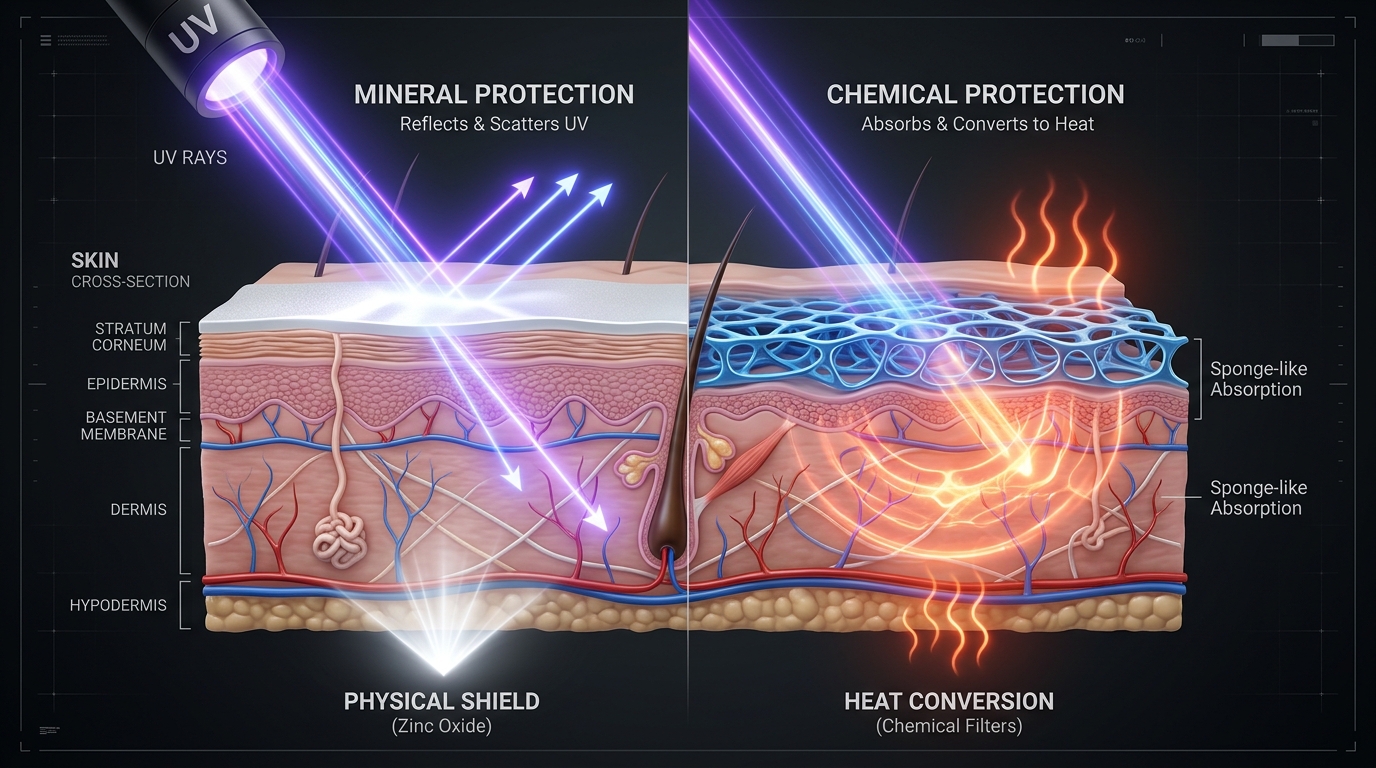
Chemical vs Mineral vs New-Gen Hybrid Filters: What Actually Works on Indian Brown Skin
The performance, texture, and cosmetic elegance of any sunscreen depend fundamentally on the active UV filters it uses. Understanding how different filter classes behave on brown skin and bi-zonal oiliness is critical:
| Filter Category | Common Active Ingredients | Performance on Oily T-Zone | Performance on Dry Cheeks | White Cast on Fitzpatrick IV–VI |
|---|---|---|---|---|
| Pure Mineral (Physical) | Zinc Oxide, Titanium Dioxide. | Good sebum control, but heavy powders can mix with sebum and form follicular plugs. | ❌ Dries out cheeks severely; clings to dry patches and micro-crusts. | 🚨 High Risk: Chalky white, purple, or ghostly bluish hue on brown skin. |
| Old-Generation Chemical | Avobenzone, Oxybenzone, Octinoxate, Homosalate. | ❌ Oil-soluble filters require greasy vehicle bases; turns shiny quickly; migrates into eyes. | Can sting sensitized or broken cheek barriers; potential allergic contact dermatitis. | ✅ Completely transparent; zero white cast. |
| New-Generation Hybrid & Organic (Gold Standard) | Tinosorb S (BEMT), Tinosorb M (MBBT), Uvinul A Plus (DHHB), Uvinul T 150, Mexoryl SX/XL. | ✅ Featherweight water-based or fluid gel carriers; excellent photostability; zero eye sting. | ✅ Does not desiccate cheeks; compatible with light humectant pre-hydration. | ✅ Virtually Zero Cast: Microfine dispersion absorbs invisibly into melanin-rich skin. |
Dermatologists strongly advise patients with Indian combination skin to look for formulations built on new-generation European and Asian filters (such as Bis-Ethylhexyloxyphenol Methoxyphenyl Triazine / Tinosorb S, and Diethylamino Hydroxybenzoyl Hexyl Benzoate / Uvinul A Plus). These modern large-molecule filters do not penetrate the living dermis, do not generate reactive free radicals upon UV exposure, and can be suspended in featherweight, oil-free aqueous emulsions that satisfy both oily foreheads and dry cheeks.
Texture Formulation Breakdown: Gel vs Matte Silicone vs Fluid Milk vs Water-Gel
Beyond the active UV filters, the base emulsion (the vehicle) dictates whether a sunscreen will feel comfortable or disastrous on combination skin. Here is how four primary sunscreen textures perform:
1. Fluid Milk / Shake-Well Lotions (Recommended)
Ultra-low viscosity emulsions that spread effortlessly in an ultra-thin veil. They utilize water-in-oil or oil-in-water micro-droplets that flash-evaporate, leaving behind a breathable, weightless protective mesh. They neither suffocate the T-zone nor desiccate the cheeks.
2. Water-Gel Emulsions (Recommended)
Formulated with high concentrations of water, glycerin, and cross-linked acrylate polymers. When smoothed onto the skin, the water phase bursts, delivering immediate hydration to dry cheeks while drying down to a non-sticky, velvet-soft finish that controls T-zone shine.
3. Silicone Matte "Dry Touch" Gels (Use with Caution)
Anhydrous or high-dimethicone formulations. While they create an immediate blurring, pore-smoothing primer effect on the nose, they form an impermeable plastic barrier. Within 2 hours, they draw water out of the cheeks, causing severe tightness and pilling.
4. Rich Cream Sunscreens (Avoid on Combination Skin)
Designed for mature or severely dry skin. Rich in shea butter, mineral wax, and heavy plant oils. On an Indian combination face, these cause forehead comedones, slide off the nose during sweating, and leave an unmanageable greasy shine.
💡 The Golden Rule of Texture Selection
Choose a fluid milk or hydrating water-gel sunscreen. It is vastly easier to add a drop of moisturizer to your dry cheeks beneath a lightweight fluid sunscreen than it is to remove greasiness from an oily T-zone caused by a heavy cream sunscreen.
The White Cast & Ashy Residue Problem in Fitzpatrick IV–VI Melanin-Rich Skin
On melanin-rich Indian skin (Fitzpatrick types IV, V, and VI), a white cast is not merely an aesthetic annoyance; it is a clinical compliance obstacle. When a sunscreen leaves an ashy, ghostly, or purplish cast, users inevitably under-apply the product (using a fraction of the required 2 mg/cm² dosage) or rub it aggressively into the skin, destroying the uniform protective film.
Why do traditional sunscreens look ashy on Indian skin? The optical physics are straightforward:
Refractive Index Mismatch (Mie Scattering)
Mineral particles like Zinc Oxide (refractive index ~2.0) and Titanium Dioxide (refractive index ~2.6) have a much higher refractive index than epidermal keratin (~1.5). When ambient light hits these large mineral particles, it scatters back across the visible spectrum (Mie scattering). On fair skin, this scattered white light blends in; on brown skin rich in brown-black eumelanin, it produces high visual contrast, appearing as an ashy, lavender, or chalky mask.
Particle Clumping on Dry Cheek Flakes & Facial Hair
In combination skin, dry cheek areas feature raised, microscopic corneocyte edges. Mineral sunscreen particles lodge beneath these micro-flakes and around fine vellus facial hair follicles, creating visible white specks and emphasizing texture irregularities.
Why Iron Oxides Are Vital for Melasma & Brown Skin
Dermatological research has demonstrated that High-Energy Visible (HEV) blue light (400–500 nm) from the sun and digital screens induces more intense and longer-lasting pigmentation in Fitzpatrick IV–VI skin than in lighter skin types. Traditional colorless UV filters do not block visible light. Adding iron oxides (red, yellow, and black iron oxides) not only neutralizes any white cast to match warm Indian skin undertones, but it also provides up to 90% protection against blue-light-induced hyperpigmentation.
To understand how solar radiation and blue light interact with deeper dermal pigmentation, read our clinical analysis: Uneven Skin Tone on Face: Causes & Dermatological Protocol ➔.
Zone-Mapping Sunscreen Application: The Dermatologist 2-Zone Technique
The secret to wearing sunscreen on combination skin without getting an oily forehead or flaky cheeks is Zone-Mapping Pre-Hydration. Follow this step-by-step morning protocol:
Gentle, Non-Stripping Wash
Wash your face with a low-pH, sulfate-free amino acid cleanser. Focus your gentle lather on the oily T-zone to remove overnight sebum buildup, and simply let the rinse-water flow over your cheeks. Pat completely dry with a clean microfiber towel.
Moisturize Cheeks Only (Skip the T-Zone)
Dispense a pea-sized amount of a lightweight ceramide moisturizer or 1 drop of pure plant squalane. Smooth this strictly over your dry cheeks, jawline, and orbital eye area. Do not apply moisturizer to your forehead, nose, or chin. Your modern hybrid sunscreen will provide all the hydration your T-zone needs.
Allow Film Equilibrium
Wait 3 to 5 minutes before applying sunscreen. This allows the moisturizer to bind to the cheek's stratum corneum and let the water phase evaporate. Applying sunscreen immediately over wet moisturizer disrupts sunscreen film formation and causes severe pilling.
Even Distribution Without Friction
Dispense two finger-lengths of fluid hybrid sunscreen (approximately 1.25 ml for the face and ears). Dot the sunscreen evenly across all zones. Smooth the product in one single direction (from the center of the face outward toward the hairline). Never rub sunscreen in aggressive circular motions; circular rubbing disrupts the polymer emulsifiers and rolls the protective film into clumps.
Zero Touching Before Sun Exposure
Allow 10 to 15 minutes for the sunscreen to form an unbroken, cross-linked protective film on your skin before stepping into direct sunlight, wearing a mask, or applying makeup.
For a complete morning and evening step-by-step regimen tailored to combination skin, consult our companion manual: Zone-Mapping Skincare Routine for Combination Skin: Indian Dermatologist AM & PM Guide ➔.
Ingredient Audit: What to Look For & What to Avoid in Indian Formulations
Before purchasing a sunscreen in India, examine the ingredient label (INCI list) closely. Look for formulations engineered with these supportive actives while steering clear of known formulation traps:
| Category | ✅ Highly Recommended Ingredients | 🚨 Problematic Ingredients (Avoid on Combination Skin) |
|---|---|---|
| Sebum & Pore Regulators |
Silica & Silica Dimethyl Silylate: Micro-porous spheres that adsorb excess sebum on the T-zone without dehydrating deeper skin layers. Niacinamide (2–3%): Normalizes sebaceous output while boosting ceramide synthesis on cheeks. Zinc PCA (0.5–1%): Anti-inflammatory and antimicrobial. |
Heavy Waxes (Cera Alba, Paraffin): Traps sweat and sebum beneath the film. Bentonite / Kaolin Clay in high doses: Over-dries the lateral cheeks, causing immediate micro-cracking and tight discomfort. |
| Hydrators & Barrier Soothers |
Glycerin & Sodium Hyaluronate: Weightless humectants that bind ambient moisture. Centella Asiatica (Madecassoside): Calms UV-induced erythema. Ectoin & Panthenol (Vitamin B5): Protects cellular membranes against thermal and osmotic stress. |
High Concentration Denatured Alcohol (Alcohol Denat >10%): While it creates a fast-drying matte feel, high alcohol content severely dehydrates the cheek barrier, causing rebound oiliness on the forehead within hours. |
| Emollients & Texture Bases |
C12-15 Alkyl Benzoate: Light, dry-touch ester with high filter solvency. Caprylic/Capric Triglyceride: Non-greasy, non-comedogenic ester. Dicaprylyl Carbonate: Velvet dry finish. |
Isopropyl Myristate / Isopropyl Palmitate: Highly comedogenic esters that trigger closed comedones on the T-zone. Coconut Oil / Shea Butter fractions: Heavy occlusives that trigger breakouts in tropical humidity. |
| UV Filter Profile | Tinosorb S, Tinosorb M, Uvinul A Plus, Uvinul T 150, Mexoryl SX/XL, Ensulizole. | Oxybenzone (Benzophenone-3) & Octinoxate: Prone to photo-allergies, eye stinging, and barrier irritation on dry cheek patches. |
Reapplication Strategies in Indian Climate (Without Ruining Makeup or Causing Breakouts)
Dermatologists agree that sunscreen degrades after 2 to 3 hours of cumulative UV exposure and natural sebum dissolution. However, telling an Indian professional with combination skin to "wash your face and reapply cream at 2:00 PM in the office" is clinically impractical. Here are four effective, dermatologist-approved reapplication methods:
Blotting Paper + Cushion Sponge Application
Take an unpowdered blotting paper and gently press it against your forehead, nose, and chin to lift excess midday sebum and sweat. Do not rub. Then, dispense a nickel-sized amount of lightweight fluid sunscreen onto the back of your hand, pick it up with a dry beauty blender or cushion puff, and gently tap it over your entire face. Tapping layers fresh UV protection evenly without smudging foundation or caking dry cheek patches.
Targeted T-Zone Oil Control & Photoprotection
Translucent or skin-tinted mineral sunscreen powders containing Zinc Oxide, Titanium Dioxide, and Silica (SPF 30–50 PA+++) are ideal for office touch-ups. Swirl the built-in brush and dust specifically over the forehead, nose, and chin. It absorbs midday shine instantly while boosting UV protection. Avoid dusting heavily over dry cheeks.
Convenient for Bare Skin or Outdoor Sports
Sunscreen sticks are excellent for hands-free touch-ups. However, on combination skin, sticks can drag across dry cheek flakes and pull at facial hair. Warm the tip of the stick on the back of your hand before gliding it smoothly across your face. Caution: To avoid transferring bacteria and sebum back into the stick, wipe the tip with an alcohol wipe after application.
Good for Refreshing, Inadequate as Primary Protection
Sunscreen aerosol mists are refreshing in hot Indian weather, but aerodynamic tests prove that over 50% of the mist disperses into the air rather than adhering to your face. Use mists only as a secondary top-up between full re-applications, closing your eyes and mouth, and holding the nozzle 15 cm away.
If your makeup frequently cakes, separates, or flakes over your sunscreen, read our comprehensive diagnostic breakdown: Why Makeup Looks Cakey on Textured Skin & Flakes Around Dry Cheeks ➔.
Seasonal Sunscreen Swaps Across India: Monsoon Sweat vs North Indian Winter Dryness
India's seasons dramatically alter your skin's sebum excretion and hydration levels. A sunscreen that performs flawlessly in a Delhi December will feel suffocating in a Mumbai July. Adapt your sunscreen selection to your regional climate:
Monsoon Season (June – September)
The Environment: Extreme humidity (80–95% RH) in coastal and central India (Mumbai, Kolkata, Chennai, Kerala). Copious sweating breaks ordinary sunscreen films within 20 minutes.
Sunscreen Selection: Choose a very water-resistant (tested to 80 minutes) fluid hybrid sunscreen with a sweat-resistant polymer matrix. Skip all morning cheek moisturizers; let the sunscreen act as your sole hydrator. Ensure the formula is fungal-acne safe to prevent Malassezia folliculitis.
North Indian Winter (November – February)
The Environment: Freezing dry winds in Delhi NCR, Punjab, and Uttar Pradesh drop ambient relative humidity below 30%. Indoor heaters accelerate cutaneous water loss.
Sunscreen Selection: Discontinue silicone matte "dry touch" sunscreens entirely—they will turn your cheeks into sandpaper. Transition to a hydrating fluid or gel-cream sunscreen enriched with ceramides or hyaluronic acid. Layer 2 drops of pure squalane over your cheeks before SPF application.
🌞 Peak Summer UV Index Advisory (March – May)
Across central and northern India, the summer UV Index routinely reaches 10 to 12 (Extreme Danger). At this intensity, unshielded skin develops DNA damage and melanin activation within 15 minutes. Pair your broad-spectrum PA++++ sunscreen with UV-400 polarized sunglasses and a wide-brimmed umbrella or hat during peak solar hours (11:00 AM – 3:30 PM).
7 Critical Sunscreen Mistakes Indians with Combination Skin Make
Avoid these seven common photoprotection blunders that trigger breakouts, peeling, and persistent hyperpigmentation:
Skipping Sunscreen on the T-Zone Because "It Already Has Enough Natural Oil"
Sebum is not sunscreen. In fact, UV rays oxidize the squalene in your sebum into squalene monohydroperoxide, an intensely comedogenic and inflammatory lipid that triggers acne flares and worsens pore congestion. The T-zone requires equal photoprotection.
Applying Heavy Winter Cold Cream All Over the Face Under Sunscreen
Layering thick creams under sunscreen oversaturates the T-zone, preventing the sunscreen polymers from adhering to the skin surface. The sunscreen slides off within an hour, leaving you completely unprotected.
Using Pure Mineral Sunscreen Without Pre-Hydrating Dry Cheeks
Applying zinc oxide or titanium dioxide directly over unmoisturized, flaky cheeks causes the mineral powder to bind to dehydrated corneocytes. It creates an ashy, chalky mask that accentuates every dry patch and fine line.
Aggressive Circular Rubbing Instead of Unidirectional Smoothing
Vigorously rubbing sunscreen in circles shears the polymer film, forcing the sunscreen into facial crevices and rolling it into tiny clumps (pilling). Always smooth sunscreen in one fluid direction from the center outward.
Using Fragranced Body Sunscreens on the Face to "Save Money"
Body sunscreens are formulated with heavier occlusive waxes, cheaper thickeners, and strong synthetic fragrances. When applied to a combination face, they trigger severe contact dermatitis on the cheeks and cystic breakouts on the T-zone.
Relying Exclusively on SPF in Makeup or Compact Powders
To achieve the labeled SPF 30 on a foundation, you would need to apply 7 to 10 times the normal cosmetic amount—resulting in an unwearable mask. Makeup SPF should only be considered a bonus, never your primary UV defense.
Failing to Double-Cleanse Water-Resistant Sunscreen at Night
Modern water-resistant hybrid sunscreens form an unbroken, resilient film designed to withstand sweat and friction. Simple face washes leave behind microscopic filter and polymer residues that oxidize overnight, creating bumpy closed comedones on the forehead and chin. Always remove sunscreen with a gentle oil cleanser or micellar water before your water-based cleanser.
Frequently Asked Questions (Dermatologist FAQ)
The gold-standard formulation for combination skin in India is a hybrid fluid or gel-cream sunscreen powered by new-generation organic filters (such as Tinosorb S, Tinosorb M, and Uvinul A Plus) combined with sebum-regulating silica microspheres. Pure mineral sunscreens often leave an ashy white cast and cling to dry cheek flakes, while heavy chemical creams turn the T-zone greasy and trigger closed comedones.
Sunscreen pilling occurs when incompatible polymers clash on dehydrated skin. If you apply a silicone-based matte sunscreen (containing dimethicone or cyclopentasiloxane) directly over a water-based hyaluronic acid or carbomer gel that has not fully absorbed, the polymer films shear against each other and ball up. Inadequate stratum corneum hydration on the cheeks accelerates this friction. Allowing 3 to 5 minutes between moisturizer and SPF completely prevents pilling.
Dermatologists recommend a zone-targeted approach: apply a lightweight, ceramide-rich moisturizer or squalane only on your dry cheeks and perimeter of your face, while leaving your oily forehead, nose, and chin bare. Modern hybrid sunscreens contain sufficient glycerin and hydrating polymers to serve as the sole moisturizer for your oily T-zone.
New-generation hybrid chemical sunscreens are clinically superior for Indian brown skin (Fitzpatrick IV–VI). Pure mineral sunscreens (Zinc Oxide and Titanium Dioxide) physically reflect white light, producing an unnatural purplish-gray cast on melanin-rich skin and catching on dry cheek patches. New-generation European and Asian filters (Tinosorb S/M, Mexoryl, Uvinul) provide superior UVA protection with 100% invisible, transparent finishes.
Eye stinging is primarily caused by old-generation chemical filters like Avobenzone and Octocrylene, which are oil-soluble and migrate easily into the ocular conjunctiva when forehead sweat emulsifies the sunscreen film. To prevent stinging, choose sunscreens formulated with photostable modern filters (Tinosorb S/Uvinul A Plus), set your eye area and brows with translucent silica powder, or use a mineral SPF stick specifically around the orbital rim.
Yes. Sunscreens formulated with heavy comedogenic emollients (such as Isopropyl Myristate, Isopropyl Palmitate, Ethylhexyl Palmitate, or Coconut Alkanes) mix with your natural sebum to form follicular micro-plugs. Furthermore, failing to properly double-cleanse water-resistant sunscreen films at night allows UV filter residues to oxidize inside the pores, forming stubborn closed comedones across the forehead and nose.
For midday reapplication without ruining makeup or caking dry cheeks: First, gently blot excess sebum from your forehead and nose using an unpowdered blotting paper. Then, either pat a fluid hybrid sunscreen using a cushion beauty sponge, or dust an oil-absorbing broad-spectrum mineral powder brush (SPF 30–50) specifically over the T-zone while misting the cheeks with a hydrating thermal water spray.
The PA rating measures protection against Ultraviolet A (UVA) rays, which penetrate deeply into the dermis and directly stimulate melanocytes. PA+++ indicates a Persistent Pigment Darkening (PPD) factor of 8 to 16, while PA++++ offers PPD >16 (the highest possible rating). For Indian skin prone to melasma, post-inflammatory hyperpigmentation (PIH), and uneven tanning, PA++++ is non-negotiable.
Standard UV filters block UVA and UVB, but they do not block High-Energy Visible (HEV) blue light (400–500 nm). Research confirms that HEV light induces significantly darker, more persistent hyperpigmentation in Fitzpatrick IV–VI skin than in lighter skin types. Iron oxides (found in tinted sunscreens) absorb visible light, offering essential defense against stubborn forehead darkening and melasma.
Yes. Modern water-resistant and hybrid sunscreens form a cross-linked polymer film that resists simple water and foaming cleansers. To prevent T-zone congestion, use a gentle non-comedogenic cleansing oil, cleansing balm, or micellar water as Step 1 to dissolve the sunscreen film, followed by a gentle, low-pH amino acid gel cleanser as Step 2 to leave both T-zone and cheeks clean without stripping the barrier.
