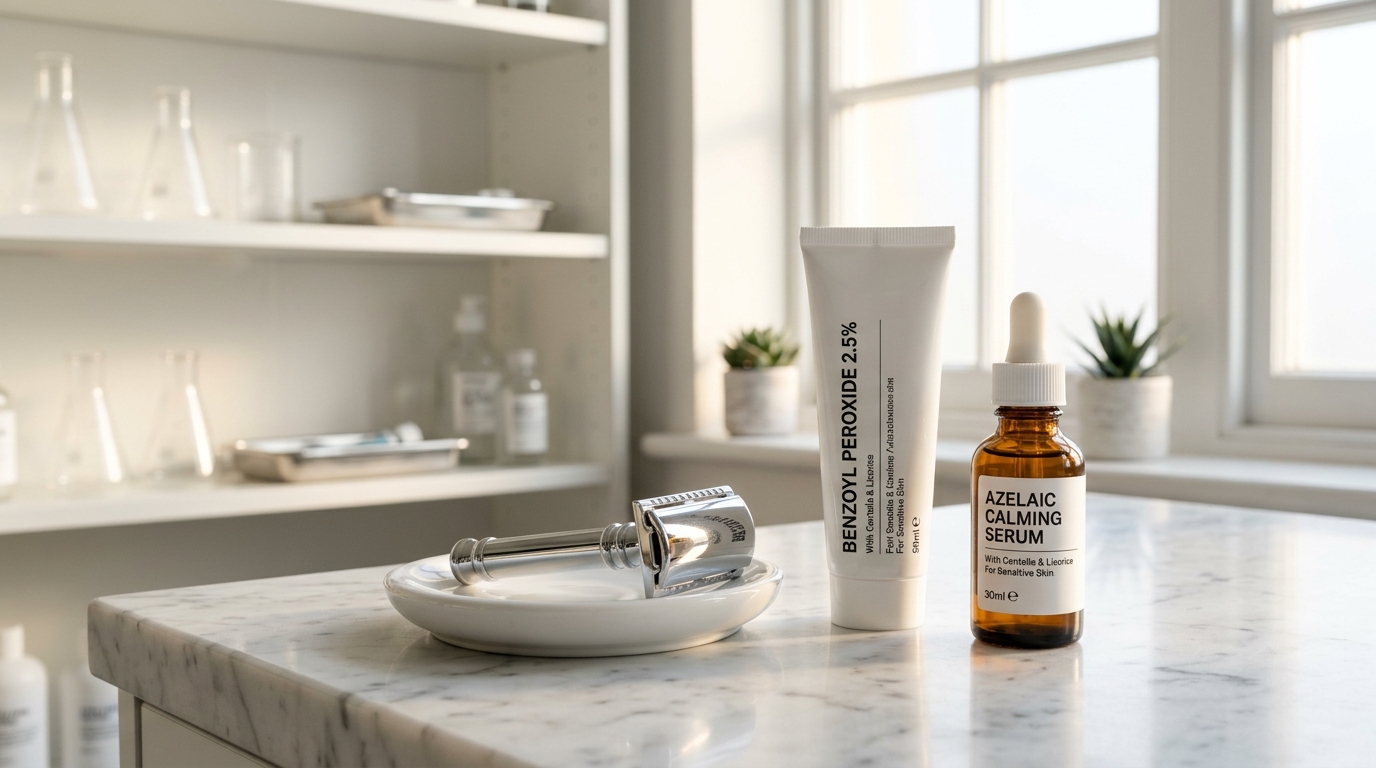
The "Beard Pimple" Dilemma: Acne, Folliculitis, or Razor Bumps?
Almost every Indian man who sports a beard or shaves his neck has experienced painful, inflamed bumps along the jawline and Adam's apple. In colloquial conversation, these are all labeled "beard pimples." However, clinical dermatology recognizes three entirely separate conditions that require opposite treatments:
Diagnostic Matrix: Acne Vulgaris vs Folliculitis Barbae vs Pseudofolliculitis (PFB)
Treating ingrown razor bumps with harsh acne drying lotions or treating bacterial folliculitis with heavy oils causes immediate failure. Use this 3-way clinical matrix to pinpoint your exact condition:
| Diagnostic Feature | Pseudofolliculitis Barbae (PFB) | Folliculitis Barbae (Infection) | Acne Vulgaris (Acne) |
|---|---|---|---|
| Primary Root Cause | Mechanical: Sharp curved hair piercing skin | Infectious: Staphylococcus or Malassezia | Hormonal / Sebum: Clogged sebaceous pore |
| Relation to Shaving / Trimming | Appears 24–48 hours after shaving | Can appear anytime; aggravated by dirty blades | Independent of shaving frequency |
| Central Hair Shaft | Hair is trapped, curved, or visible looped under bump | Hair stands upright right through center of pustule | Pore contains blackhead/whitehead core, no visible hair |
| Presence of Comedones | Zero blackheads or whiteheads | Zero comedones | Blackheads and whiteheads present |
| Primary Location | Anterior neck, submental jawline, Adam's apple | Beard area, mustache, cheeks, neck | Cheeks, jawline, forehead, chest, back |
| Sensation | Itching, stinging, collar friction irritation | Tender, warm, stinging pus heads | Deep throbbing, pressure in cystic bumps |
| Gold-Standard Solution | Single-blade shaving + Salicylic / Azelaic | Benzoyl Peroxide 2.5% wash + Clindamycin gel | Adapalene 0.1% + Benzoyl Peroxide |
💡 Quick Visual Self-Test: Take a flashlight and look at the bump under a mirror. If you see an upright hair sticking directly out of the center of a small yellow pus head, you have Folliculitis Barbae. If you see a hard red bump with a dark curved hair loop trapped underneath the surface, you have Pseudofolliculitis Barbae (Razor Bumps).
The Multi-Blade Cartridge Trap: Why "Lift-and-Cut" Razors Destroy Indian Skin
Global razor advertising has convinced men that more blades mean a better shave. Cartridge razors with 3, 4, or 5 blades (such as Gillette Mach 3 or Fusion) rely on an engineering phenomenon called hysteresis (the "lift-and-cut" mechanism):
🚨 Dermatologist Verdict: If you suffer from chronic neck bumps, throwing away your 3-blade and 5-blade cartridge razors will immediately resolve 70% of your razor bumps within 3 weeks. Switch to a traditional single-blade safety razor or a foil electric trimmer with a 1 mm guard.
The Indian Beard Oil Trap: How Castor, Coconut & Onion Oils Clog Follicles
The explosion of Indian D2C men's grooming brands has created a marketing craze around "beard growth oils." These formulations are heavily marketed with promises to fix patchy beards, fill in cheeks, and accelerate growth. In clinical practice, they are one of the leading causes of severe beard breakouts:
| Popular Beard Oil Ingredient | Comedogenic Rating (0–5) | Clinical Impact on Beard Skin |
|---|---|---|
| Pure Coconut Oil | Rating 4 / 5 (Highly Comedogenic) | Forms a heavy occlusive wax layer over follicles, trapping dead cells, sweat, and sebum. Leading cause of beard blackheads. |
| Castor Oil (Arandi Ka Tel) | Rating 3 / 5 (Extremely Viscous) | Dense ricinoleic acid consistency suffocates the follicular infundibulum. Zero clinical evidence for accelerating hair growth. |
| Onion Seed / Black Seed Oil | Rating 2–3 / 5 + Irritant | High sulfur content causes irritant contact dermatitis, red pustules, and strong stinging on freshly shaved skin. |
| Synthetic Mineral Oil / Fragrance | Severe Allergen | Synthetic fragrances (limonene, linalool) in cheap beard oils trigger allergic contact dermatitis that mimics acne. |
✅ The Safe Beard Conditioning Rule: You do not need heavy oils to maintain a soft beard. If your beard feels coarse, use a lightweight, non-comedogenic leave-in conditioner containing pure Argan Oil (Rating 0), Jojoba Oil (Rating 2, mimics human sebum), or Squalane (Rating 0). Apply only to the beard hair tips — never massage oils into the underlying skin.
The 5-Step Dermatologist Shaving Protocol for Zero Razor Bumps
If you prefer a clean-shaven neck or a sharply sculpted beard line, follow this clinically tested, low-irritation shaving protocol designed for coarse South Asian hair:
Pre-Shave Hydration (The 3-Minute Warm Water Soak)
Dry hair is as tough as copper wire of equal diameter. Never dry-shave. Shave immediately after a warm shower, or press a warm, damp washcloth against your neck for 2 to 3 minutes. Water hydration swells the hair shaft by 30%, making it 65% softer and dramatically easier for a blade to slice cleanly without pulling.
Use a Slick, Low-Foam Shaving Gel (Not Foaming Cans)
Avoid aerosol shaving cans that spray thick, airy foam. They contain drying propellants (isobutane) and lack lubricating film strength. Use a lubricating, translucent shave gel or a glycerin-rich shaving cream applied with warm water so you can clearly see hair growth direction.
Switch to a Single-Blade Safety Razor or Electric Foil Trimmer
Use a classic double-edge (DE) safety razor with a fresh, sharp stainless steel blade (e.g., Feather, Astra, or Gillette 7 O'Clock Super Platinum). A single blade cuts the hair flush with the skin surface without stretching or retracting it below the pore. Alternatively, use an electric beard trimmer with a 0.5 mm or 1 mm stubble guard — keeping hair just above the skin completely eliminates ingrowns.
Shave STRICTLY With the Grain (Never Against the Grain)
Map your neck hair growth. On most Indian men, neck hair grows downwards near the jawline, but swirls sideways or upwards near the collar line! Shave strictly in the direction the hair grows. Never pull your skin taut while shaving — stretching the skin allows the hair to be cut below the surface. Use short, light strokes (1 to 2 cm) with zero downward pressure.
Cold Water Rinse & Alcohol-Free Active Post-Shave
Rinse immediately with cold water to soothe skin and constrict micro-capillaries. Discard all alcohol-based aftershaves (such as Old Spice or Brut) which sting and cause chemical burns. Pat dry and apply an alcohol-free post-shave balm containing Azelaic Acid 10% or Centella Asiatica (Cica) to neutralize bacteria and stop dark marks before they start.
Indian Pharmacy Active Arsenal: Creams & Washes That Actually Clear Bumps
When bumps appear, commercial grooming washes with charcoal or menthol are ineffective. You need targeted, clinical active ingredients available over the counter at Indian pharmacies:
| Active Ingredient | Top Indian Pharmacy Brands | Primary Clinical Mechanism | How to Use for Beard Bumps |
|---|---|---|---|
| Benzoyl Peroxide 2.5% Wash / Gel | Benzac AC 2.5% Gel, Brevoxyl 4% Creamy Wash, Perobar 2.5% Soap | Releases oxygen directly into the follicle, eradicating S. aureus and C. acnes without causing antibiotic resistance. | Top Pick for Folliculitis Use as a 2-minute wash-off mask in the shower on alternate mornings. |
| Salicylic Acid 2% Solution / Gel | Saslic DS Face Wash, Minimalist 2% Salicylic Acid Serum, Sebogel | Oil-soluble BHA that penetrates deep into sebum-filled pores to dissolve the keratin cap trapping ingrown hairs. | Top Pick for Razor Bumps Apply 3 nights a week on dry skin over the neck and jawline. |
| Azelaic Acid 10% – 15% Gel | Aziderm 10% / 15% Gel (Micro Labs), Picspot Gel | Suppresses follicular inflammation, kills bacteria, and actively inhibits tyrosinase to prevent dark neck marks (PIH). | Top Pick for Brown Skin PIH Apply as an evening post-shave treatment. Non-stinging. |
| Clindamycin 1% Gel | Clinda-N Gel, Clinka Gel, Acnesol Gel | Topical lincosamide antibiotic that stops bacterial protein synthesis in active pus-filled lesions. | For Acute Painful Pustules Spot treat on yellow pus heads for 7–10 days only. |
| Ketoconazole 2% Wash / Lotion | Nizral 2% Solution, Scalpe Pro Daily Wash | Antifungal agent that destroys Malassezia yeast cell membranes in itchy fungal folliculitis. | For Itchy Beard Folliculitis Leave on beard area for 3 minutes, 2x a week during humid months. |
⚠️ Benzoyl Peroxide Fabric Warning: Benzoyl Peroxide bleaches colored fabrics! Always rinse your face and neck thoroughly before drying with white towels, and allow gels to dry completely before putting on colored shirts or collars.
Fading Dark Shaving Marks on the Neck: Fitzpatrick III–VI PIH & Keloid Defense
For Indian men with Fitzpatrick phototypes III, IV, and V, every inflamed razor bump leaves behind a dark brown or charcoal spot (Post-Inflammatory Hyperpigmentation / PIH). Over months of aggressive shaving, the neck develops an unsightly "dirty collar" shadow. Worse, repetitive trauma can trigger keloids and hypertrophic scars along the jawline.
The 3-Step Neck PIH & Keloid Prevention Framework
Stop Tweezing & Digging Out Ingrown Hairs
Using tweezers or needles to dig under the skin creates deep dermal lacerations. Melanocytes immediately flood the wound with melanin, creating dark scars that take up to 12 months to fade. If a hair is trapped, apply a warm compress for 5 minutes followed by a drop of 2% salicylic acid; the hair will pop out on its own within 48 hours.
Daily Sun Protection on the Neck
Indian men often apply sunscreen to their face but completely ignore their neck. UV rays stimulate tyrosinase in freshly shaved, inflamed neck skin, oxidizing post-inflammatory spots into permanent dark hyperpigmentation. Apply a matte, non-sticky gel sunscreen (SPF 50 PA++++) over the jawline and neck every morning.
Nightly Azelaic Acid 10% + Niacinamide 5%
This active combination is dermatologically tailored for brown skin. Azelaic acid halts melanin production in hyperactive melanocytes without bleaching normal skin, while Niacinamide prevents melanosomes from transferring to surface skin cells, clearing dark neck shadows within 6 to 8 weeks.
When to Consider Nd:YAG Laser Hair Reduction (LHR) in India
If you suffer from severe, recurring pseudofolliculitis barbae with persistent keloids or dark hyperpigmentation that fails to improve with single-blade shaving and topicals, Laser Hair Reduction (LHR) is the definitive clinical cure.
💡 You Don't Have to Remove Your Beard! Many Indian men assume laser means going completely hairless. Dermatologists frequently perform "Beard Line Shaping" or partial laser treatments only on the neck and lower jawline (below the beard contour), leaving the full beard completely intact while permanently curing neck razor bumps. In India, a neck contour laser session typically costs ₹1,500 to ₹3,000 per session, with 4 to 6 sessions needed for permanent relief.
Frequently Asked Questions (FAQ)
Neck skin is significantly thinner, looser, and more sensitive than cheek skin. Furthermore, hair follicles on the neck grow at an extremely low, diagonal angle to the skin surface, often in irregular, swirling patterns. When you shave over the Adam's apple and neck folds, the blade easily cuts the hair below the skin line, and collar friction continually irritates the emerging hair, triggering ingrown razor bumps.
Yes, absolutely. Most popular beard oils sold in India are formulated with heavy, comedogenic base oils like pure coconut oil (comedogenic rating 4/5), castor oil, or synthetic mineral oil. When massaged into the skin under a dense beard in India's humid climate, these heavy lipids trap sebum, dead skin cells, and sweat, creating a fertile breeding ground for acne bacteria and Malassezia yeast folliculitis.
Yes, dramatically better. Multi-blade cartridges use a 'lift-and-cut' mechanism where the first blade pulls the hair shaft forward and the next blades slice it below the surface of the skin, causing the hair to retract beneath the pore. A single-blade safety razor cuts the hair cleanly flush with the skin without retracting it, preventing the sharp tip from curling into the surrounding dermis.
No. Never use alcohol-based aftershaves (like traditional aftershave splashes). While alcohol kills surface bacteria momentarily, it severely dehydrates the stratum corneum, strips essential skin lipids, and causes intense chemical stinging. This acute barrier damage triggers rebound sebum production and worsens post-inflammatory hyperpigmentation on Indian skin. Use an alcohol-free balm with azelaic acid or niacinamide instead.
Bacterial folliculitis typically features tender, painful red bumps with yellow or white pus heads pierced by a hair, often caused by Staphylococcus. Fungal folliculitis (Pityrosporum/Malassezia) presents as uniform, tiny, intensely itchy red bumps that do not respond to antibacterial creams and often flare up after heavy sweating or gym workouts in humid weather.
No. Never squeeze or dig out ingrown hairs with tweezers or needles. Doing so tears delicate dermal tissue, introduces bacteria, and causes bleeding. On Indian skin tones (Fitzpatrick III–VI), this mechanical trauma triggers severe Post-Inflammatory Hyperpigmentation (PIH) and can lead to permanent hypertrophic keloid scars. Instead, apply a warm compress followed by 2% salicylic acid to let the hair release naturally.
Look for a gentle foaming cleanser containing 2% Salicylic Acid (such as Saslic DS or Minimalist Salicylic Acid Cleanser) or a 2.5% Benzoyl Peroxide wash (such as Brevoxyl or Perobar 2.5%). Salicylic acid penetrates oily follicles to dissolve trapped dead skin cells, while Benzoyl Peroxide eliminates acne and folliculitis bacteria without risk of antibiotic resistance.
Once you stop multi-blade shaving and picking at ingrown bumps, post-inflammatory dark marks on the neck typically take 6 to 12 weeks to fade with consistent use of 10% Azelaic Acid, a gentle BHA exfoliant, and daily morning sunscreen application over the neck.
